Certain code letters next to a voter’s name mean they cannot vote in-person on polling day

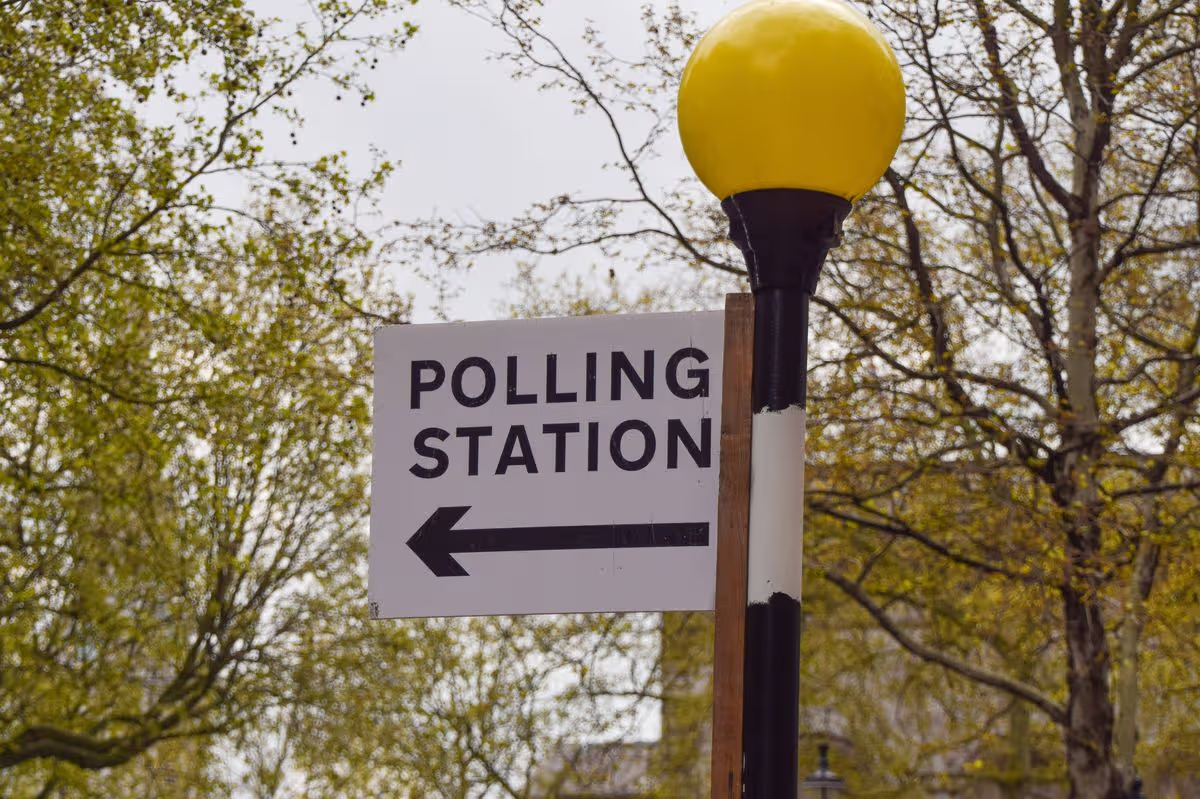
Polls will open on Thursday, May 7(Image: VV Shots via Getty Images)
Local elections are set to take place across 136 counties and six mayoral authorities throughout England on May 7, and residents are currently preparing to cast their ballots. With millions of Londoners set to head to their designated polling stations to exercise their democratic right, it’s important to check whether you have the correct ID and entitlement to vote in-person.
While the vast majority will be able to vote without difficulty – provided they possess valid Photo ID, are aged 18 and above on polling day and have registered to vote – volunteers at each polling station will be provided with a special list of codes to check whether each voter is entitled to cast their ballot in-person.
A Polling Station Handbook for Local Elections is distributed to polling station staff and contains unpublicised code letters that appear alongside certain people’s names indicating whether they can or can’t cast their vote, explains the Express.
Who won’t be able to vote in-person on polling day?
- Electors with an ‘A’ preceding their name – these are voters who have opted to vote by post and as a result are unable to vote in person at the polling station.
- Electors with an ‘F’ preceding their name – these are overseas electors who can vote only in UK parliamentary elections (i.e. general elections).
- Electors with a date of birth alongside their name which shows that they will not be 18 years old until after polling day will also be turned away.
Other codes and their meanings
- Electors with an anonymous entry who have no letter alongside their entry or the letter ‘N’ – Some people register to vote anonymously if they feel having their details known could endanger them or someone in their household.
- Electors who are 18 years of age or over (unless they also have a letter next to their entry indicating they are not eligible) – the figures printed before an elector’s entry indicate the date on which that elector becomes 18 years old.
- Electors with a ‘G’ preceding their name – these are citizens of European Union (EU) member states (other than the Republic of Ireland, Cyprus and Malta) who can vote at local government elections and Police and Crime Commissioner elections.
- Electors with an ‘L’ preceding their name – these are electors who sit in the House of Lords and who may vote at local government elections.
What voter ID is accepted?
According to the Electoral Commission, there are plenty of ID options that will be accepted at polling stations, with no specific voter ID document required. The full list includes:
- A passport issued by the UK, any of the Channel Islands, the Isle of Man or a British Overseas Territory
- A passport or passport card issued by an EEA state, or a country whose citizens are Commonwealth citizens
- A photocard driving licence issued by the UK, any of the Channel Islands, the Isle of Man, or an EEA state (this includes a provisional driving licence)
- A Blue Badge
- Older Person’s Bus Pass funded by the UK Government
- Disabled Person’s Bus Pass funded by the UK Government
- 60+ London Oyster Photocard funded by Transport for London
- Freedom Pass
- a National Entitlement Card issued by a local authority in Scotland
- 60 and Over Welsh Concessionary Travel Card
- Disabled Person’s Welsh Concessionary Travel Card
- Senior SmartPass issued in Northern Ireland
- Registered Blind SmartPass or Blind Person’s SmartPass issued in Northern Ireland
- War Disablement SmartPass issued in Northern Ireland
- 60+ SmartPass issued in Northern Ireland
- Half Fare SmartPass issued in Northern Ireland
- Identity card bearing the Proof of Age Standards Scheme hologram (a PASS card)
- Biometric Immigration Documents, including eVisas
- Ministry of Defence Form 90 (Defence Identity Card)
- Ministry of Defence Form 100 (HM Armed Forces Veteran Card)
- National identity card issued by an EEA state
- Electoral Identity Card issued in Northern Ireland
- Voter Authority Certificate
- Anonymous Elector’s Document
- Veterans’ card e-visa
What if I don’t have any of the ID listed above?
According to the Electoral Commission, registered voters can apply for a free voter ID document (known as a Voter Authority Certificate) if:
- you don’t have an accepted form of photo ID
- you’re not sure whether your photo ID still looks like you
- you’re worried about using an existing form of ID for any other reason, such as the use of a gender marker
Looking for more from MyLondon? Subscribe to our daily newsletters here for the latest and greatest updates from across London.