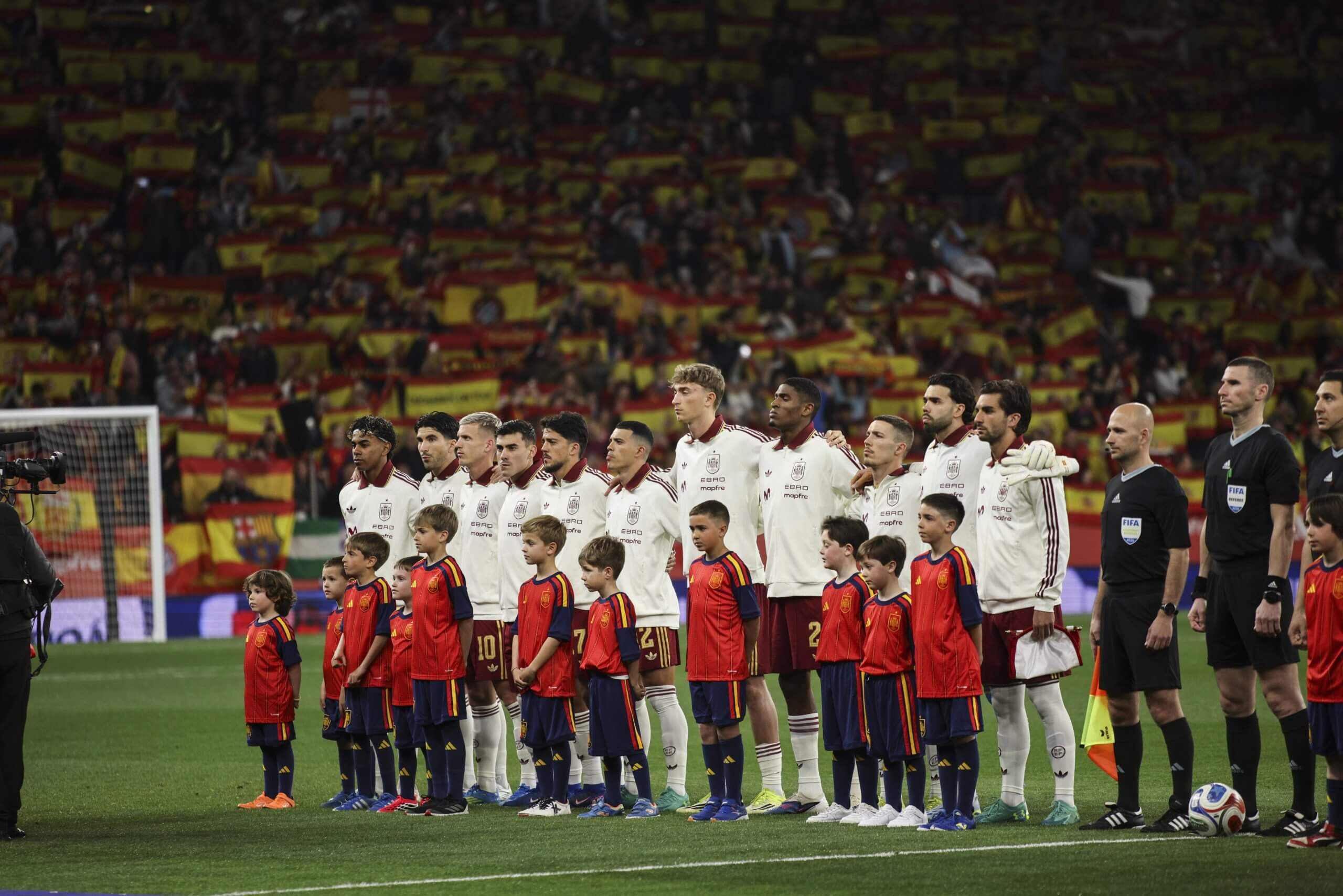
It should have been a night of celebration, and the chance to hail Spain’s gifted football team before a World Cup that many expect them to win.
Instead, Tuesday’s 0-0 friendly draw against Egypt at Espanyol’s RCDE Stadium in Barcelona — the last game Spain will play on home soil before this summer’s tournament — will be remembered as an awful day in the country’s football history.
Loud, concerted anti-Muslim chanting provided a toxic soundtrack to the match. It started in the 10th minute, with the vast majority of fans inside the ground singing, “Musulman el que no bote es” — translating to “whoever does not jump is a Muslim”. The scenario was repeated 15 minutes later, again with a large part of the crowd joining in.
At half-time, the Spanish Football Federation (RFEF) relayed a message over the stadium’s loudspeakers and screens urging the crowd not to sing racist, homophobic or xenophobic chants, but to little avail. The chant was heard a third time in the second half, although on this occasion, it was whistled by most Spain fans.
Such scenes would have been an embarrassment at any time, but for a nation co-hosting the 2030 World Cup with Morocco, a majority-Muslim country, it was particularly shocking.
The senselessness of it all was compounded by the fact that Spain’s best player, Lamine Yamal, is a devout Muslim and was on the pitch when the loudest chants took place. The 18-year-old did not speak to the media after the match but people close to the player, who asked to remain anonymous since they were discussing a sensitive issue, told The Athletic he was upset with what happened at RCDE Stadium.
Tuesday’s friendly against Egypt was marred by the anti-Muslim chants (Xavi Bonilla/DeFodi Images via Getty Images)
On Wednesday, he posted on social media against the “ignorant and racist” chants.
“I am a Muslim, thank God,” he posted on Instagram.
“Yesterday in the stadium, we heard the chant ‘whoever does not jump is a Muslim’. I know it was directed to the opposing team and nothing towards myself as a person, but as a Muslim myself, this does not stop it from being a lack of respect and something we can’t tolerate.
“I understand not all the fanbase is like that, but to those who sing those chants: using religion as something to mock people in a football stadium leaves you as ignorant and racist people. Football is to enjoy and support, not to offend people by who they are or what they believe in.”
The Barcelona star has been open in the past about what his faith means to him and how it has shaped his life. He has practised Ramadan over the past two seasons as a professional player.
“It’s all about religion and the faith you have in it. I really have that faith, and right now, I am healthy enough to do Ramadan, for example,” Yamal said in an interview with Spanish broadcaster DAZN in March last year.
Yamal was born in Spain to a Moroccan father, and his mother is from Equatorial Guinea. He has always expressed the importance of his background and has referred to his Moroccan grandmother as one of the biggest inspirations in his life.
“I delayed the signing of my new contract with Barca for my grandmother,” Yamal said last July, after signing a new deal at the club. “She was on holiday in Morocco. Now she is back. I could not do something that special without her next to me.”

Lamine Yamal with his grandmother at last year’s Ballon d’Or ceremony (Stephane Cardinale – Corbis/Corbis via Getty Images)
Yamal was replaced at half-time against Egypt. At the end of the game, when all the Spain players went onto the pitch to applaud the home fans before leaving the stadium, Yamal was nowhere to be seen. He went straight to the dressing room.
This is far from the first time racism has been seen at a football stadium in Spain, although the scale of it on Tuesday was stark.
Yamal himself faced racist abuse at a Clasico played at Real Madrid’s Bernabeu in October 2024, when all the insults he received referred to his Muslim background. A minor was identified as having insulted Yamal in that game and Spanish authorities banned him from attending football matches for a year. He was charged with 30 hours of social work.
Real Madrid’s Vinicius Junior has faced multiple incidents of racist abuse across Spain in recent seasons — he was also the victim of alleged abuse in a Champions League game against Benfica this season, which UEFA is investigating. Other players have suffered from it too, including Athletic Club’s Ghana forward Inaki Williams at RCDE Stadium in 2020.
The RFEF decided to stage the Egypt game in Barcelona after it cancelled initial plans to play it in Qatar this month due to the situation in the Middle East. The last time Spain men’s national team played in Barcelona was four years ago, a friendly against Albania, also at RCDE Stadium. But the national team has only played twice in Catalonia over the past 22 years.
This is because of Catalonia’s historically strong independence movement, which makes widespread shows of support for Spain rare. But the waning of that call for autonomy in recent years, plus changes in local governments, have encouraged all parties to push for Spain matches to be staged in the region. With Barcelona’s Camp Nou effectively off the table — given its status as a symbol of Catalan identity and nationalism — Espanyol’s ground was seen as the best choice.
But the atmosphere last night felt hostile from the start. Home fans booed Egypt’s national anthem before the match and in addition to the Islamophobic chants, there were refrains of “Gibraltar is Spanish” and insults directed at the Spanish prime minister, Pedro Sanchez.
That is a reflection of wider political issues in Spain, where immigration is the subject of much debate. These tensions often find expression in football, and specifically the abuse of players’ race or religion.
But it is especially significant given Spain’s status as co-hosts for the 2030 World Cup. It remains to be seen whether what happened at Espanyol’s stadium on Tuesday night leads to further consequences for the organisation of that tournament.
It has not been decided which of Spain, Portugal or Morocco will host the final. The RFEF had hoped to be given that honour, with shiny renovated stadiums such as the Bernabeu and Barcelona’s Camp Nou at its disposal. RCDE Stadium was also expected to be named as one of the tournament’s host venues.
The RFEF president, Rafael Louzan, spoke in the stadium’s mixed zone after the game. He said the chants were “exceptional and isolated” and said the federation had “condemned the actions on the stadium screens and asked fans not to repeat it”.
But the chanting was certainly not isolated, at least for the first half of the game.
There has been a general recognition within Spain, across media and public opinion, that what happened on Tuesday night was not acceptable. The front cover of Madrid sports newspaper AS called it a “Worldwide shame”. Spain’s most-read paper, Marca, used similar language.
At a moment when Spanish football fans should be excited about having arguably the most exciting team in the game — and being top contenders for this summer’s World Cup in the United States, Canada and Mexico — their on-pitch performances have been overshadowed by a needless scandal.

Spain celebrate in their previous friendly against Serbia (Manuel Queimadelos/Quality Sport Images/Getty Images)
The Catalan police, known as the Mossos d’Esquadra, have confirmed they have opened an investigation into a “potential criminal offence”. They said they were working with the prosecutor’s office for hate and discrimination to “determine if the acts could become hate crimes”.
The Spanish government released a statement, too. “The ministry of education, vocational training and sport condemns in the strongest possible terms the xenophobic and racist chants voiced by a group of supporters during Tuesday’s match between the men’s national football teams of Spain and Egypt,” it read.
“The government reaffirms its firm and unequivocal commitment to combating all forms of violence in sport and will continue to promote, in collaboration with institutions and sporting bodies, all necessary measures to eradicate such conduct.”
We will see what impact those words have and what actions the authorities take. But Spain has a big issue with racism and football has, sadly, once again provided a platform for the world to witness it.