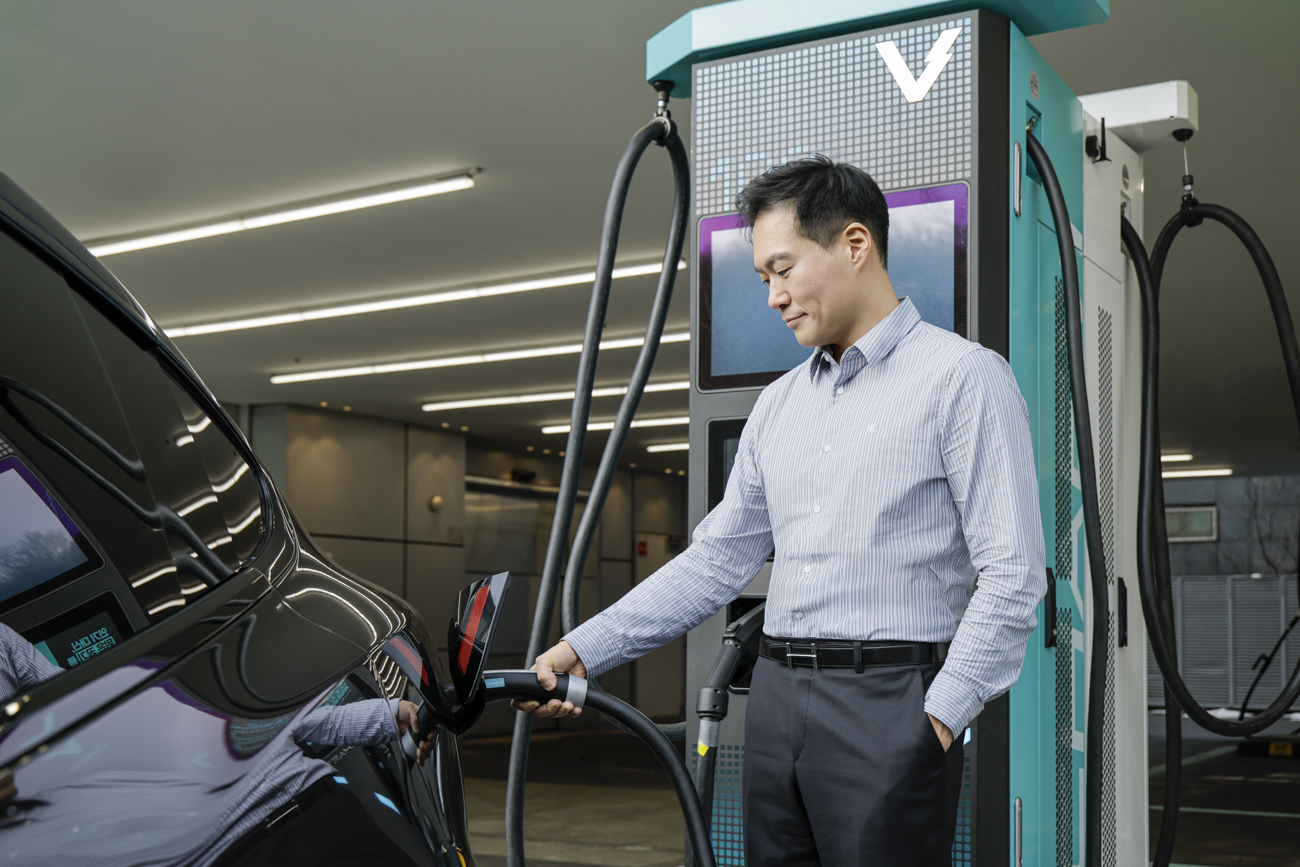
![A man charges a Tesla vehicle using Chaevi’s “Supersonic” electric vehicle charger on Feb. 20. [CHAEVI]](https://koreajoongangdaily.joins.com/data/photo/2026/02/22/20979afa-94e6-4877-af13-0ae5655301fd.jpg)
A man charges a Tesla vehicle using Chaevi’s “Supersonic” electric vehicle charger on Feb. 20. [CHAEVI]
Korea’s electric vehicle charging industry, struggling through the EV “chasm” — a period of stalled demand between early adopters and mass market buyers — is turning to Tesla for relief.
Nearly 60,000 Tesla vehicles were sold in the country last year, making the U.S. automaker a critical source of business for charging operators. With Tesla expected to attract more buyers this year through aggressive price cuts, charging companies are moving quickly to win over its customers.
Operators are accelerating the rollout of fast chargers equipped with Tesla’s North American Charging Standard (NACS), according to industry insiders on Friday. Most fast chargers in Korea use the DC Combo connector, the standard for Hyundai and Kia models. But the market shifted after Tesla accounted for 27 percent of the 220,177 electric vehicles sold last year, delivering 59,893 units and surpassing Hyundai.
Chaevi, the country’s largest fast-charging operator and a charger manufacturer, developed a third-generation fast charger last year with NACS built in. The company plans to install the model, called the Supersonic, across central Seoul, highways and major hubs nationwide this year.
“If one in four EVs sold in Korea is a Tesla, then about one in four chargers should support NACS,” said Lee Keun-wook, head of the research and development division at Chaevi. “Going forward, charger installations should at least reflect Tesla’s sales share.”
Chaevi is also trying to mirror Tesla’s Supercharger experience. Its “Baro Chaevi” service allows drivers to plug in and charge without separate authentication or payment steps, offering a one stop process similar to Tesla’s system.
SK Electlink, the second-largest fast-charging operator, said it will expand NACS charger installations nationwide in the first half of the year.
“We plan to proactively expand NACS chargers in line with the growing number of Tesla vehicles on the road,” a company official said. “We plan to install them not only along expressways but also at charging stations with strong commercial viability.”
![SK signet's ultra-fast EV charger [SK SIGNET]](https://koreajoongangdaily.joins.com/data/photo/2026/02/22/835dc771-39cb-424f-8995-fa9e2d674333.jpg)
SK signet’s ultra-fast EV charger [SK SIGNET]
SK Signet and Water, the two firms that introduced NACS chargers in 2025, are also expected to speed up distribution.
The pivot to Tesla follows a difficult stretch. Four or five years ago, major conglomerates rushed into the EV charging business. Many have since exited as profits thinned because of the EV chasm. LG Electronics withdrew last year, and Hanwha Solutions sold its charging business to a startup. SK Electlink continues to operate, but its former largest shareholder, SK Networks, sold its stake to a private equity fund, ending its status as an SK affiliate.
“The business is not profitable enough for large conglomerates,” an industry insider said. “The domestic charging market is now largely sustained by startups and small- and medium-sized enterprises.”
Industry players say expanding fast-charging infrastructure is one of the key conditions for overcoming the EV demand slowdown.
Korea has 484,660 EV chargers — roughly one for every 1.8 EVs — a more favorable ratio than in Europe or China. However, 89 percent of the chargers are slow chargers installed mainly at apartment complexes and residential areas, leaving fast charging infrastructure still insufficient.
Critics argue that a distribution policy centered on slow chargers — which can occupy a parking space for nearly 10 hours for a full charge — makes it difficult to significantly accelerate EV adoption.
![Tesla EVs are charged at a Supercharger in central Seoul. [YONHAP]](https://koreajoongangdaily.joins.com/data/photo/2026/02/22/62eae3a6-c7f1-4d32-b26c-632390672935.jpg)
Tesla EVs are charged at a Supercharger in central Seoul. [YONHAP]
Industry insiders believe that technologies capable of dramatically reducing fast-charging times — currently between 30 minutes and one hour — could become a game changer.
Chaevi won an innovation award at CES 2026 in Las Vegas in January for its Megawatt Charging System (MCS), which can fully charge a vehicle in as little as five minutes.
“Battery charging technology is essential not only for vehicles but also for humanoids, which are drawing more attention,” Lee said. “To maximize robot utilization, ultrafast charging systems like MCS will become increasingly important.”
This article was originally written in Korean and translated by a bilingual reporter with the help of generative AI tools. It was then edited by a native English-speaking editor. All AI-assisted translations are reviewed and refined by our newsroom.
BY NAM YOON-SEO [[email protected]]