Local social media groups are fuelling misinformation in areas with no reliable sources of news, according to an investigation that reveals the scale of fake news flowing to vulnerable communities across Britain.
Misinformation was nearly three times more common in areas with little or no recognised local journalism, according to a study of tens of thousands of posts seen by the Guardian. Immigration and Islamophobia were the most common topics of misinformation across Facebook and X.
Spikes in misinformation were identified around local elections. Misinformation grew as a share of news posts by 56% in the run-up to polling day, compared with earlier in the year, from 8.2% of all news posts to 12.9%.
The findings, by the Social Market Foundation (SMF) thinktank, are based on the analysis of more than 125,000 social media posts across local Facebook groups, X searches and Nextdoor communities. They led to immediate calls for action from senior MPs.

MPs are concerned about the growing influence of unreliable online groups. With the decline and financial peril faced by local news outlets, inaccurate online forums are filling the void.
One MP said the groups in his area were now read in far greater numbers than any local media outlet – and even some national media – yet were run by administrators with no legal experience or who openly supported a particular party.
The authors of the SMF study described local online groups as “the silent killer of trust in Britain”. Their analysis uncovered faked local authority communications, AI-generated content and misleading claims of councils behaving corruptly.
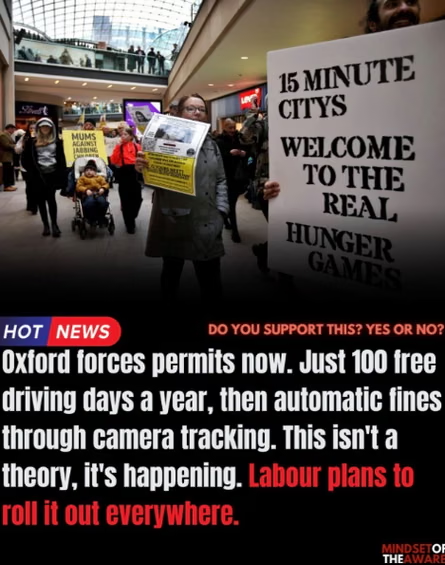
One post falsely suggested Birmingham council meetings had “stopped being conducted in English altogether”. Another pointed to a false expansion of London’s congestion charge. Another pointed to a plan to make the countryside “less white”.
Misinformation was detected in three out of four local groups in Gorton and Denton, south-east Manchester, during the recent byelection. The seat was won by the Greens, with Reform UK in second place. False information was found relating to the Greens, Reform and Labour.
Misleading posts included a fake quote attributed to the Reform candidate in Gorton and Denton, Matthew Goodwin, saying: “Mancunians are thick.” Another described the Black Lives Matter campaign as a “terrorist group”, above a picture of Keir Starmer and Angela Rayner taking the knee.
The analysis found that 6.5% of news-related posts in the Gorton and Denton groups amounted to misinformation. It will fuel concerns about the threat of misinformation before the Makerfield byelection, in which Andy Burnham is attempting to return to parliament in order to challenge Starmer for the Labour leadership.
The SMF analysis found that a fifth of all fake news posts in Facebook groups related to local issues, including planning decisions, transport, local services and council politics.
Places with few or no local news outlets had nearly three times as many misinformation posts as the average. More than 4.4 million people in the UK now live in a “news desert” where there is no dedicated local news provider.
Chi Onwurah, the Labour chair of the science and technology select committee, said the findings were “deeply concerning”. She said ministers had been wrong to reject a series of recommendations from her committee on tackling online misinformation.
“It’s clear that far more must be done to safeguard the public from unreliable online sources that are filling the void left by trusted local news,” Onwurah said. “The government should adopt our recommendations and embed core principles – such as responsibility and transparency – into the online safety regime. These are essential to create a strong regulatory framework that can protect the public.”
The government has said it recognised the dangers of online misinformation. However, it said the most appropriate response was to concentrate on the most “prevalent and concerning harms” associated with it.
The SMF research found that two in five local Facebook groups and more than four in five X searches featured at least one piece of misinformation in their most recent 1,000 posts. Nearly one in 26 news-related posts on Facebook contained misinformation. On X, the ratio was more than one in four.
“Local misinformation is the silent killer of trust in Britain,” said Jamie Gollings, the SMF’s deputy research director and a co-author of the study. “For too long it has gone under the radar. We cannot afford further erosion of local journalism, which is our best defence against local misinformation.
“Not acting fast enough would be a mistake – affecting how people vote, how they feel about their neighbours and whether they trust the institutions that serve them.”
Theo Bamber, the chief executive of the News Media Association, said: “This report illustrates exactly why a strong local news media sector is vital in combating the growing threat of misinformation on social networks. We urge government to bring forward meaningful interventions to support the businesses that invest in trusted local journalism.”
SMF carried out its research by randomly selecting 95 places across the UK. Researchers analysed the 1,000 posts served on the platforms when “scrolling down” on the feeds for the relevant location and platform. The study was financially supported by the BBC.
Meta said it had community standards and a misinformation policy, which states: “We remove misinformation where it is likely to directly contribute to the risk of imminent physical harm. We also remove content that is likely to directly contribute to interference with the functioning of political processes.”
A Nextdoor spokesperson said: “We have a dedicated misinformation policy covering elections, political content, manipulated media and health emergencies. Reports of misinformation are not handled by volunteer moderators, they are escalated directly to our dedicated neighbourhood operations team, ensuring consistent and professional enforcement.”
X, formerly Twitter, did not respond to a request for comment.