Have you just got one of the best espresso machines for Christmas? Espresso machines are a sure-fire way to become a coffee snob. Mark my words, it’s a slippery slope from “Sure, I like coffee,” to “Hm, those beans aren’t rare, artisanally roasted, single-origin Ethiopian Yirgacheffe, so I’m good, thanks.”
Trust me. I’ve become who I hate.
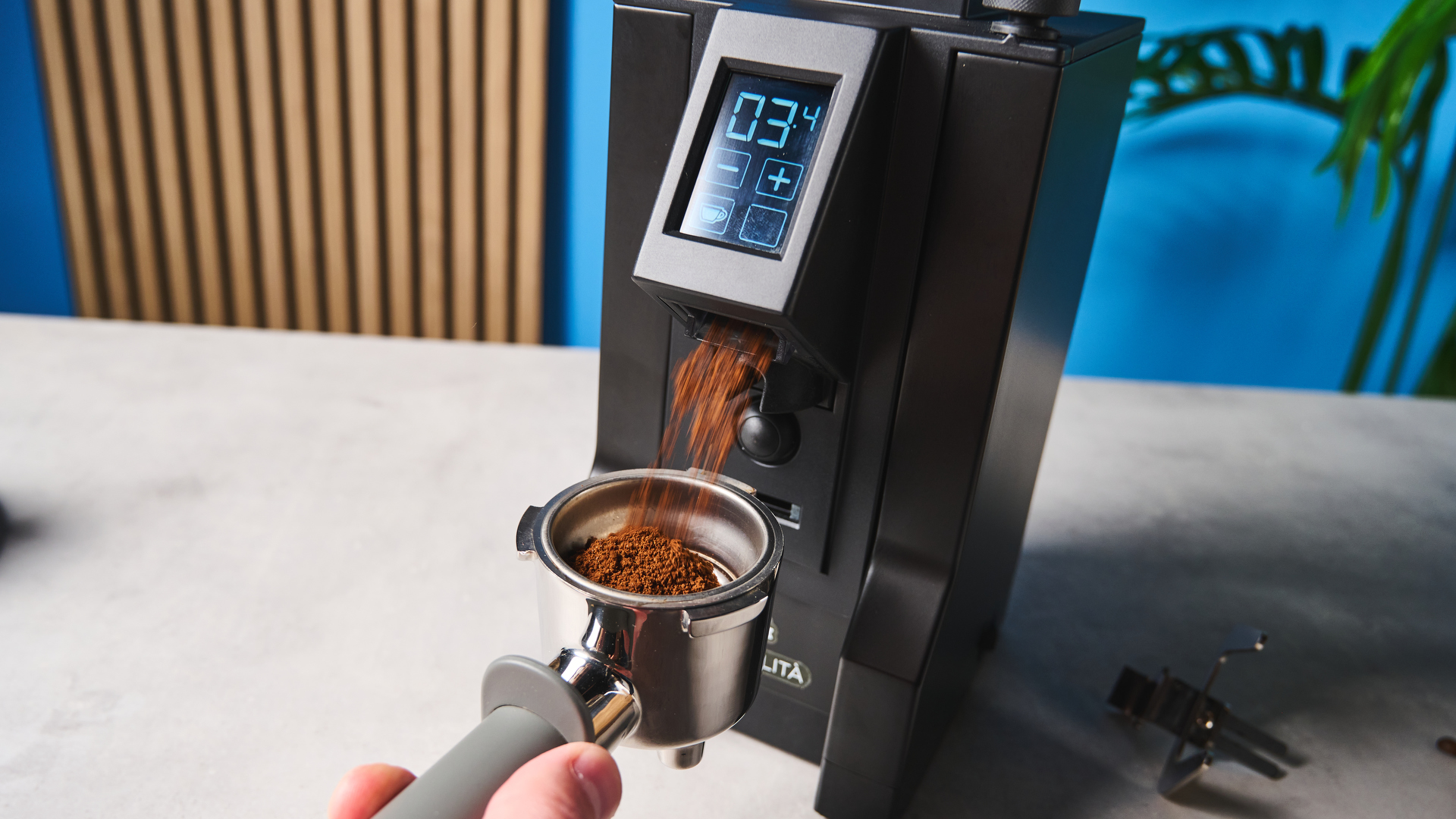
Mean bean grinding machine

I’m here to teach you exactly how to grind your beans and why it’s so important. If you haven’t already got one of the best coffee grinders and best coffee scales, I’ll tell you exactly which ones to buy to upgrade your home cafe for less.
Once you’ve got a bit of experience under your belt, you’ll find yourself relying on visual cues. In that case, you can tell if your espresso is “correct” based on how it pours. But while you’re still getting your bearings, you might want to practice with various grind sizes until your espresso looks and tastes good.
If you consider yourself a bit of an expert already, and you’ve already got a decent grinder, I’ve written tons about how to make your espresso machine even better — at no extra cost.
Why is a grinder so important?

Grind size and uniformity are the most important things when it comes to making espresso. Your coffee should be both the correct size and uniform. Are all the tiny granules the same size, or are there some minuscule grains and some large chunks?
When some grounds are large, and some are too small, the water will get clogged in the tiny grounds and flow straight over the big grounds. This results in nasty-tasting coffee. It might be burned and weak at the same time, or it might taste stale.
If your espresso extracts slowly and tastes burned, you’re grinding too fine. If your espresso extracts quickly, has no crema, and tastes sour or watery, you’re grinding too coarse.
Don’t worry, though — it’s easy to rectify. With a good grinder (I’ve got some recommendations below), you’ll be brewing barista-quality shots in no time.
What should my coffee grounds look like?

There are hundreds of variables at play, so there’s no one “true” answer to this question. Different bean types, different machines, different humidities, different tastes, different water heat, different roasts… it’s a never-ending list.
However, I can give you some advice. For espresso, you want to grind your beans to around 300-600 microns. If, like most normal people, you don’t happen to have coffee sieves at home, you can also just use your eyes and fingers.
The coffee grounds should look like superfine/baker’s sugar and stick to your fingers. However, the coffee should not look like powdered sugar. If it looks like powdered sugar, it’s too fine.
You can also test your coffee grounds using the following ratio and timing. If you dose around 10g for a single shot, you should get 20g of espresso out in 25-28 seconds. Similarly, if you dose 18g for a double shot, you should get 36g of espresso in 25-28 seconds.
If your timings are way off — below 20 seconds or above 33 seconds, for example — you’re grinding too coarse and too fine, respectively.
You’re going to have to experiment, which is fine! Coffee is as much of an art as it is a science, and sometimes you have to play around with variables to get the best-tasting shot.
Remember the three T’s: Texture, Time, Taste. Does the coffee look like baker’s sugar? Does the shot reach a 1:2 ratio in under 30 seconds? Does the shot taste good?
If the answer to all those questions is “Yes”, then you’ve hit the sweet spot.
My favorite coffee grinders
Repeat after me: I will not use pre-ground coffee. Bad things happen if you use pre-ground coffee. Namely, nasty coffee.
To help you out, I’ve rounded up my three favorite coffee grinders. The cheapest one is just $159, and you can get the premium Comandante option for around $300 these days. However, my best overall recommendation is the $199 Baratza Encore ESP.

Follow Tom’s Guide on Google News and add us as a preferred source to get our up-to-date news, analysis, and reviews in your feeds.