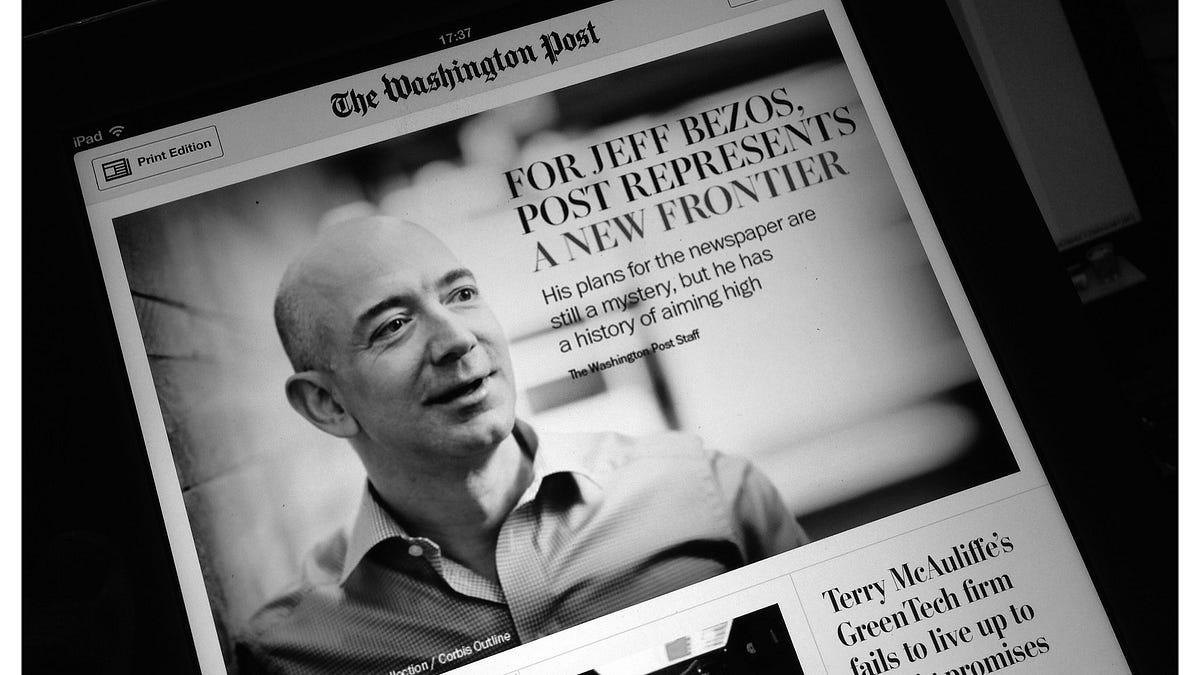
As a former Washington Post columnist, I’ve been saddened to see the precipitous decline of a paper that was once one of the most important institutions in American journalism, one that still employs great reporters, albeit in ever-dwindling numbers. While the paper has been struggling under the increasingly malevolent leadership of its centi-billionaire owner for a while now, in the last year things have gotten truly dire, and it’s only gotten worse. At this point, the survival of one of the pillars of American journalism is in serious doubt.
On Wednesday, employees were told on a Zoom call that the paper’s staff would be cut by a third; among other things, the sports desk and books section would be closed down, international reporting would be cut back significantly, metro reporting further diminished, and the team covering climate change apparently eliminated. Social media quickly filled up with posts like this one:
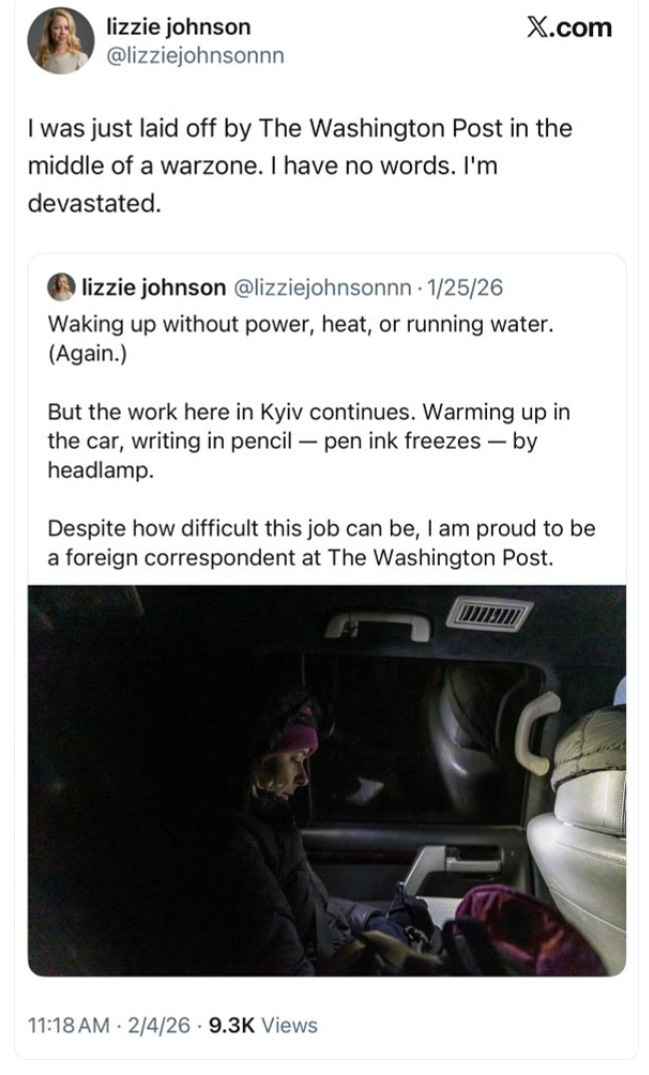
Reaction was swift and angry. Former Post political reporter Ashley Parker wrote that Jeff Bezos and Will Lewis, the CEO he installed a couple of years ago, “are embarking on the latest step of their plan to kill everything that makes the paper special.” Marty Baron, who led the paper in its most recent golden age, posted a blistering statement in which he said that while he was grateful for the support he got from Bezos during his time editing the paper, “Bezos’s sickening efforts to curry favor with President Trump have left an especially ugly stain of their own. This is a case study in near-instant, self-inflicted brand destruction.”
If you said that ten years from now there will no longer be a publication called “The Washington Post,” or that it will have been reduced to a zombie site like newsweek.com that performs no journalism, it would sound far from impossible. While there are many dimensions to this tragic story, what it boils down to is something quite simple: Jeff Bezos saved the Post, then decided to kill it.
The ostensible reason for these layoffs — only the latest in a series — is that Post is losing money. And that’s true. But there are two important things to know to contextualize that fact. First, Bezos could absorb those losses from now until the day he dies and barely notice it. His current net worth is $245 billion, or around a thousand times what he paid for the Post when he bought it in 2013. The paper reportedly lost $100 million in 2024, which is horrendous. But even at that unusual rate, Bezos could cover the losses for, let’s say, the next 50 years, until he is 112 years old, and spend only $5 billion, or 1/121th of his current fortune.
Or to think about it another way: Bezos just spent $75 million to purchase and market “Melania,” an apparently dreadful documentary about the most vacuous public figure on the planet. At least that was an obvious bribe that might yield future dividends; he also owns a $500 million yacht so enormous that it requires another gargantuan support yacht to trail it wherever it goes.
The second important piece of context is that Bezos is himself the reason for the Post’s awful economic position. If he were not so determined to make the paper worse in almost every way, it could be on much sounder financial footing.
When I started writing for the Post in 2014, the feeling about Bezos was what I would describe as one part suspicion to three parts gratitude and optimism. Yes, he was a billionaire with some questionable business practices, but the way he treated the paper was about as good as anyone could have hoped for. He seemed to have bought it not as a money-making proposition but as a public service. He provided ample resources to hire more staff and develop new ways to report and communicate the news, and he kept his hands completely out of editorial decision-making. What more could you ask for? Sure, though officially the line was that everyone was free to report on Amazon as though it were just another company, there may have been some self-censorship. But other than that, he was a nearly perfect owner.
Nobody would have argued that finding billionaire owners would be the savior of American journalism — especially newspapers, which are in a long and steep decline — but it was working for the Post. People felt that the paper just kept getting better, particularly in its coverage of politics and government. That goes double for the opinion section, which five or ten years ago I would have said was more dynamic and interesting than that of any paper in the country, including the New York Times (and yes, I’m biased, but it’s true).
Not surprisingly, readers are fleeing. In June, we learned that print subscriptions had fallen below 100,000 for the first time in over half a century. It’s true that most people don’t bother with a print subscription anymore, but still, for a paper with national reach and a metro area population around its home town of over 6 million, that’s stunning. While the paper doesn’t publicly release subscriber data, we do know that after Bezos torpedoed the paper’s planned endorsement of Kamala Harris in 2024, at least 300,000 people canceled their subscriptions.
Meanwhile, much of the paper’s top talent has departed for other publications. CEO Will Lewis has been a disaster, especially for morale. Then last February, Bezos announced that henceforth the opinion section would advocate for “personal liberties and free markets,” and “viewpoints opposing those pillars will be left to be published by others.” In response, opinion editor David Shipley — who had himself pushed the section to the center after he took over in 2022 — resigned in protest. Ruth Marcus, the deputy opinion editor and my direct boss for all my time at the Post, wrote a column criticizing the new focus; the column was spiked, and she quit too (you can read her account of the Post’s fall here). Shortly after, NPR reported that another 75,000 subscribers had cancelled.
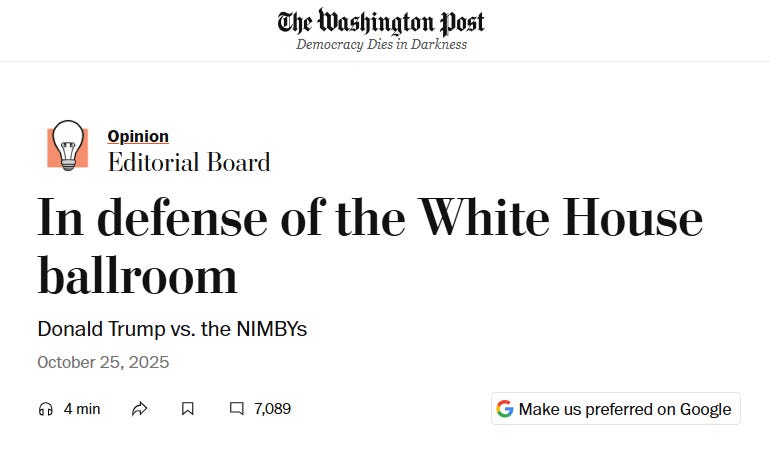
It’s hard to overstate what a spectacularly imbecilic idea it was to move the Post to the right just as Donald Trump brought his version of fascism to America. Before the liberal opinion writers were pushed out — a list that includes myself, Greg Sargent, Helaine Olen, Perry Bacon, Jennifer Rubin, E.J Dionne, Catherine Rampell, Karen Attiah, and others — the opinion section was an absolutely huge driver of traffic to the site. I’d be shocked if the utterly decimated opinion section that exists now is generating anything like the same kind of interest from readers.
It’s not like there’s an enormous hunger for editorials like the above out there, and people are just yearning for establishment-tinged apologetics for Trumpism. Anyone who likes this president is being amply served by the right’s comprehensive media machine, and the approach the Post has taken is guaranteed to keep losing it subscribers.
Here’s the irony: By getting more involved in decision-making at the Post, business genius Jeff Bezos has worsened its long-term financial outlook by destroying much of what makes the Post valuable for readers and consequently decimating its subscriber base. I can’t tell you how many people have told me that they’ve cancelled their Post subscriptions.
Sometimes they say “That’s why I’m subscribing to your newsletter,” which I greatly appreciate. But a truly vibrant media system needs institutions with the resources to support the time-consuming and often expensive work of gathering news, even when it doesn’t generate immediate clicks — and as the Times has shown, it’s possible to do that and still find ways to expand your subscriber base. There are still people at the Post trying to do that vital journalism, but fewer than there were last week. I fear their numbers will continue to diminish, and before long the Post will be an empty shell.
Thank you for reading The Cross Section. This site has no paywall, so I depend on the generosity of readers to sustain the work I present here. If you find what you read valuable and would like it to continue, consider becoming a paid subscriber.