Escalation of Gaza offensive will ‘only bring more bloodshed’ says UK PM
UK prime minister Keir Starmer on Friday said Israel’s decision to further escalate its offensive in Gaza is wrong and urged the Israeli government to reconsider.
In a statement, Starmer said:
The Israeli government’s decision to further escalate its offensive in Gaza is wrong, and we urge it to reconsider immediately. This action will do nothing to bring an end to this conflict or to help secure the release of the hostages. It will only bring more bloodshed.
Every day the humanitarian crisis in Gaza worsens and hostages taken by Hamas are being held in appalling and inhuman conditions. What we need is a ceasefire, a surge in humanitarian aid, the release of all hostages by Hamas and a negotiated solution. Hamas can play no part in the future of Gaza and must leave as well as disarm.
Together with our allies, we are working on a long-term plan to secure peace in the region as part of a two-state solution, and ultimately achieve a brighter future for Palestinians and Israelis.
But without both sides engaging in good faith in negotiations, that prospect is vanishing before our eyes.
Our message is clear: a diplomatic solution is possible, but both parties must step away from the path of destruction.
Key events
Finland’s foreign minister Elina Valtonen said she was “extremely worried” by the looming famine in Gaza.
According to Reuters, Valtonen said:
We hope for an immediate Gaza ceasefire and the immediate release of Israeli hostages.
Escalation of Gaza offensive will ‘only bring more bloodshed’ says UK PM
UK prime minister Keir Starmer on Friday said Israel’s decision to further escalate its offensive in Gaza is wrong and urged the Israeli government to reconsider.
In a statement, Starmer said:
The Israeli government’s decision to further escalate its offensive in Gaza is wrong, and we urge it to reconsider immediately. This action will do nothing to bring an end to this conflict or to help secure the release of the hostages. It will only bring more bloodshed.
Every day the humanitarian crisis in Gaza worsens and hostages taken by Hamas are being held in appalling and inhuman conditions. What we need is a ceasefire, a surge in humanitarian aid, the release of all hostages by Hamas and a negotiated solution. Hamas can play no part in the future of Gaza and must leave as well as disarm.
Together with our allies, we are working on a long-term plan to secure peace in the region as part of a two-state solution, and ultimately achieve a brighter future for Palestinians and Israelis.
But without both sides engaging in good faith in negotiations, that prospect is vanishing before our eyes.
Our message is clear: a diplomatic solution is possible, but both parties must step away from the path of destruction.
In additional comments, this time to Sky News, Fahnbulleh said:
We think that the decision is the wrong decision. We think that it will risk escalating an already intolerable situation, and the consequence will be more bloodshed. There’s no one that can see what is happening and unfolding in Gaza that isn’t horrified by it.
Our priority is, in order to try and get a ceasefire, we’ve got to get parties around the table. I know it feels incredibly hard given the current situation, but it has to be the priority.
The UK hopes Israel will reconsider its decision to take control of Gaza City, a junior energy minister said on Friday, reports Reuters.
Miatta Fahnbulleh told Times Radio:
We think that decision is the wrong decision, and we hope that the Israeli government will reconsider it.
It risks escalating an already intolerable and atrocious situation.
The Times of Israel reports that Yair Golan, the leader of the Democrats party, has said that Benjamin Netanyahu and the security cabinet’s decision means that “more hostages will be abandoned to their deaths”.
Of the Israeli prime minister, he said:
He is weak, easily pressured, lacking decision-making ability, and without the capacity to bridge between what the professional level presents and the group of messianists controlling the government.
Golan described the decision as “a disaster for generations”.
Speaking to the Israeli Army Radio, Golan said:
Our sons and grandsons will still patrol the alleys of Gaza, we will pay hundreds of billions over the years, and all this for reasons of political survival and messianic visions.
Asking how the government plans to demilitarize the Gaza Strip, he added:
Are we going to crawl through tunnels and retrieve the last Kalashnikovs?
Summary
Here’s a recap of the latest news after Benjamin Netanyahu’s office said the Israeli security cabinet had approved a plan to take over Gaza City, marking another escalation of Israel’s offensive in the Gaza Strip.
The decision – early on Friday during a marathon meeting – came after the Israeli prime minister said Israel intended to take full control of Gaza and eventually hand it over to friendly Arab forces opposed to Hamas.
It is thought that the security cabinet’s decision to take over Gaza City as opposed to the entire territory could reflect the reservations of Israel’s top military officials.
In key developments:
-
Israeli opposition leader Yair Lapid blasted the security cabinet’s Gaza City decision as “a disaster that will lead to many more disasters” and said far-right ministers Itamar Ben Gvir and Bezalel Smotrich had dragged Benjamin Netanyahu into something that was “exactly what Hamas wanted”. Lapid said the decision would lead to the deaths of more hostages and many soldiers as well as “political collapse”.
-
In announcing the Gaza City takeover plan, Netanyahu’s office referred to another plan submitted to the Israeli security cabinet but said most of the ministers believed it “would neither achieve the defeat of Hamas nor the return of the hostages”. Israeli media reported that this appeared to be referring to a proposal presented by Israeli military chief of staff, Lt Gen Eyal Zamir, who has reportedly warned that occupying Gaza would plunge Israel into a “black hole” of prolonged insurgency, humanitarian responsibility and heightened risk to hostages.
-
Hamas said in a statement that “Netanyahu’s plans to escalate the aggression confirm beyond any doubt his desire to get rid of the captives and sacrifice them in pursuit of his personal interests and extremist ideological agenda”. And in the first reaction by a main Arab neighbour to Netanyahu’s comments on taking over Gaza, a Jordanian official told Reuters that Arabs “will only support what Palestinians agree and decide on”.
-
Hundreds of demonstrators outside Netanyahu’s office in Jerusalem on Thursday evening protested against any expansion of the war, demanding an immediate end to the military campaign in return for the release of all hostages.
-
Before the security cabinet meeting, Netanyahu was asked on Fox News if Israel would “take control of all of Gaza” and he replied: “We intend to, in order to assure our security, remove Hamas there, enable the population to be free of Gaza.” He also said: “We don’t want to keep it. We want to have a security perimeter. We want to hand it over to Arab forces that will govern it properly without threatening us and giving Gazans a good life.”
-
Israeli media reported that Netanyahu had been hoping to obtain approval for fully controlling Gaza at the security cabinet meeting. The plan would have meant sending ground troops into the few areas of the strip that have not been totally destroyed – roughly 25% of the territory where many of its 2 million people have sought refuge.
-
Israel was reportedly preparing a two-phase operation aimed at seizing control of Gaza City, with plans to evacuate about 1 million residents – half of Gaza’s population – in what officials described as a temporary measure to establish civilian infrastructure in central Gaza.
-
At least 42 Palestinians were killed in Israeli airstrikes and shootings across southern Gaza on Thursday, according to local hospitals. Of the 42, at least 13 were seeking aid in an Israeli military zone in southern Gaza where UN aid convoys are regularly overwhelmed by looters and desperate crowds.
Former Palestine national team player Suleiman al-Obeid, known as the “Palestinian Pele”, has been killed by Israeli gunfire in the Gaza Strip, the sport’s local governing body said.
Obeid, 41, was killed when Israeli forces “targeted people waiting for humanitarian aid in the southern Gaza Strip” on Wednesday, the Palestinian Football Association (PFA) said.
Agence France-Presse reports that Obeid – an ex-star of the Khadamat Al-Shati club in Gaza – played 24 international matches for team Palestine, the PFA said.
During his long career, Al-Obeid scored more than 100 goals, making him one of the brightest stars of Palestinian football.
The midfielder also played for the Al-Amari youth centre club in the West Bank, which Israel has occupied since 1967.
While living there in 2010, Obeid was among six players on the national team from Gaza who were turned back at the Jordanian border for “security reasons” on their way to a friendly match in Mauritania. An Israeli security official said at the time that the players had failed to renew special permits allowing them to play in the West Bank.
Obeid told AFP in 2010:
When I heard that we would be forbidden from travelling I was very upset, because any athlete dreams of wearing his national jersey in international forums.
We want to be able to travel freely with our families, just like athletes anywhere else in the world.
Another major Israeli ground operation will almost certainly lead to the killing of more Israeli soldiers in hit-and-run attacks, eroding domestic support for the war, and could endanger the remaining hostages, as the AP reports.
Hamas-led militants killed about 1,200 people in the October 2023 attack and abducted 251 hostages, most of whom since been released in ceasefires or other deals. Fifty remain in the territory, around 20 of whom are believed by Israel to be alive.
Palestinian militants have released videos in recent days showing emaciated hostages, saying they are suffering the same starvation as the Palestinian population.
Hamas is believed to be holding the hostages in tunnels and other secret locations and has hinted it will kill them if Israeli forces draw near.
Former security officials have also spoken out against further military operations, saying there is little to gain after Hamas has been militarily decimated.
Israel’s military chief of staff, Lt Gen Eyal Zamir, reportedly argued during the security cabinet meeting that a more sweeping plan to retake all of Gaza would endanger the hostages and put added strain on the army after two years of regional wars.
Yair Lapid calls Gaza City takeover decision ‘a disaster’
Israeli opposition leader Yair Lapid has blasted the security cabinet’s Gaza City decision as “a disaster” and said far-right ministers Itamar Ben Gvir and Bezalel Smotrich dragged the Israeli prime minister into something that was “exactly what Hamas wanted”.
Lapid also said the decision would lead to the deaths of more hostages and many soldiers as well as “political collapse”.
His post on X reads in full (in a translation):
The cabinet’s decision tonight is a disaster that will lead to many more disasters.
In complete contradiction to the opinion of the military and security ranks, without considering the erosion and exhaustion of the fighting forces, Ben Gvir and Smotrich dragged Netanyahu into a move that will take months, lead to the death of the hostages, the killing of many soldiers, cost tens of billions to the Israeli taxpayer, and lead to a political collapse.
This is exactly what Hamas wanted: for Israel to be trapped in the field without a goal, without defining the picture of the day after, in a useless occupation that no one understands where it is leading.
The UK’s ambassador to Israel has said extending the war in Gaza would only lead to more deaths and that occupying Gaza would be a “huge mistake”.
Simon Walters was quoted by Israel’s Haaretz newspaper as saying on Thursday:
The IDF has achieved all that it can achieve in Gaza, and extending the war any further will simply lead to more deaths. Deaths of soldiers, deaths of Palestinians, deaths of hostages.
If you want to defeat Hamas, you cannot achieve that through military force. You need to use politics and diplomacy and you need to give the people of Gaza an alternative to Hamas.
Walters said the UK’s approach to the ceasefire proposal set forth by US special envoy Steve Witkoff – for one full and comprehensive deal that brings back all hostages – would end the war and initiate a new governing body for the Gaza Strip, Haaretz reported.
Walters said:
We are working with friends, allies in Europe and in the Middle East to generate a real plan for what happens after the fighting stops, after the war.
It needs to be a description of what the governments will be for Gaza. That has to be governance by Palestinians who are not members of Hamas with a role for the Palestinian Authority.
Looking at Gaza City – which Israel’s security cabinet has earmarked for a military takeover – much of it is in ruins.
Israel has repeatedly bombarded the city in northern Gaza and it launched major ground operations there within weeks of Hamas’s October 2023 attack that triggered the war. Several neighbourhoods and key infrastructure are almost completely destroyed.
The Associated Press reports that on the eve of the war it was Gaza’s most populous city, home to about 700,000 people. Hundreds of thousands fled under Israeli evacuation orders at the start of the war but many returned during a ceasefire earlier this year.
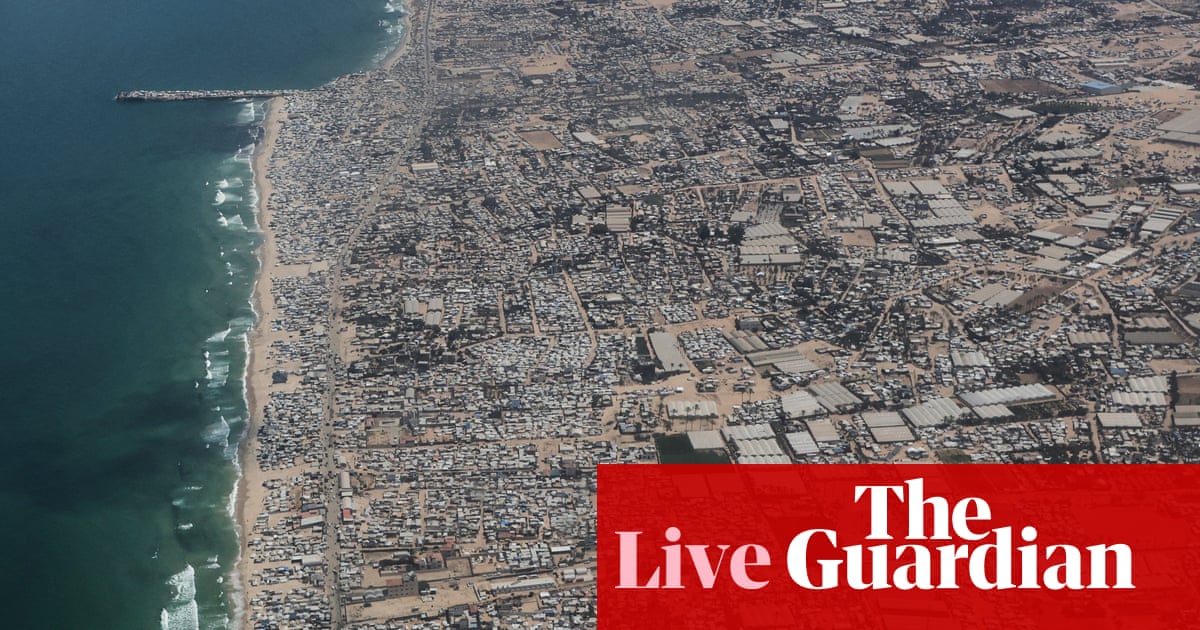
Israel already controls and has largely destroyed around 75% of Gaza, with most of the population of some 2 million Palestinians now sheltering in Gaza City, the central city of Deir al-Balah and the sprawling displacement camps in the Muwasi area along the coast.

Josh Butler
Australian foreign minister Penny Wong has urged Israel not to follow through on its plans to occupy Gaza, a step she said could constitute a breach of international law.
After Benjamin Netanyahu’s office said the Israel Defense Forces would prepare to take over Gaza City, Wong pushed back on the plan, telling the Guardian:
Australia calls on Israel to not go down this path, which will only worsen the humanitarian catastrophe in Gaza.
Permanent forced displacement is a violation of international law.
Wong said Australia and international partners were maintaining ongoing calls for a ceasefire, the return of hostages and aid to flow unimpeded.
A two-state solution is the only pathway to secure an enduring peace – a Palestinian state and the state of Israel, living side-by-side in peace and security within internationally-recognised borders.
Israeli media reports disagreement between Netanyahu and top military official
In announcing the approval of plans to take over Gaza City, the office of Benjamin Netanyahu referred to another plan that had been submitted to the Israeli security cabinet.
A decisive majority of security cabinet ministers believed that the alternative plan that had been submitted to the security cabinet would neither achieve the defeat of Hamas nor the return of the hostages.
Israeli media reported that this appeared to be referring to a proposal presented by IDF chief of staff, Lt Gen Eyal Zamir, who has reportedly warned that occupying Gaza would plunge Israel into a “black hole” of prolonged insurgency, humanitarian responsibility and heightened risk to hostages.
It’s thought that the announcement from the security cabinet to take over Gaza City as opposed to the entire territory – as Netanyahu pledged on Thursday – could reflect the reservations of Israel’s top military officials.
After nearly two years of war in Gaza, Benjamin Netanyahu faces mounting pressure at home and abroad for a truce deal to pull the Palestinian territory’s more than 2 million people back from the brink of famine and to spare hostages held by Palestinian militants.
Outside the prime minister’s office in Jerusalem on Thursday evening, hundreds of demonstrators protested against any expansion of the war, demanding an immediate end to the military campaign in return for the release of all the hostages.
Protesters held signs bearing the faces of hostages still held in Gaza and voiced deep frustration with the government’s handling of the crisis.
“I’m here because I am sick and tired of this government. It’s ruined our life,” said 55-year-old Noa Starkman, a Jerusalem resident who was born in a southern Israeli community close to where Hamas attacked in October 2023.
Indonesia will convert a medical facility on an uninhabited island to treat about 2,000 wounded residents of Gaza, according to a spokesperson for the president, reports Kate Lamb and agencies.
“Indonesia will give medical help for about 2,000 Gaza residents who became victims of war, those who are wounded, buried under debris,” Hasan Nasbi said in Jakarta on Thursday.
Indonesia plans to allocate the facility on Galang island, home to a former refugee camp for Vietnamese asylum seekers which lies off its island of Sumatra, to treat the wounded Gaza residents and temporarily shelter their families, the spokesperson said.
The patients would be taken back to Gaza after they had healed, he added, without providing further details on the timing of the plan, or how their return would be guaranteed.
Muslim-majority Indonesia has sent humanitarian aid to Gaza during the war and the announcement follows an Axios report in July that the director of Israel’s Mossad spy agency had sought US help in convincing several countries – including Indonesia, Libya and Ethiopia – to take in hundreds of thousands of Palestinians from Gaza.
See the full report here:
The Axios reporter Barak Ravid has cited an Israeli official as saying Israel’s occupation of Gaza City is to involve besieging Hamas fighters there while carrying out a ground offensive.
Ravid’s post on X says:
Senior Israeli official tells me: The operation that the IDF is currently preparing for is only in Gaza City. The goal is to evacuate all Palestinian civilians from Gaza City to the central camps and other areas by October 7. A siege will be imposed on the Hamas militants who remain in Gaza City, and at the same time, a ground offensive will be carried out in Gaza City. The Prime Minister and the Defense Minister have been authorized to approve the IDF’s final operational plan
The Israeli prime minister’s office also said the “vast majority of cabinet ministers believed that the alternative plan presented in the cabinet would not achieve the defeat of Hamas nor the return of the hostages”.
Netanyahu’s office said on X that the security cabinet voted by a majority to adopt what he called “the five principles for ending the war”. It listed them as (translated from Hebrew):
1. Disarming Hamas of its weapons.
2. Return of all hostages – both the living and the deceased.
3. Demilitarization of the Gaza Strip.
4. Israeli security control over the Gaza Strip.
5. Establishment of an alternative civilian administration that is neither Hamas nor the Palestinian Authority.
Benjamin Netanyahu’s office has said on social media that the Israel Defense Forces will prepare to take over Gaza City and to provide aid to civilians outside the areas of fighting.
The full post on X (translated from Hebrew) reads:
The Political-Security Cabinet approved the Prime Minister’s proposal for the defeat of Hamas.
The IDF will prepare to take control of Gaza City while providing humanitarian aid to the civilian population outside the combat zones.
Opening summary
Welcome to our live coverage of the Israel-Gaza war.
Benjamin Netanyahu’s office says Israel’s security cabinet has approved a plan to take over Gaza City after he earlier said the country intended to take full control of the entire Gaza Strip.
The decision early on Friday marks another escalation of Israel’s offensive in Gaza.
Ahead of the security cabinet meeting, which began on Thursday and ran through the night, Netanyahu said Israel planned to retake control over the whole territory and eventually hand it off to friendly Arab forces opposed to Hamas.
The announced plans stop short of that, perhaps reflecting the reservations of Israel’s top general, who reportedly warned that it would endanger the remaining 20 or so living hostages held by Hamas and further strain Israel’s army after nearly two years of regional wars, the Associated Press reports.
Many families of hostages are also opposed, fearing further escalation will doom their loved ones.
A Hamas official was reported as telling the Al Jazeera Mubasher television network that the militant group would treat any force formed to govern Gaza per Netanyahu’s suggestion as an “occupying” force linked the Israel. And in the first reaction by a main Arab neighbour to Netanyahu’s comments, a Jordanian official told Reuters that Arabs “will only support what Palestinians agree and decide on”.
In key developments:
-
Before the security cabinet meeting, Netanyahu was asked on Fox News if Israel would “take control of all of Gaza” and he replied: “We intend to, in order to assure our security, remove Hamas there, enable the population to be free of Gaza.” The Israeli prime minister said: “We don’t want to keep it. We want to have a security perimeter. We want to hand it over to Arab forces that will govern it properly without threatening us and giving Gazans a good life.”
-
Israeli media reported that Netanyahu was hoping to obtain approval for fully controlling Gaza at the security cabinet meeting. The plan would mean sending ground troops into the few areas of the strip that have not been totally destroyed – roughly 25% of the territory where many of its 2 million people have sought refuge.
-
Israel was reportedly preparing a two-phase operation aimed at seizing control of Gaza City, with plans to evacuate about 1 million residents – half of Gaza’s population – in what officials described as a temporary measure to establish civilian infrastructure in central Gaza.
-
The proposal was being framed as a limited operation rather than a full invasion, apparently to placate military chiefs wary of long-term occupation, according to Israel’s Channel 12. The chief of staff, Lt Gen Eyal Zamir, has reportedly warned that occupying Gaza would plunge Israel into a “black hole” of prolonged insurgency, humanitarian responsibility and heightened risk to hostages.
-
At least 42 Palestinians were killed in Israeli airstrikes and shootings across southern Gaza on Thursday, according to local hospitals. Of the 42, at least 13 were seeking aid in an Israeli military zone in southern Gaza where UN aid convoys are regularly overwhelmed by looters and desperate crowds.
-
The World Health Organization said on Thursday that 99 people were known to have died from malnutrition in Gaza this year and the figure was probably an underestimate, amid famine warnings from UN agencies.
-
The families of the roughly 20 remaining living hostages held in Gaza have called for Israelis to protest against the government and a decision they fear would endanger the lives of their loved ones.

