With 220 games played and 603 goals scored in 2025-26, there is a feeling that this season’s Premier League might not be living up to the expectations of yesteryear.
Long balls are back, you cannot move for attacking box-throws, and the table is looking as tight as it ever has been, with just six points separating seventh-placed Brentford and 15th-placed Bournemouth.
Narrative is one thing, but the facts are another — is this season really an outlier?
You can call it nostalgia, you can call it short-term memory. For younger fans, you might only know the Premier League as being the dominant league in European football.
No one is expected to remember every trend in the Premier League era, but allow The Athletic to pore over some simple numbers over a longer period, and you will see that this season is not quite as anomalous as many have claimed.
An added physicality and directness to the league has been a leveller among some teams, allowing newly promoted sides to lean into the agricultural parts of the game with greater confidence. Even possession-dominant Arsenal and Manchester City are benefiting from the counter-attacking, transitional trend that we are seeing at the league level.
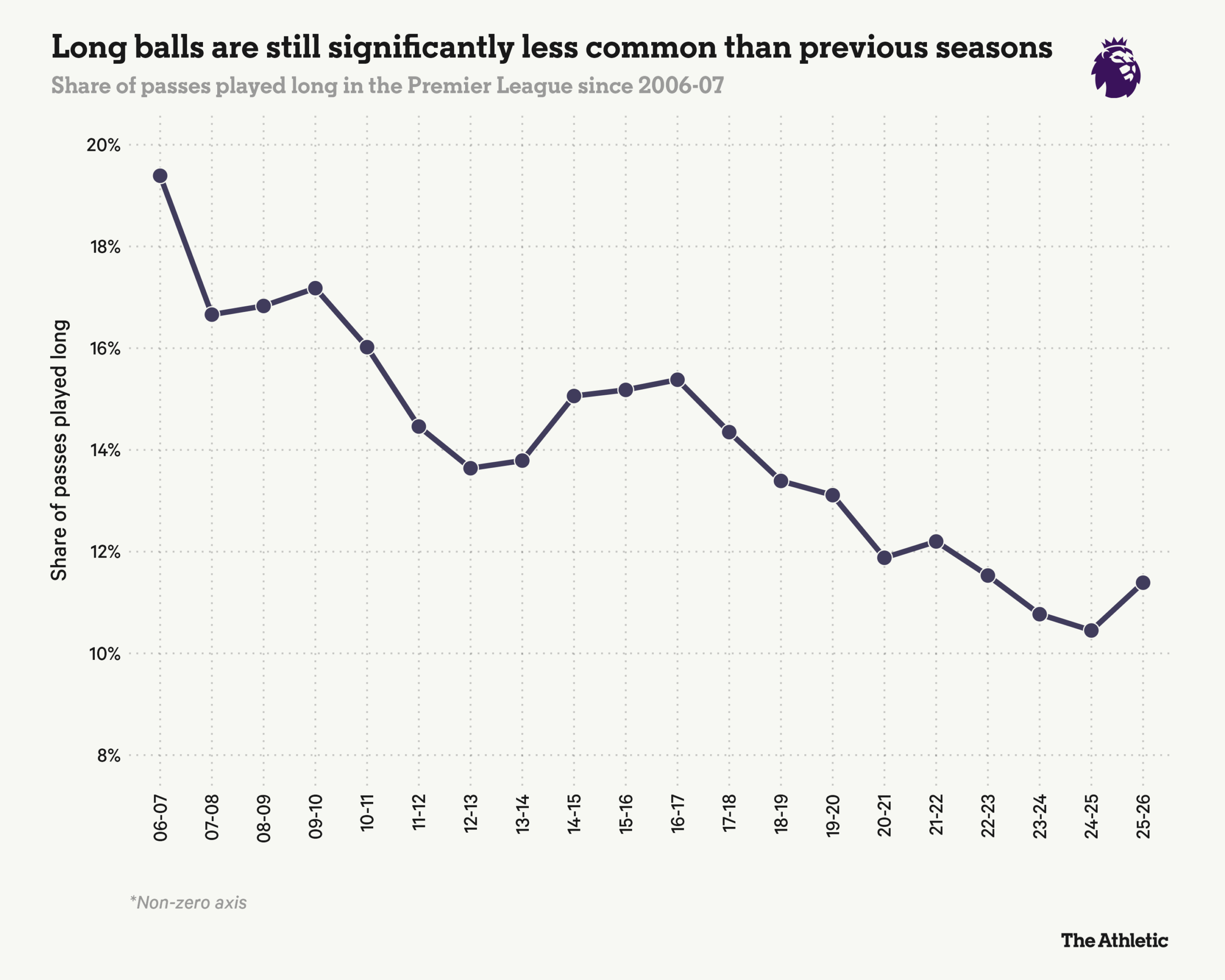
However, the notion that “long balls are back” is only partly true. This year’s share of 11.4 per cent of passes being long (35-plus yards) is a subtle increase on the 2024-25 and 2023-24 seasons, but that figure is still remarkably low in the wider context.
Zooming out since Opta began collecting this data in 2006-07, it is, in fact, the third-lowest share of long balls being made across this period.
This year’s entertainment value has also been questioned in some corners. By this measure, we are ultimately talking about goals.
Last Sunday’s 0-0 between Wolverhampton Wanderers and Newcastle United was the 17th stalemate of the season, which is already more than the entire 2024-25 season. Fans might use this as evidence of a declining spectacle, but nuance is required once again.
As a share of total games ending goalless, this season’s eight per cent is a jump up from the past few seasons.

However, this share is about average when looking across the Premier League era — nowhere near the all-time high observed in 1998-99, which saw 49 games finish with a 0-0 scoreline as a 13 per cent share of all matches.

Derby County 0-0 Arsenal in 1998-99, one of a record 49 matches to end goalless that season (Ross Kinnaird /Allsport)
The same trend can be levelled at this year’s goals-per-game rate, with a downward trend over the past couple of seasons. With elite tacticians in England’s top division, a greater proficiency in out-of-possession setups can sometimes see little goalmouth action with both teams cancelling one another out.
In relative terms, we are seeing a decline from the 2023-24 season, but that was a campaign that saw an unprecedented rate of 3.3 goals per game — the highest in England’s top flight since the 1960s. This year’s rate might be the lowest since 2020-21, but a return of 2.74 goals per game is higher than 21 of the 34 seasons in the Premier League era.
As shown in the graphic below, the lowest period of goals began in the 2004-05 season when Jose Mourinho arrived in England to help Chelsea achieve 25 clean sheets in a single season — a Premier League record that still stands today.
The likes of Rafa Benitez, David Moyes and Sam Allardyce were also responsible for the attritional trend observed in the mid-noughties, before goals began to make a comeback in the 2010s.

Perhaps it is the type of goals scored that is irking some fans this year, which would be a valuable point to make.
Set-piece specialists are as in vogue as they have ever been, and the goal return shows just how successful their work has become — albeit at the expense of open-play finishes. The spike in (non-penalty) set-piece goals is shown below, with a return of 28 per cent scored thus far, the highest share in the Premier League for over 15 years.

Set-piece goals are experiencing a spike this season (Adrian Dennis / AFP via Getty Images)
While it is edging closer, it is yet to surpass the record set in 2009-10, in which 29 per cent of all goals came from dead-ball situations.

Still, we cannot say that the peril is lacking in the final throes of each contest this season.
Since 2006-07, this year has the highest rate of stoppage time goals, with 0.28 per game, even though the reasons why are obvious. With five substitutions per team and a near-inevitable VAR review in an average game, stoppage time has notably increased in recent seasons, with an all-time average of seven minutes and 29 seconds in 2023-24 — a season that saw a record 103 stoppage time goals.
This season’s average is a little lower at six minutes and 40 seconds, but it is no surprise to see that the spike in goals has been maintained after 90 minutes.

The strength of the Premier League has never been more evident, with each side posing a genuine threat to take points off each other.
Last weekend’s results mean that none of the 20 teams has a winning streak longer than one game currently. That was the first time that a full matchweek has ended in such a way since 2020-21 (October 23-26), with the previous occasion occurring in 2016-17, suggesting a reliable and curious five-year cycle.
Examining the current league table, there is considerable congestion in the middle of the pack. But how condensed are the teams compared to this stage of the season across the Premier League era?
For those with a statistical eye, we can measure the standard deviation — denoting the spread of a dataset — of each side’s points tally after 22 games played. The smaller the standard deviation, the tighter the points are spread across the league.
By that measure, this season does not come close to the congestion seen in other Premier League seasons. Plotting the five tightest league tables at this stage (with the 2025-26 as a point of reference), the inaugural 1992-93 campaign was the tightest, with only one side (Nottingham Forest) failing to accrue 20 points and only one side (Norwich City) accruing more than 40 points after 22 games.

Curiously, things were similarly tight across three consecutive seasons between 2000-01 and 2002-03. Arsenal led the league with 43 points after 22 games in 2001-02, later winning the title as the only team to have scored at least once in every game within a Premier League season.
With all the patterns and trends that we are observing in 2025-26, there is a case to be made that we should all simply wait and see before drawing our conclusions on this campaign. There are still 160 more games to play, meaning that we might see current trends subside, further innovations emerge, and the Premier League positions shuffle once more.
Whatever the outliers appear to be, it’s important to remember that we have almost certainly been here before.