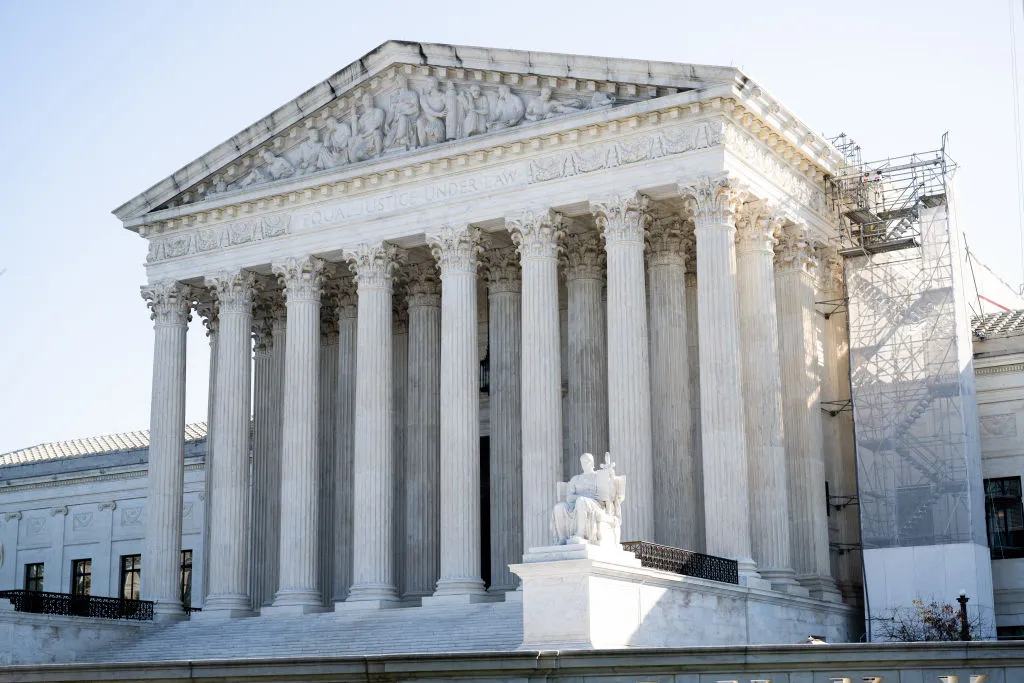
As the Trump administration’s immigration policies continue to dominate headlines, and as legal battles over deportation procedures and the protected status of certain immigrant groups draw closer to the Supreme Court, the justices already are wrestling with four immigration-related questions, including, most notably, whether President Donald Trump has the authority to make the grant of automatic citizenship to children contingent on their parents’ immigration status.
The Trump administration is involved in all four cases, but the birthright citizenship dispute is the only one centered on a policy put in place during Trump’s second term. The other three cases actually originated before Trump returned to office, and they serve as a reminder that immigration issues are a perennial fixture on the court’s oral argument docket.
Still, wins for the administration in any of the four cases would support Trump’s immigration agenda by making it more difficult for certain immigrants to gain – or maintain – legal status. Here’s a brief overview of the disputes.
Asylum determinations
In Urias-Orellana v. Bondi, the justices are considering federal courts’ role in asylum cases. Specifically, they will determine whether federal courts of appeals must defer to the Board of Immigration Appeals’ judgment on whether an asylum seeker has experienced persecution or has a “well-founded fear” of future persecution in their home country, a condition such individuals must meet in order to qualify for asylum protections under the Immigration and Nationality Act.
The dispute centers on a section of the act addressing judicial review. While the statute enables asylum seekers to appeal a BIA decision to a federal court of appeals, it states that the appellate court must treat “the administrative findings of fact” as “conclusive unless any reasonable adjudicator would be compelled to conclude to the contrary.” The key question in the Supreme Court case is whether a persecution determination is primarily the result of a factual inquiry – and thus subject to that limit – or a legal inquiry, which the appeals court can review de novo, or from scratch.
The court heard oral argument in Urias-Orellana on Dec. 1, and the justices appeared to lean toward holding that a persecution determination is the result of fact-finding. “[W]e have all these masses of evidence of what the threats were and who made them and, you know, how serious they were. I don’t mean to belittle that. That’s an important question,” said Justice Elena Kagan at one point. “But it’s a factual question.”
Such a ruling would limit the role of federal courts of appeals in asylum cases and decrease the likelihood that an asylum seeker could successfully challenge a BIA decision stating that they do not qualify for protections under the INA.
Asylum seekers at the border
The Supreme Court is also examining the text of the INA in Noem v. Al Otro Lado, which is scheduled to be heard on March 24. The case addresses the portion of the law stating that an asylum seeker must “arrive[] in the United States” before applying for asylum. The question is whether an individual can satisfy this requirement without physically crossing the border.
The case originated during Trump’s first term, after his administration began limiting how many immigrants could cross the border into the U.S. per day, formalizing a strategy for reducing border surges that emerged during the Obama administration. Officials would meet with asylum seekers in Mexico and turn them away if they did not have valid travel documents. While the Biden administration did not adopt the same “metering” approach, it, too, limited border crossings with an online appointment system, and, like the Trump administration, argued in court that a physical border crossing is required to be eligible to claim asylum.
The Supreme Court is considering whether to accept the government’s view or to affirm the U.S. Court of Appeals for the 9th Circuit, which held that asylum seekers “arrive[] in the United States” when they present themselves to immigration officials, even if this meeting takes place in Mexico. The court’s eventual ruling will affect not just the Trump administration’s border policies, but also the policy options available to future administrations.
Birthright citizenship
This term’s highest-profile immigration-related case is Trump v. Barbara, on Trump’s effort to limit access to birthright citizenship. The justices are considering the legality of an executive order that denies automatic citizenship to children born to parents who are temporarily or illegally in the U.S., which Trump signed as soon as he returned to office. The order has not yet taken effect due to multiple legal challenges.
The case is focused on the citizenship clause of the 14th Amendment, which states that “[a]ll persons born or naturalized in the United States, and subject to the jurisdiction thereof, are citizens of the United States.” The Trump administration contends that this clause was intended to offer protections to “newly freed slaves and their children,” not to everyone born in the U.S. The challengers emphasize that the court held in 1898 that the 14th Amendment “safeguard[s] U.S. citizenship at birth for all persons born in this country, with only a handful of exceptions not applicable here.”
The birthright citizenship case is set to be argued on April 1. The court’s ruling, expected by early July, will determine the future of one of Trump’s signature immigration policies.
Removing lawful permanent residents
In Bondi v. Lau, the court is considering the rights of lawful permanent residents, also known as green card holders, who are charged with – but not yet convicted of – committing a crime that would allow for their removal.
The case centers on Muk Choi Lau, a Chinese citizen who became a permanent resident of the U.S. in September 2007. In May 2012, Lau was charged with trademark counterfeiting, and while the case was pending, he temporarily left the country. Upon his return, immigration officers at John F. Kennedy International Airport, having discovered the pending case, did not “admit” him, which is the status typically afforded to lawful permanent residents. Instead, they paroled him into the U.S., which made him automatically subject to the INA’s inadmissibility criteria, meaning he could be removed from the country for, among other things, being convicted of “a crime involving moral turpitude.” As expected, after Lau entered a guilty plea and was convicted of trademark counterfeiting in 2013, the government moved for his removal.
Lau challenged the removal proceedings on a number of grounds, including that the immigration officers did not have the authority to parole him. An immigration judge and the Board of Immigration Appeals rejected this argument, but the U.S. Court of Appeals for the 2nd Circuit agreed with Lau’s position, holding that officers must have “clear and convincing evidence” that a crime has been committed to parole a lawful permanent resident. Criminal charges do not satisfy that standard, according to the 2nd Circuit.
The 2nd Circuit’s opinion noted that the government could have pursued Lau’s removal even if he had been admitted into the country. However, to do so, the government would have first had to show that he had violated the terms of his green card. By taking up the case, the Supreme Court agreed to determine if the government must indeed take that step.
The court will hear argument in Bondi v. Lau on April 22. As César Cuauhtémoc García Hernández explained in a SCOTUSblog post about the case, a ruling against Lau would give the federal government broader latitude to sweep lawful permanent residents “into the immigration detention and deportation pipeline.”
Emerging immigration cases
The court’s work on immigration issues won’t be over once it resolves these four cases. The justices regularly addressed cases related to immigration law before Trump returned to office, and this trend will likely hold after his presidency ends.
But this term may still be remembered for its impact on immigration law, especially if the court sides with the Trump administration on birthright citizenship.