Donald trump’s most enduring legacy may be his imprint on the Supreme Court. In his first term he appointed three justices—Neil Gorsuch, Brett Kavanaugh and Amy Coney Barrett—creating a 6-3 conservative majority. The court has since delivered several landmark rulings applauded by the president and his supporters. The constitutional right to abortion is gone; affirmative action in university admissions has been curtailed; and former presidents now enjoy broad immunity for official acts. More recently the court has provisionally blessed Mr Trump’s policies on spending, immigration and the restructuring of the executive branch. The president has made it clear he thinks the conservative justices’ job is to advance his agenda; critics on the left accuse them of doing just that.
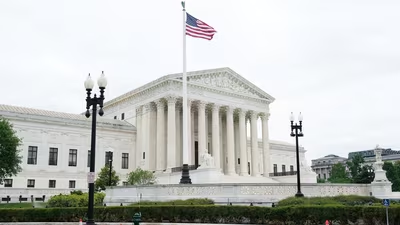
U.S. Supreme Court in Washington, D.C., U.S., May 21, 2026 (REUTERS)
Yet a closer look at the court’s current term—at both the decisions already handed down and those still to come—suggests a more complicated picture. On several occasions the justices have shown themselves willing to rule against the president when he has clearly crossed statutory or constitutional boundaries. At the same time, in cases that will shape the structure of American government and the conduct of politics, the court is moving to the right—often in ways that benefit Mr Trump. In effect, the court of Chief Justice John Roberts shows how difficult it has become to disentangle conservatism from Trumpism. That, in turn, is making it harder for the court to sustain its reputation as an institution above politics.
The court does not reliably rule in Mr Trump’s favour. Earlier this term it delivered its most forceful check on the president, ruling 6-3 that his “Liberation Day” tariffs were not authorised under the International Emergency Economic Powers Act. Chief Justice Roberts pointed out that the act does not mention tariffs, and the constitution clearly gives the power to raise taxes to Congress, not the president. Mr Trump responded furiously. He called the ruling “a disgrace to the nation” and lashed out at the justices in the majority—including two of his own appointees—describing them “fools and lapdogs for the RINOs [Republicans in name only] and the radical left Democrats”.
More disappointment may be in store for the president if The Economist’s scotusbot is accurate. This artificial-intelligence tool creates a digital twin of each justice based on their votes, speeches and writings, then uses those models to predict the outcome of cases. Two previous versions have proven reasonably accurate in predicting important rulings. In the upcoming Trump v Cook—which concerns whether Mr Trump can remove Lisa Cook, a Federal Reserve governor, for allegedly lying on her mortgage application—the model predicts a 7-2 or 6-3 defeat for the president. The Federal Reserve Act says governors may be removed only “for cause”, and at oral argument the justices appeared sceptical that Ms Cook’s alleged misstatements met that threshold. If they rule against Mr Trump, anyone who values central bank independence will be relieved.
The justices also seem sceptical of the government’s position in Trump v Barbara, a case over whether the president can, by executive order, deny birthright citizenship to children born to undocumented immigrants or visa holders. Mr Trump signed the order on his first day in office and attended the case’s oral arguments, an unprecedented move. He later fumed on social media that America is “the only Country in the World stupid enough to allow ‘Birthright’ Citizenship!” That claim is both untrue (several countries allow it) and irrelevant to the case, which turns on whether the 14th Amendment means what it says: “All persons born or naturalised in the United States, and subject to the jurisdiction thereof, are citizens of the United States.” Mr Trump’s lawyers claim that temporary visitors are somehow not subject to American jurisdiction while in America, a contention they would be unwise to test by, say, robbing a convenience store. scotusbot predicts that he will lose 8-1.
Still, even as the court rules against Mr Trump in cases where he pushes fanciful interpretations of the law or the constitution, several of its forthcoming decisions are likely to please him. The conservative majority is expected to uphold bans on natal males in women’s sports, loosen campaign-finance restrictions and allow the administration to revoke temporary protections for migrants from Haiti and Syria.
In Trump v Slaughter the president is likely to get his way. Not because the conservative justices feel any kind of loyalty to the man who appointed half of them, but because such a ruling would fit with the principles of a conservative movement that long pre-dates his presidency. This case concerns whether the president can fire Rebecca Slaughter, a Democratic commissioner of the Federal Trade Commission (ftc). Ms Slaughter appears to have the stronger argument: a century-old statute, backed by longstanding judicial precedent, protects ftc commissioners from arbitrary dismissal.
Conservative legal scholars have long opposed that precedent, established in 1935 in Humphrey’s Executor v United States after Franklin Roosevelt attempted to remove an ftc commissioner hostile to the New Deal. Since then independent agencies have proliferated, and conservatives have increasingly viewed them as an unaccountable fourth branch of government. Last year the justices allowed Mr Trump to remove officials from several independent agencies while litigation continued. According to scotusbot, the court is now poised to entrench a stronger view of presidential power.
Chief Justice Roberts often pushes back against accusations that the court has become “politicised”. However, decisions favoured by the conservative legal movement do often have political consequences that benefit Mr Trump and the Republicans. Perhaps the clearest example came on April 29th, when the court overturned a 40-year-old reading of a 1982 update to the Voting Rights Act in Louisiana v Callais. In a 6-3 ruling the conservative majority held that challenges to electoral maps must show not only racially discriminatory effects but also strong evidence of intentional discrimination. The decision had immediate partisan consequences, making it harder to create majority-black electoral districts while leaving both parties free to pursue partisan gerrymanders. The six conservative justices also agreed to fast-track the legal process to allow redistricting in Louisiana and Alabama, despite the court’s usual reluctance to alter rules close to an election.
The left greeted the decision in Louisiana v Callais with outrage. Justice Elena Kagan’s dissent described the ruling as the VRA’s “now-completed demolition”. Justice Ketanji Brown Jackson accused the conservative majority of allowing “principles [to] give way to power”. Justice Samuel Alito, joined by Justices Gorsuch and Clarence Thomas, called her charge “groundless and utterly irresponsible”. Chief Justice Roberts almost certainly agrees. To him the case represented the culmination of a decades-long campaign against racial gerrymandering that dates back to his time as a lawyer in Ronald Reagan’s Justice Department. In his view, the case was about interpreting the constitution correctly, not helping Republicans win elections.
The court will probably continue to rule against Mr Trump when he crosses obvious red lines. But in most cases, as the court puts a conservative stamp on America’s government and political order, Mr Trump stands to benefit.