The Africa Cup of Nations reaches its conclusion this weekend with hosts Morocco taking on Senegal in the final on Sunday. Many of the Premier League-based players who took part in the tournament are already back with their clubs, but not all.
Senegal have the largest Premier League contingent at AFCON 2025 with six (El Hadji Malick Diouf, West Ham United; Habib Diarra, Sunderland; Idrissa Gueye and Iliman Ndiaye, both Everton; Pape Matar Sarr, Tottenham Hotspur; Ismaila Sarr, Crystal Palace), and Morocco’s squad includes Manchester United’s Noussair Mazraoui and Chemsdine Talbi of Sunderland. Egypt and Nigeria, who meet in Saturday’s third-place play-off, have another six between them.
Those individuals aside, more than half of the Premier League players involved in this year’s AFCON (33 in total) have returned from their international duties, with many in contention to be involved in this weekend’s round of games. How though, do clubs reintegrate these guys who have largely been absent since mid-December, missing a series of matches (at least seven of them in the case of Liverpool and Egypt forward Mohamed Salah)?
From a physical perspective, much depends on what level of work the player has done while away with his national team.
That is something that is tracked very closely, says Geoff Scott, a high-performance specialist who worked in the Premier League for 20 years — most recently as head of medicine and sports science at Tottenham Hotspur — and is the founder of Hauora, an elite physiotherapy and performance centre.
“While the players are away, we would be in constant contact with them,” says Scott. “And the national teams will send quite detailed documentation of what the sessions are, including any gym sessions, so we know what they’ve done throughout the time they’re away.”
Club staff would have access to all of the players’ training data in terms of what they’re doing in these sessions and their GPS numbers, so that they have a good measure of where they are physically. “Then we base a lot of their reintegration on what they’ve done while they’re away,” says Scott.
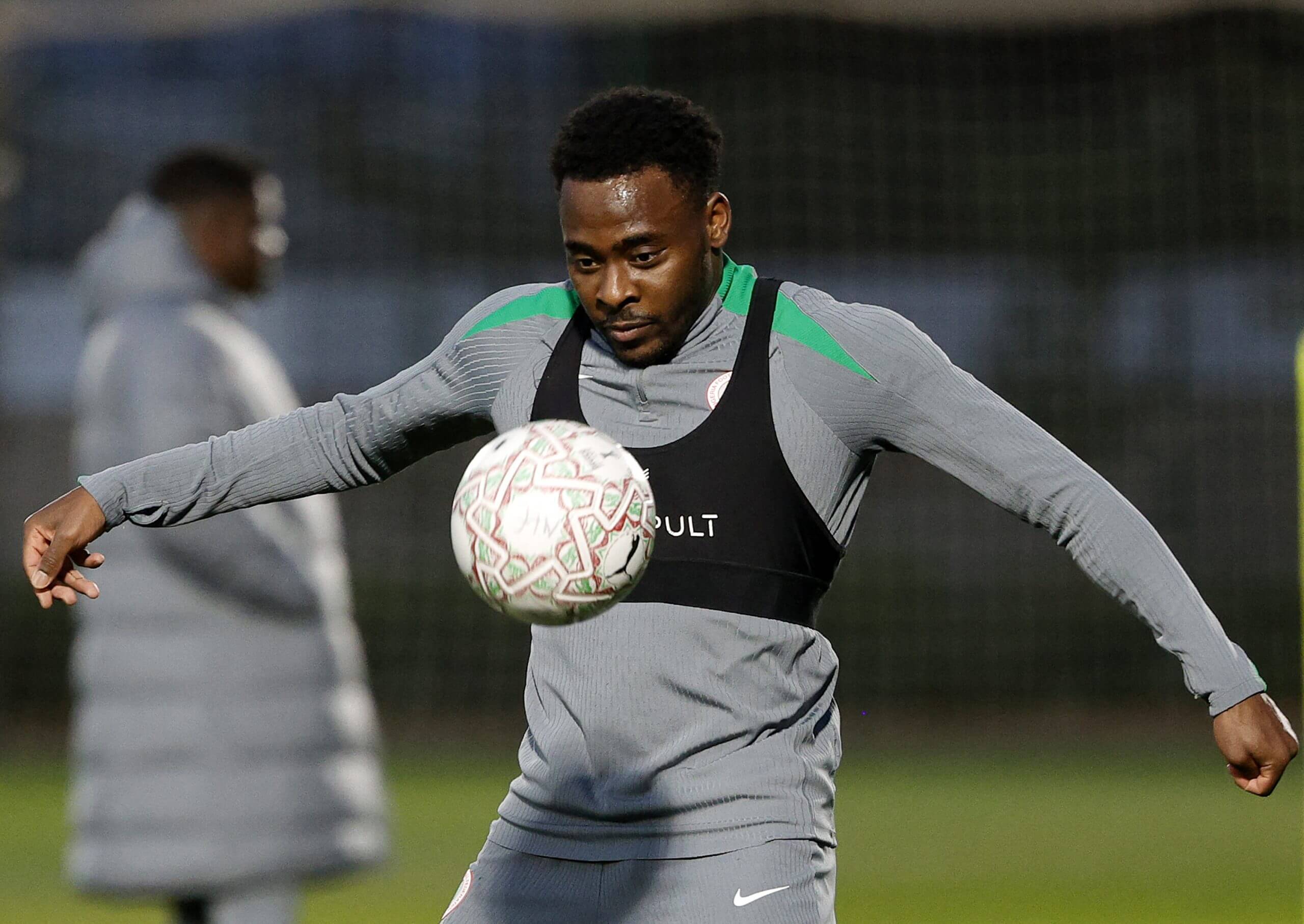
The GPS trackers provide a large number of different metrics in terms of what players are doing on different training days, including total distances covered, amount of high-speed running, accelerations and decelerations. Club staff look at this data to see if it’s comparable with what their team-mates in the UK are doing.
“If there’s a significant drop-off, then, of course, we’ll need to make some modifications to bring them back up to the level for the Premier League,” says Scott, “but predominantly, the national teams look after them very well and that really won’t be a big issue.”
Nigeria’s Bright Osayi-Samuel training in a GPS vest (Abdel Majid Bziouat/AFP/Getty Images)
Communication between clubs and national teams plays a key role.
Performance staff at some clubs might use WhatsApp chat groups to keep in touch with all of the national teams their players are involved with, via which they can be updated on what their absentees are doing each day. It has also become more common in recent years for clubs to fly out a physiotherapist or fitness trainer to attend a given tournament involving their player(s). “At Tottenham one year, we sent a staff member to cover three players who were with different teams,” says Scott.
The influence that club staff can have on what players are doing on duty with their country will vary depending on the team. While staff recognise that each manager will have their own training style, they will try to have some influence when it comes to what they want the gym sessions to deliver and the training numbers to be. “We are definitely not trying to interfere with their coaching methods,” says Scott, “it’s more the physical attributes that the player has to work at around the training to stay in peak condition. The national teams are very good at communicating in this area in the best interests of the player.
“Ultimately, the idea is to not let them get deconditioned (from their club levels) and then have to deal with it when they come back. It’s to try and be more on the proactive side, making sure there is no deconditioning while they’re away, for example if they are not playing regularly.”
When players do return, they will often go straight to the club’s training ground on the day they land back in the UK, says Scott.
“That’s for medical evaluation — to make sure there are no injuries they’ve suffered or been carrying while away, he says. “So they would have a screening with the club doctor and physio, and then, depending on the time of day, they would start a recovery programme — obviously appreciating they’ve just come off a relatively long flight with potentially a time-zone difference (though in this case, Morocco is only an hour ahead of England).
“The reintegration and recovery is active, though — you (the returning player) definitely don’t stay at home.”
The medical side is key. Clubs ensure that players are up to date on vaccinations before leaving, but there is always a risk. Blood tests aren’t done as routine but as soon as a player becomes unwell, they are carried out.
“We had a situation (at Tottenham) after AFCON where a player came back and was ill very soon after with malaria,” says Scott. “That’s probably relatively rare, but when players are based in Europe and don’t travel to Africa very often, they can be a bit more susceptible to illnesses such as malaria, so we monitor closely.”
Ultimately, it’s expected that players will have been working at a high level with their national team during the tournament, meaning their return to the club game is mostly about recovering from travel and any jet lag before phasing them back into training with their colleagues. “They would normally have a day or two where they’re recovering, post-flight and post-tournament,” says Scott, “but as long as their GPS numbers are where we need them to be for the weeks that they’ve been away, they’d integrate back into the team very quickly.
“It’s almost universal throughout the Premier League that they’ll be back playing for their club within just a few days of returning.”

Manchester United’s Bryan Mbeumo training with Cameroon (Franck Fife /AFP/Getty Images)
In terms of what they might have missed while away, players will be integrated immediately back into team meetings and looking at the games coming up.
“This will include a review of the previous games and what’s gone wrong and what has gone right,” says Scott, who adds that it’s very likely that most players will keep an eye on how their club are getting on while they’re away. “They tend to spend most of their time watching football wherever they are, so as long as it’s available to them, it’s likely most of them are catching up.”
That reintegration into the weekly routine of club life is important not just from a tactical or performance perspective but a mental one, too, says sports psychologist Michael Caulfield, who has spent more than a decade in professional football and currently works with the Premier League’s Brentford.
“What footballers crave more than anything is routine,” Caulfield tells The Athletic. “They love to know what’s going to happen next, and getting players settled back into that routine after often-excessive travel is just craved by them and by the staff as much as possible, because it’s a very routine process-based sport.”
It’s also important to recognise and celebrate what they have been part of for the past month, though, he adds, recalling that when Brentford’s central midfielder Frank Onyeka returned from the previous AFCON two years ago, where he was part of the Nigeria team that got to the final, the club’s player support staff decked out the canteen in Nigeria flags and their green-and-white colours to welcome him back.
“AFCON is a remarkably important tournament. It means so much to those players to qualify and play for their country in Africa. Therefore, you can’t not celebrate that, you can’t resist it. You have to completely psychologically embrace it and celebrate or commiserate with them in equal measure,” Caulfield says.
As with any international window, it’s important that clubs are mindful of the fact each player’s experience of it will vary. Some might return on a real high, others on a serious low. That’s a scenario Caulfield says has to be played “cannily, managing, talking to and understanding them all a bit differently”.
There might have been changes while they’ve been gone, to staff (managers, even), fellow players, or simply where the coffee cups are kept. Footballers, though, are incredibly “adaptive”, says Caulfield. For most, changes in environment and colleagues are something they’ve experienced all their professional lives. “So many international-based players speak four or five languages with ease,” he adds. “It (only) takes them six months to learn a new language. That’s how adaptive they can be.”
Mostly, it’s important that their return is embraced.
“The basic human need is still to be wanted and valued,” says Caulfield. “Particularly given the country they travel from or come from or play for. It’s easy for those brought up and living in the UK, but when you’ve crossed continents or hemispheres and you’re suddenly just left there…
“To make them feel wanted, engaged and valued is so important.”