Operating the world’s largest navy by hull count, China possesses combat vessels—including surface warships and submarines—acquired from Russia decades ago, that helped it build sea power capable of challenging the United States.
While Russian legacy systems remain a relevant part of the rapidly expanding Chinese fleet, Alex Luck, an Australia-based analyst who specializes in the People’s Liberation Army Navy, told Newsweek they will likely disappear from PLAN service within the next decade or two, “depending on how long particular units remain in service.”
Newsweek has reached out to the Chinese Defense Ministry for comment via email. The Russian Defense Ministry did not immediately respond to a request for comment.
Why It Matters
China and Russia have formed what Russian President Vladimir Putin once called a partnership without limitations, with both sides providing support—diplomatically and militarily—to each other on issues such as the ongoing Russia-Ukraine war and tensions across the Taiwan Strait, as they join hands in countering U.S.-led alliances in Europe and Asia.
As part of efforts to build a “world-class” military aimed at displacing the U.S. as the world’s most powerful nation, China has undergone naval modernization—supported by a robust shipbuilding capacity—and fields a fleet of more than 370 ships and submarines, including three aircraft carriers, eight 10,000-ton-class destroyers and 60 submarines.
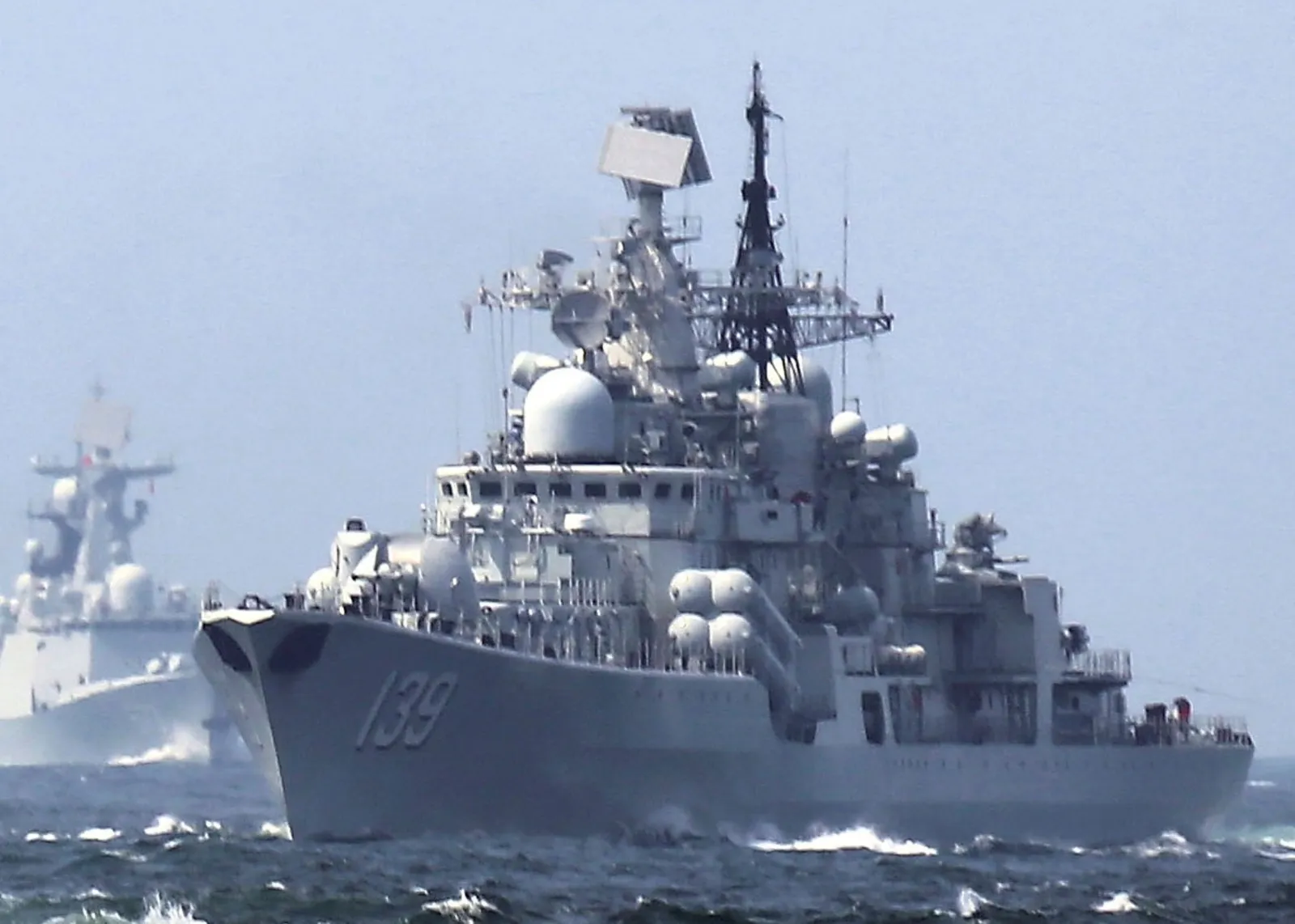
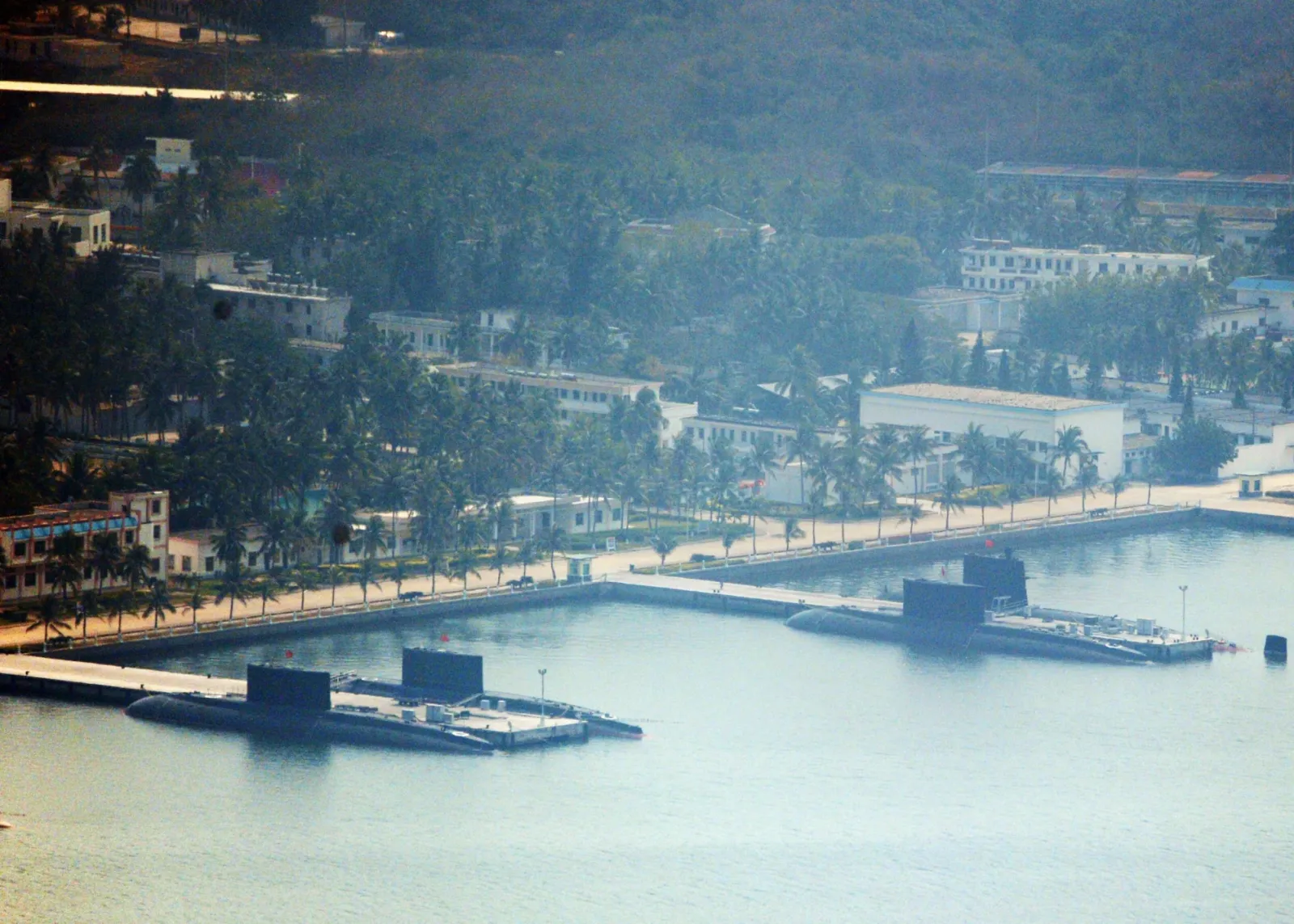
While the majority of the Chinese fleet is domestically designed, it has been integrated with Russian-origin naval assets, including four Sovremenny-class destroyers and 10 Kilo-class submarines acquired in the early 1990s and 2000s, as well as its first aircraft carrier, CNS Liaoning, formerly the Varyag, originally constructed for the Soviet Navy.
Addressing Operational Needs
According to Luck, China’s initial motivation for acquiring naval platforms from Russia was mainly to rapidly field what he described as “meaningful capability,” particularly after its relations with the West deteriorated over two major incidents: the 1989 crackdown on protesters at Tiananmen Square and the 1996 Third Taiwan Strait Crisis.
The Chinese Communist Party has long claimed Taiwan—a self-ruled island—as its own, despite never having governed the territory. During the 1996 crisis, when the Chinese military conducted live-missile drills in the Taiwan Strait, the U.S. dispatched two naval strike groups, each led by an aircraft carrier, to serve as a deterrent against China.
“The Chinese Navy needed both capable platforms for credibly deterring the [U.S. Navy] and underlining their own political aspirations in the region, and a broader technological base to incorporate into future developments,” Luck told Newsweek.
Citing China’s indigenously built Type 039A diesel-electric-powered submarine as an example, Luck said this class of vessel has “more significant” Russian influence on its hull design, which can be considered a hybrid of Chinese and Russian engineering.
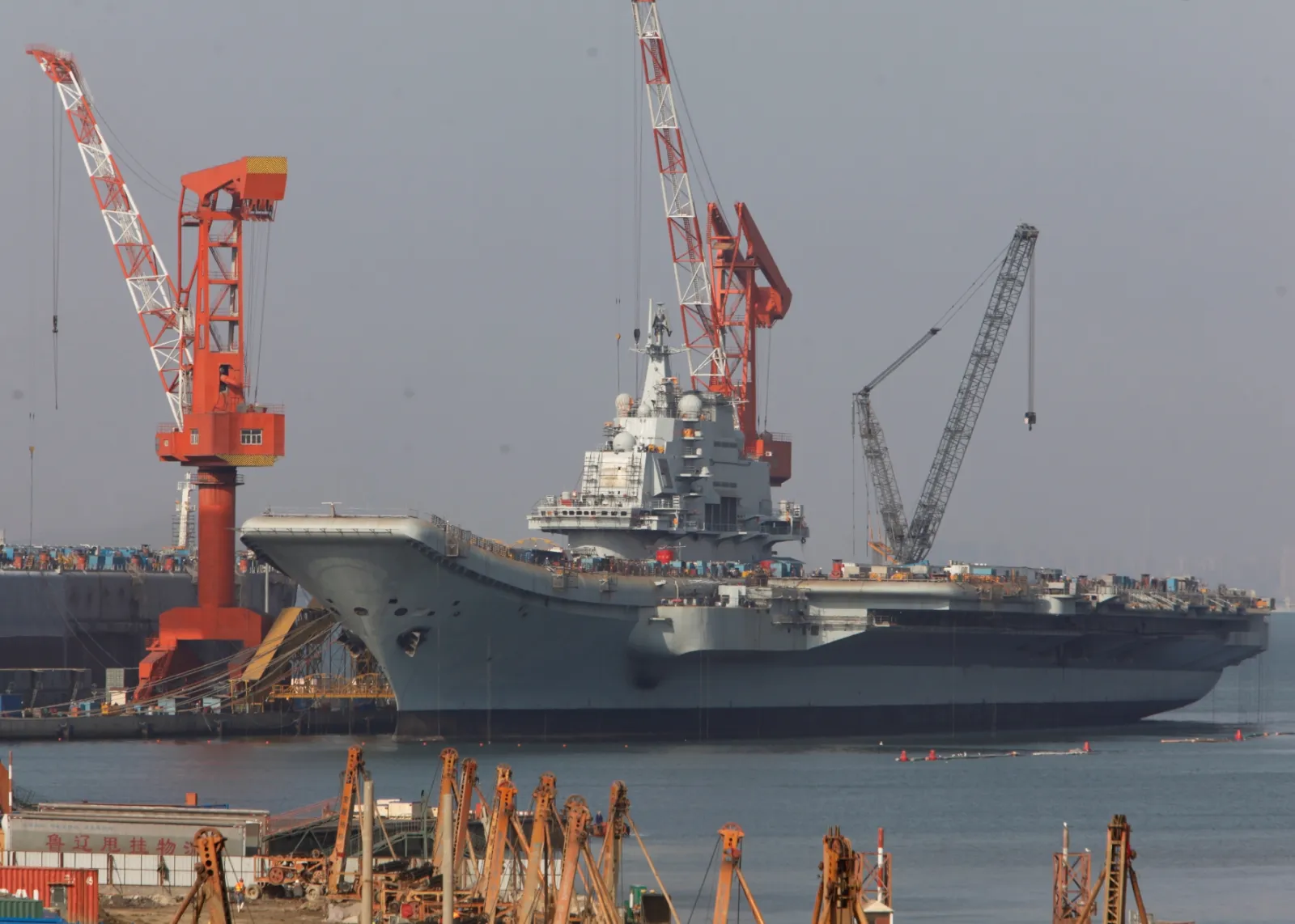
Regarding the Liaoning, which China purchased as an unfinished hull to extensively modernize, the analyst said it was used to gain foundational expertise in designing, building and operating an aircraft carrier, a capability China did not previously possess.
Calling it the most meaningful aspect of technological transfer from Russia to China, Luck said it took the Chinese Navy longer to acquire operational carrier capability because of the significant resources and time required to establish it.
More than a decade after the Liaoning was commissioned in 2012, the Pentagon said in its 2025 assessment that China aims to have a total of nine aircraft carriers by 2035, planning to build six additional vessels, which would outnumber its U.S. counterpart in the Pacific, currently home to six aircraft carriers in Japan and on the U.S. West Coast.
Scaling Back Front Line
As China fields more advanced, indigenously designed naval vessels, Russian platforms are expected to be phased out. Luck said China has now surpassed Russia in certain areas, such as the overall quality and connectivity of its electronics and sensors because of a far more robust domestic electronics and semiconductor industrial base.
The most obvious example of the transition from Russian hardware and know-how to domestic expertise is China’s aircraft carrier program. In developing its carrier-based aviation, the Chinese Navy has moved from the ski-jump design used on the Liaoning to catapults capable of launching heavier aircraft, a major feature of CNS Fujian.
At the same time, a new generation of Chinese carrier-based aircraft, the J-35 fighter jet, has entered service and is expected to eventually succeed the J-15, a Chinese equivalent of the Soviet-designed Su-33 Flanker, according to Luck.
To maintain the operational viability of Russian-origin hardware in its fast-growing fleet, the Chinese Navy has what the analyst called “a general habit” of applying newer technology and expertise to older units, notably the four Sovremenny-class destroyers.
Only one of the destroyers has yet to complete a refit, the analyst said, which include integration with more modern Chinese missiles—designed for air defense and anti-ship missions—and sensors, as well as improved command-and-control (C2) capability.
“Comprehensive modernization of these now aging destroyers seems to underscore a desire by PLAN to not compromise on numbers for their larger and more capable combatants,” Luck wrote in a Naval News article reviewing the Chinese Navy in 2025.
What People Are Saying
Alex Luck, an Australia-based naval analyst, told Newsweek: “China for the last 15 years has pursued an increasingly ambitious policy of fielding indigenous capabilities, including those based significantly on the influx of Russian technology. This dynamic is also the reason why the original Russian systems have lost most of their immediate operational significance.”
The Pentagon’s Chinese military power report 2025 commented: “China’s historic military buildup has made the U.S. homeland increasingly vulnerable. China maintains a large and growing arsenal of nuclear, maritime, conventional long-range strike, cyber, and space capabilities able to directly threaten Americans’ security.”
What Happens Next
It remains to be seen how Russian naval platforms will change their role in China’s more modernized fleet, as the East Asian power rapidly fields new vessels to expand its maritime power and project forces farther across the contested Indo-Pacific region.