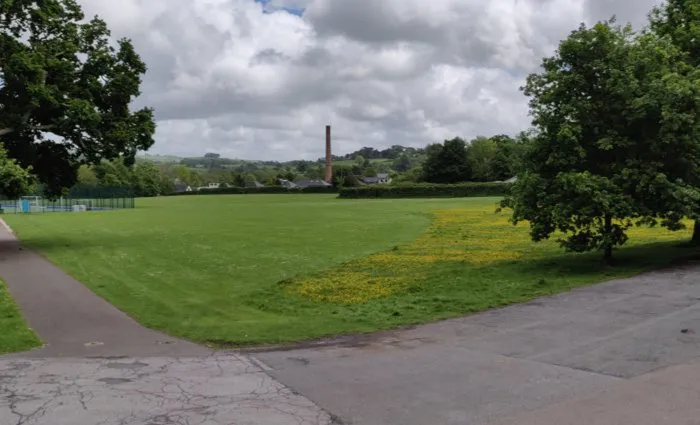
School playing fields are being sold off across the country including in the home towns of the England squad, which could jeopardise the development of the next generation of World Cup stars.
England’s schools have lost 189 playing fields over the last decade, with some sales being for new homes, according to The i Paper‘s analysis of official data.
In 2024, the year the Labour Party came to power, there were 22 “disposals” – the highest level since 2017, the Department for Education figures show.
Last year, ministers outlined plans to remove the requirement for local authorities to consult with Sport England before granting a planning application as part of plans to fast-track the building of new homes. But charities have warned this could fuel additional sell-offs.
Jill Scott, who was part of the England women’s team that won Euro 2022, previously told The Telegraph that children risked losing their “dreams to become sportspeople”.
“I relied on my local playing field, the local park, to get outside,” she said. “Without that space I wouldn’t have gone on to fulfil my dreams as a professional footballer. It was the biggest part of my life.”
Fields sold off since 2021 include one in Ealing, west London – the home town of Bukayo Saka, England’s 24-year-old winger.
Others are in striker Ivan Toney’s home town of Northampton and Morgan Rogers’s home town of Halesowen in the West Midlands.
Facilities ‘not fit for purpose’
Mark Lawrie, chief executive at sports charity StreetGames, warned that the loss of playing fields could jeopardise the development of the next generation of England footballers by reducing the opportunities for children to play.
“A lot of the centres that would be used to find the next Jude Bellingham are all very well set up, but the real question is about that first stage on the ladder – that real grassroots access to sport,” he said.
In some areas, school facilities are the only good facilities available for grassroots teams, he added.
Lawrie said funding challenges have placed pressure on schools and local authorities are struggling to invest in the upkeep of facilities in some areas.
Housing developers will sometimes promise new sports facilities as part of their planning applications to build on playing fields, but what is delivered is not always “fit for purpose”, he added.
Cost is another barrier for children looking to play football, according to StreetGames.
A survey by Grassroots Football UK shows club subscriptions cost £15 to £35 a month – although prices can be higher in some areas, particularly where facilities charge more.
Although football is free within schools, 45,000 hours of PE have been lost from school curriculums since 2012, with 4,000 hours lost in 2024-25, according to the Youth Sport Trust.
‘Disaster for the town’
In Totnes, Devon, the Government approved the sell-off of the King Edward VI Community College playing field last year despite a local campaign against the decision.
It had previously been used by children to play football and other sports and it is anticipated that it will be used for new homes.
Peter Shearn, a 65-year-old local, said the decision was a “disaster for the town”.
“It’s one of the few green spaces remaining in the town,” he said. “We’re being swallowed up by lots of buildings.”
The town council had previously put a bid together to turn it into a public park.
“The current Government wanting to ‘build, build, build’ is looking harder to fight off,” Shearn said.

In the London borough of Waltham Forest, where England captain Harry Kane and his predecessor David Beckham grew up, locals have mounted a campaign to bring disused football grounds back into use.
The abandoned grounds of Leyton Football Club, where schools and the Arsenal women’s team have played, are now being used as a car park for a local restaurant.
Although the site has a covenant that states the land has to be used as a sports ground, the private owners applied to redevelop it into housing and a health centre – plans which were rejected by the council.
Nigel West, a resident in his fifties, said the Government promised to “keep investing in grassroots sports” but claimed “nothing has happened”.
“Former sports grounds like the Hare and Hounds… are being left to rot and earmarked to be turned into flats,” he said.

Munira Wilson, education spokesperson for the Liberal Democrats, accused the Government of “waging war against grassroots sports”.
“Whether it is cutting PE sports premium funding in schools, removing Sport England as a statutory consultee for planning purposes, or continuing the Conservatives’ disastrous legacy of school playing field closures, Labour are dismantling the infrastructure that talented young people rely on to keep fit and develop their sporting talents.”
In response to the analysis, the Government said there has been only been 19 sales of playing fields since it returned to power in July 2024, compared to 166 since 2017.
It also said 172 of those sold were taken out of use permanently, but in most cases they represented a small proportion of a school’s overall playing field area.
Many others were leased to schools, while some were located on closed school sites after it was decided they were no longer needed for education, the Government said.
In a statement, a Government spokesman, said: “Every child deserves access to an excellent education, including access to sport and outdoor space. The sale of school playing fields has decreased under this government.
“School playing fields are protected by primary legislation and in the event that a land disposal of a playing field is approved, proceeds must always be reinvested back into sports improvements.
“This approach has not changed and will not change following the planning consultation – the outcome of which will have no bearing on our approval process.”