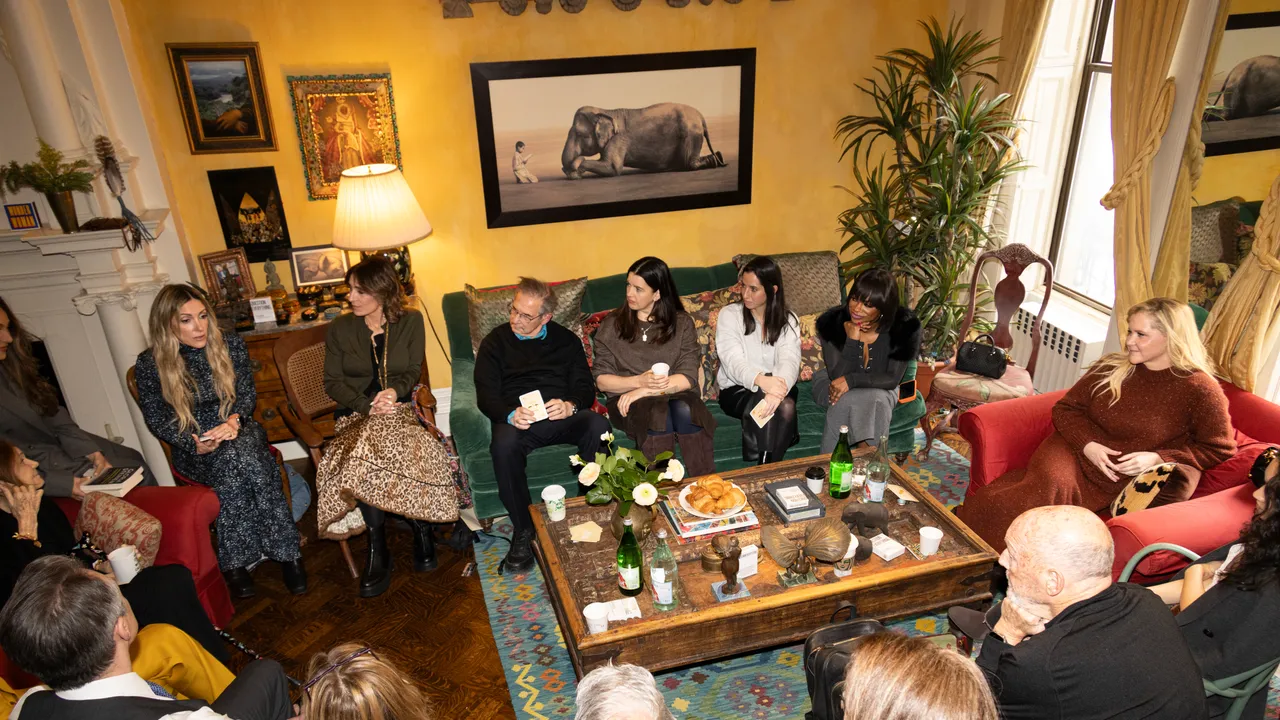
Imagine your dad throwing your birthday party. It’s a chilly Tuesday afternoon on the Upper East Side of Manhattan, but here, inside Gloria Steinem’s cozy, knick-knack-filled apartment, where a guest has just shared this prompt, the atmosphere is warm. Steinem, 91, is hosting one of her occasional “talking circles,” and the topic today is masculinity. The guests include celebrities Amy Schumer, Emmy Rossum, and the Real Housewife of Atlanta Kandi Burruss, as well as zeitgeisty experts like Dr. Corinne Low, associate professor at Wharton and author of Having It All, and the tatted, media-friendly divorce lawyer James Sexton, whose Instagram @nycdivorcelawyer boasts nearly half a million followers.

Steinem’s living room before guests arrive. Photos by Jamie Pearl.
The group laughs—even scoffs—at the idea of one’s dad organizing a birthday party. And why shouldn’t they? How many of us imagine a comedy of errors: last-minute invites, lackluster decorations, nonexistent party favors. The idea of this exercise, of course, is to illustrate how domestic duties usually fall on moms, while dads often fumble the basics (or worse, “weaponize their incompetence”).
Steinem is holding court in a red armchair. In her hands, a white mug that reads, in block letters: Keep Calm and Watch Call the Midwife. The conversation is led by Eve Rodsky, a lawyer-turned-author and Danielle Robay, host of Bookmarked, the podcast extension of Reese Witherspoon’s bookclub, and it is conducted under Chatham House Rule, meaning participants are free to share ideas without them being attributed. (I am allowed to ask on-the-record questions at the end.)
As guests settle into Steinem’s storied living room—which, among many iconic memories, played host to the founding of Ms. magazine in 1971—Rodsky distributes cards from her game, Fair Play, which is also the title of her book on the unequal division of labor within the home. Each card represents a household to-do, which she defines as any unpaid task that takes over two minutes to complete. Some are straightforward, like “dishes” and “bedtime routine.” Others are broader, like the one Rodsky handed to me, which simply said: “holidays.” She asks the guests to consider which gender they would assign the task handed to them. (The game was created as a tool for heterosexual couples with children to talk more openly about chores.) In our group of 31 women from all backgrounds, one nonbinary person, and four white men, the game brings out a lot of seemingly otherwise unspoken resentment.

Eve Rodsky distributes cards from her game Fair Play. Photos by Jamie Pearl.