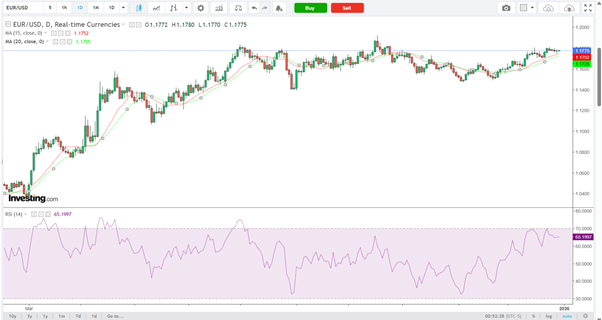
As global markets look beyond the turbulence of recent years, 2026 is shaping up to be a defining year for foreign exchange. With monetary policy cycles maturing, global growth stabilizing, and political risk remaining elevated, the FX market is likely to enter a new phase — one marked less by one-way trends and more by sharper rotations, regime shifts, and episodic volatility.
At the centre of this transition lies a critical question: is the entering a structural downtrend, or merely pausing before its next resurgence?
The Big Picture: 2026 May Mark a Turning Point for the Dollar
The dominant macro theme heading into 2026 is the gradual erosion of the US dollar’s interest-rate advantage.
With the expected to move deeper into an easing cycle while other central banks maintain more cautious paths, rate differentials — the backbone of USD strength — are likely to narrow. In parallel, global growth is expected to remain steady rather than recessionary, reducing the need for sustained safe-haven dollar demand.
This combination points toward a weaker-USD bias in 2026, though not a smooth or uninterrupted one.
Instead, currency markets are likely to experience:
- Lower USD highs over time
- Strong but short-lived dollar rallies during risk-off episodes
- Greater dispersion across G10 and emerging-market currencies
In short, the dollar may lose dominance — but not relevance.
Policy Divergence and Political Risk Will Drive Volatility
While monetary policy remains central, political and fiscal dynamics are set to play a larger role in FX pricing in 2026.
In the United States, uncertainty around fiscal policy, trade measures, and long-term debt dynamics could periodically inject volatility into the dollar. These episodes may temporarily support USD through defensive flows, even within a broader bearish trend.
Globally, geopolitical risks, trade realignments, and election cycles will increasingly influence capital flows — making FX a headline-driven asset class rather than a purely macro-rate story.
Major Currency Outlooks for 2026
Euro (EUR): Gradual Strength in a Lower-Dollar Environment
The euro stands to benefit if global growth remains resilient and US rate support fades. With inflation pressures easing and policy volatility declining, may trade with a constructive upward bias, though gains are likely to be measured rather than explosive.
The main risk to this outlook would be a renewed growth shock or energy-driven stress in the euro area.

Japanese Yen (JPY): The Asymmetric Wildcard
The yen enters 2026 as one of the most asymmetric currencies in the FX market.
If global yields fall and Japan continues even modest policy normalization, JPY could rally sharply during risk-off phases. However, if global growth holds firm and yield differentials remain wide, yen weakness may persist for longer than many expect.
This makes a pair where timing and volatility will matter more than direction.

British Pound (GBP): Domestic Fundamentals Take Centre Stage
’s performance in 2026 is likely to depend more on UK-specific dynamics than broad USD trends. Inflation persistence, growth resilience, and Bank of England signalling will all be key.
In a soft-USD environment, GBP can outperform — but it remains vulnerable to data surprises and political noise, keeping volatility elevated.

Commodity and Emerging-Market FX: Carry Returns, Carefully
If global growth holds near trend and volatility remains contained, carry trades may regain prominence in 2026, supporting commodity currencies and select emerging-market FX.
However, this environment is fragile. Any spike in global volatility could unwind carry trades quickly, reinforcing the importance of risk management and selectivity.
Three Scenarios That Could Define FX in 2026
Base Case: Soft Dollar, Higher Rotation
- Global growth remains stable
- Fed easing continues gradually
- USD weakens modestly over time
- EUR, selective EM, and high-carry currencies outperform
Risk Scenario: Policy Shock and Dollar Squeeze
- Trade or fiscal shocks trigger risk-off moves
- USD rallies sharply but temporarily
- JPY outperforms late in the cycle
Alternative Scenario: US Growth Surprise
- US growth re-accelerates
- Rate cuts slow or pause
- USD stabilizes or rebounds
- FX markets revert to range trading
2026 Will Reward Flexibility, Not Dogma
The FX market in 2026 is unlikely to resemble the one-directional trends of the past. Instead, traders and investors should prepare for more frequent regime changes, faster reversals, and greater dispersion between currencies.
While the balance of risks points toward a post-peak dollar world, the path will be volatile — and conviction trades will need to be actively managed.
In this environment, FX will once again become a trader’s market, not just a macro one.