The Pyramid of Cheops. The Taj Mahal. Chichen Itza. The Colosseum.
They’re among the great wonders of the world.
They’re the vanity projects of pharaohs, emperors and priest-kings.
And the more things change, the more they stay the same.
Chairman Xi Jinping has secured an unconstitutional third term as supreme leader of the Chinese Communist Party. And he’s doubled down on what he desires to be just one of his greatest legacies – a herculean monument to bureaucracy.
Crown Prince Mohammed bin Salman has been unexpectedly promoted to heir to the Saudi Arabian throne. His legacy is supposed to be an enormous Line in the sand – a glittering megacity in the desert.
Their building projects are supposed to be big.
They’re supposed to be bold.
They’re supposed to be expressions of absolute power.
All, however, are struggling.
And that’s nothing new.
Xi’s monument to management
A week ago, the Great Navigator of the Chinese people took a tour of his personal dream.
It’s not a city.
It’s an administration block.
On an enormous scale.
Chairman Xi’s vision is noble: to relieve the strain on the nation’s capital, Beijing.
It’s home to about 23 million people. But it’s expensive. It’s crowded. It’s confusing. It’s dilapidated.
Beijing will remain China’s seat of government.
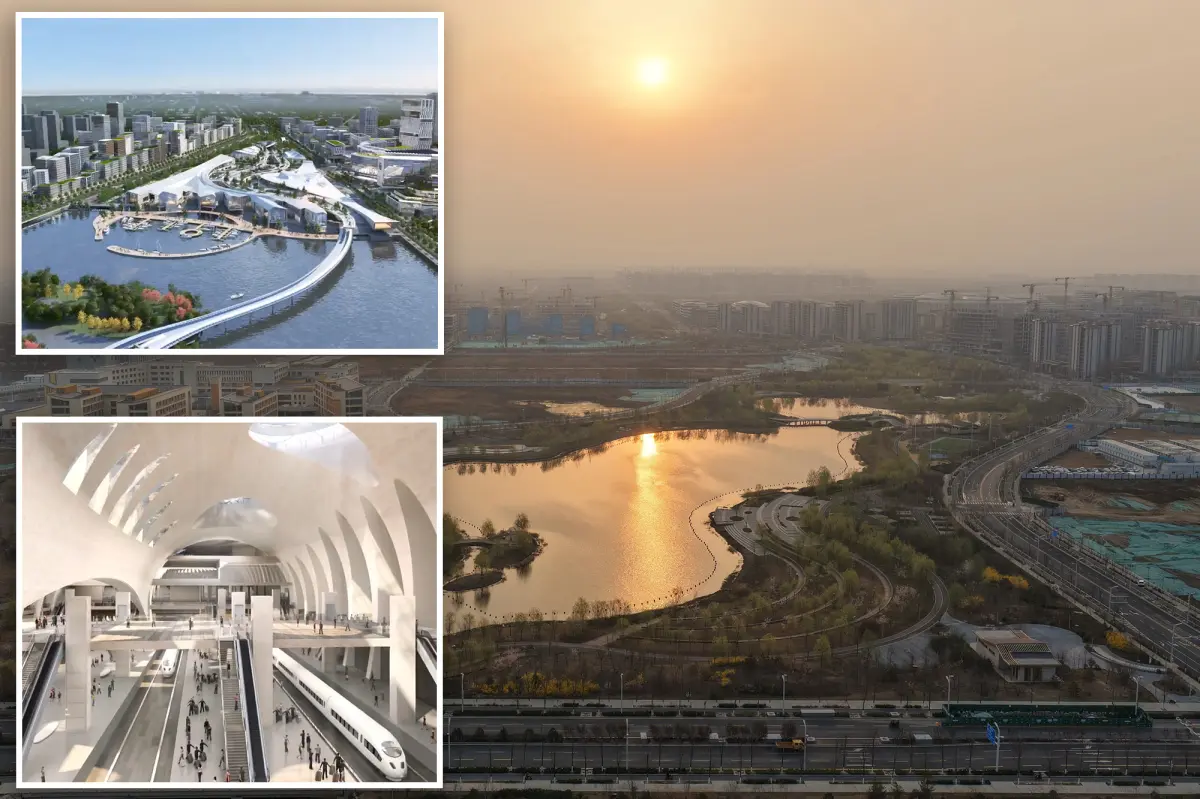
But an empty flood plain 100km to the southwest would become a new home for the millions of bureaucrats needed to keep the Communist Party’s machinery turning.
Xiong’an New Area is to be an effort of “millennial significance”, Xi proclaimed.
Construction began in 2017.
Now Chairman Xi has seen how much progress has been made on his “signature project”.
Work is well behind schedule.
And what has been completed is largely empty.
But what makes this $A842 billion ($318,905 USD) project different to dozens of other empty Chinese urban developments is that this one was Xi’s idea.
The Chairman last week dismissed doubts over his monument to managerialism.
He insists his decision to build Xiong’an was “entirely correct”, the Communist Party-controlled Xinhua news service reports.
He instructed a forum of developers and commissars to “further emancipate the mind, broaden thinking, strengthen co-ordination, and pool efforts” to “stimulate the vitality of the new area by focusing on the rational aggregation of factors and resources”.
He ordered government and private enterprise to “firmly grasp the functional positioning” of his new city, and to “maintain strategic focus and historical patience”.
End of the Line for MBS
Crown Prince Mohammed bin Salman’s idea was incredible.
A 160km-long solid line of skyscrapers spanning one of the world’s harshest deserts. The walls were to be mirrored. Millions were to live in airconditioned comfort, with every possible convenience delivered digitally. Not to mention the soccer stadium and princely amenities.
His Neom Line was a project of unprecedented scale.
As was its price tag ($A2.2 trillion ($585,993,478,400 USD) … that’s with a t).
Construction work began in 2021.
By 2024, a deep canyon had been cut into the desert (at a reported cost of thousands of lives). And some 20 per cent of the world’s available steel was diverted towards the edifice’s construction.
But oil prices were steadily falling. And Crown Prince Mohammed bin Salman’s sovereign wealth fund suddenly wasn’t so wealthy.
Changes had to be made.
Last year, the 160km-long Line was cut to just 2.5km. Nor will it be 500 meters tall.
Now, it won’t even be a city.
Reports in January suggest teams of architects have been tasked with figuring out how to repurpose what’s already been built.
But the Line isn’t the only Saudi building project turned nightmare.
The Mukaab cuboid was to be an enduring monument to the ruling family’s power. But the enormous Riyadh skyscraper – so big that it was supposed to house another skyscraper within it – has also been abandoned.
A comprehensive review of the Crown Prince’s building projects is due to be completed within the next few weeks. Soaring oil prices due to the Iran war may have offered some hope, were it not for the closure of the Strait of Hormuz.
Empires of Dust
The pharaohs of Egypt were likely evicted from their eternal tombs by looters within a few decades. Chichen Itza’s human sacrifices didn’t save the priest-kings. The Taj Mahal didn’t bring back Mughal Emperor Shah Jahan’s wife.
Rome’s Colosseum served as a hub for beer and circuses for more than 400 years. It was then converted to an apartment and workshop complex (and impromptu quarry) before being abandoned.
The edifices of the 20th Century’s authoritarians fared worse.
Benito Mussolini wanted to build an entire new district for Rome as a neoclassical monument to his Fascist ideals. At its heart was to be an enormous white-marble “Square Colosseum”.
This inspired Adolf Hitler to hire architect Albert Speer to redesign Berlin as an imposing shrine to his Third Reich – including a massive domed hall to house 180,000 as a captive audience for his speeches.
Neither lived to enforce their dreams.
Crown Prince Mohammed bin Salman is striving to salvage what he can.
The “data is the new oil” mantra is proving to be correct. And he already has foundations in place.
So The Line will now become an AI data centre.
“Riyadh’s push for more AI leadership is a bet that the general-purpose technology could boost every sector of its diversifying economy,” Goldman Sachs analysts write.
“It has unique advantages not only due to its access to capital but also through a flexible regulatory environment and an abundance of affordable energy.”
For Chairman Xi, the problem is alluvial soil.
And ambition.
Securing the foundations of Xiong’an’s monumental buildings and residential apartment blocks is proving more difficult than anticipated. The soil is soggy. Or solid. Depending on the seasonal floods.
Getting universities, tech firms and entrepreneurs to set up shop is also slower than expected. That may be because only about 1.2 million people live in the area.
“However sophisticated the new administrative centre might be, persuading officials to relocate may prove difficult,” James Palmer writes for Foreign Policy.
“Civil servants often view postings outside the capital as dead ends for their careers.”
Jamie Seidel is a freelance writer