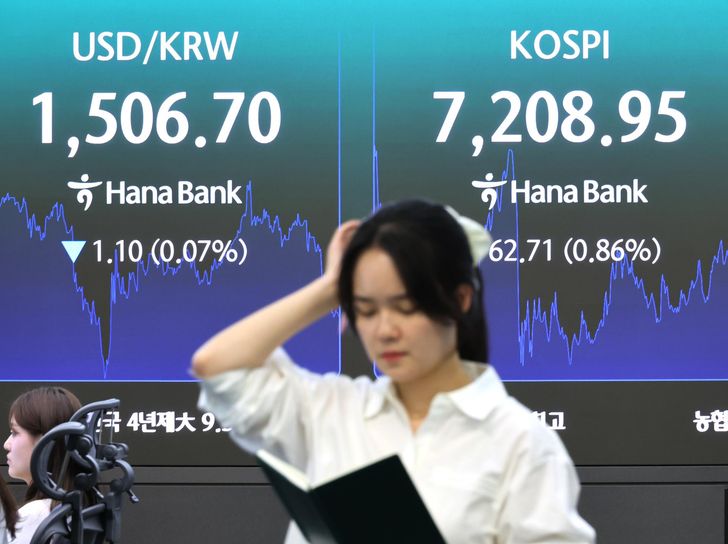
The benchmark KOSPI and won-dollar exchange rate are displayed on an electronic board in the dealing room of Hana Bank headquarters in Seoul, Wednesday. KOSPI closed at 7,208.95, down 62.71 points, or 0.86 percent, falling for a second consecutive session. Yonhap
The benchmark KOSPI remained under pressure for a second straight session Wednesday as foreign investors continued pulling funds out of the Korean stock market.
Persistent selling in semiconductor shares, coupled with the sharp depreciation of the Korean won and rising U.S. Treasury yields, added to concerns over weakening market liquidity and investor sentiment.
The country’s benchmark index opened up 52.86 points, or 0.73 percent, at 7,324.52, but reversed course within minutes and later dropped to an intraday low of 7,053.84.
Volatility persisted throughout the trading session before the index ended the day at 7,208.95, down 62.71 points, or 0.86 percent.
Data from the Korea Exchange showed that foreign investors extended their selling streak in the KOSPI market to 10 consecutive trading sessions from May 7 through Wednesday. Their cumulative net selling during the period surpassed 43 trillion won ($28.5 billion), already well above the previous monthly record of 35.88 trillion won set in March.
Foreign investors were seen rapidly reducing exposure to major semiconductor stocks, such as SK hynix and Samsung Electronics. During the period, they net sold more than 20 trillion won in SK hynix shares and nearly 19 trillion won in Samsung Electronics shares.
The sharp weakening of the Korean won has also emerged as a major factor weighing on foreign investor sentiment. As the won traded above the 1,500-won level against the U.S. dollar, concerns over currency-related losses among overseas investors intensified.
Analysts said the market is caught in a vicious cycle in which foreign outflows drive further won depreciation, while the weaker currency in turn fuels additional foreign selling.
The won opened Wednesday at 1,509 won per dollar, down 1.2 won from the previous session, before ending onshore trading at 1,506.8 won, up 1 won.
The local currency has now remained in the 1,500-won range against the dollar for four straight trading sessions based on closing prices, after ending at 1,500.8 won on Friday, 1,500.3 won on Monday and 1,507.8 won on Tuesday.
Tuesday’s closing level was the highest since April 2, when the won finished at 1,519.7 per dollar.
Additional downward pressure on the Korean market came from rising U.S. Treasury yields amid escalating geopolitical tensions in the Middle East, including the Iran conflict. As U.S. government bonds became more attractive to investors, concerns grew that funds could continue flowing out of the Korean stock market, which is viewed as a comparatively riskier asset.
Despite the continued foreign selling, analysts said the trend should not be viewed as a sign of a broad deterioration in confidence in Korean equities, pointing out that the market’s overall fundamentals remain relatively solid.
“Foreign investors are continuing to react sensitively to exchange rate fluctuations over the medium to long term, with the current currency market environment remaining unfavorable to overseas investors,” Heo Jae-hwan of Eugene Investment & Securities said. “Still, foreign investors are not broadly retreating from Korean equities.”
He added that while foreign investors’ positions in machinery and shipbuilding shares have either slightly declined or remained flat, they have been increasing investments in sectors such as IT hardware, batteries, transportation and trading and capital goods. Exposure to defensive consumption-related sectors, including retail and cosmetics, has also been expanding.
“There is no need to overinterpret foreign selling,” he said.
With volatility continuing in the Korean stock market, investor focus is shifting to Nvidia’s quarterly earnings results, due after Wednesday’s market close, or early Thursday in Korea.
Although Nvidia is no longer enjoying the runaway momentum it once had as the market’s dominant artificial intelligence stock, the company is still expected to exert significant influence on Korea’s semiconductor-heavy market as a key indicator of global chip industry conditions.
Meanwhile, the secondary bourse Kosdaq opened at 1,081.04, down 3.32 points, or 0.31 percent, from the previous session, and extended its losses throughout the session to close at 1,056.07, down 28.29 points, or 2.61 percent.