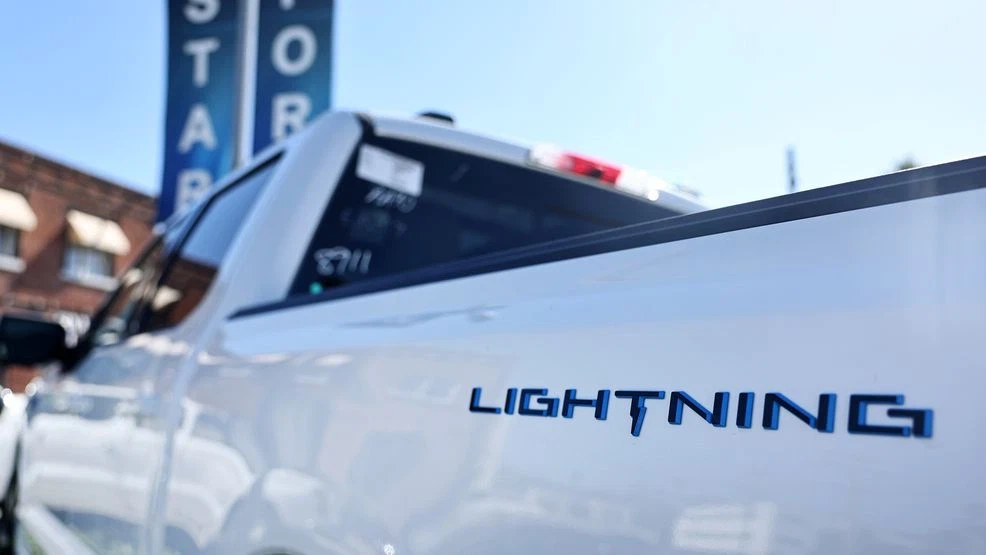
(TNND) — Ford is scrapping plans to make fully electric full-sized pickups.
Ford will take a roughly $20 billion hit, but the company expects the recalibration of its electric vehicle strategy to prove more profitable in the long run.
Ford President and CEO Jim Farley said the “customer-driven shift” will strengthen the company.
“The operating reality has changed, and we are redeploying capital into higher-return growth opportunities: Ford Pro, our market-leading trucks and vans, hybrids and high-margin opportunities like our new battery energy storage business,” Farley said in an announcement Monday.
Kelley Blue Book automotive expert Sean Tucker said the cancellation of the all-electric F-150 Lightning pickup headlines the changes announced by Ford.
“They’re cancelling a number of large EVs that they had planned, but they’re not abandoning the EV market,” Tucker said.
Ford said it still expects about half of its global inventory will be hybrids, extended-range EVs and fully electric vehicles by 2030, up from 17% this year.
And the company has big plans for its universal EV platform, which will be used to roll out lower-priced, smaller cars and trucks, beginning with a midsize pickup in 2027.
Meanwhile, an extended-range EV version of the F-150 Lightning will come to market to replace the fully electric version.

FILE – A Ford F-150 Lightning electric pickup truck is displayed for sale at a Ford dealership on August 21, 2024, in Glendale, California. (Photo by Mario Tama/Getty Images)
An extended-range EV uses gas power to recharge the EV battery, but the gas doesn’t directly power the vehicle’s movement.
The engine is effectively a generator, not actually attached to the drivetrain in any way, Tucker said.
An extended-range EV solves the fundamental problem of towing that has held electric trucks back, he said.
“All trucks lose about half the range when they tow, regardless of what their fuel source is,” Tucker said. “But that’s a much bigger deal when stopping to recharge takes hours than it is when stopping to fill a tank takes two minutes.”
Plus, big trucks are most popular in the parts of the country where EV infrastructure is poor, Tucker said.
Ford said the next-generation extended-range EV, or EREV, F-150 Lightning will add an estimated 700-plus mile range and tow “like a locomotive.”
Tucker said Ford made the right call.
“It was an understandable decision in 2021 to say, ‘Our bestselling product is the F-150. Why don’t we just electrify our bestselling product first?’ But the market for electric full-size trucks is just, it hasn’t really emerged,” Tucker said. “And I think that the EREV is probably a more realistic technology, that the sort of person who’s interested in a full-size truck might listen to that more than they would to a pure EV.”
Tucker said KBB estimates that dealers have about a 147-day supply of fully electric F-150 Lightning trucks, so folks who want to buy one still have time.
Tucker said American automakers have a tough time balancing domestic and international markets, with about a quarter of the overseas market already electric. Stateside, it’s just 7% or so, Tucker said.
That creates a two-tiered, expensive production strategy, one for the North American market and one for the rest of the world.
Tucker said the U.S. market is still moving toward EVs, but it’s moving more slowly than initial projections.
And Tucker said Ford’s decisions have more to do with market demands than politics, with President Donald Trump trying to reduce car prices by rolling back gas mileage requirements.
“Politicians want a lot of headlines talking about the automotive industry, but the automotive industry does not move at the speed of politics,” Tucker said. “If you sit down to design a new car today, it’s going to roll out to the public in about five to seven years. It’s a long design cycle. So, I don’t think they’re making a lot of quick decisions based on something the president did last month.”

