Published on
August 28, 2025
Liaoning Province’s cultural heritage was showcased at the Expo 2025 China Pavilion in Osaka, Japan. The exhibit presented the ancient Niuheliang site of the Hongshan Culture to promote one of China’s earliest civilizations, along with the ancient Niuheliang site of the Hongshan Culture, a civilization of over 5,000 years.
Revealing History During Liaoning Week
During Expo, participants were presented with the Niuheliang site in Chaoyang, Liaoning, which is important for hosting the cradle of China’s earliest astronomical calendar. Yin Xuhong of the Niuheliang Site Administration framed the Niuheliang site as China’s archaic state era, describing it as the foremost representative. It allows one to delve deeper into Chinese culture, civilization, and astronomy.
The Hongshan people, who thrived approximately 5,800 years ago, possessed advanced agricultural skills. They understood seasonal cycles, suggesting an early interplay between human activity and nature. Yin noted that such understanding facilitated the Niuheliang altar’s construction—three concentric circles symbolizing the sun’s path across key equinox and solstice markers. This altar is deemed the first astronomical calendar in China, an ancient essential serving the early worldview during the initial phases of Chinese civilization.
The Niuheliang site, located in what is now Liaoning, Hebei, and Inner Mongolia, holds great importance in the history of Hongshan Culture. More than 300,000 square kilometers in area, it serves as a remarkable testament to the sophistication, as well as the early population’s influence and hegemony in the region. Moreover, the site’s findings, along with the goddess statue, are considered the first visual representations of the Hongshan people. These finds are treasured as masterpieces, enhancing the cultural importance of the region within the collective identity of China.
Innovative Technology Brings Ancient Artifacts to Life
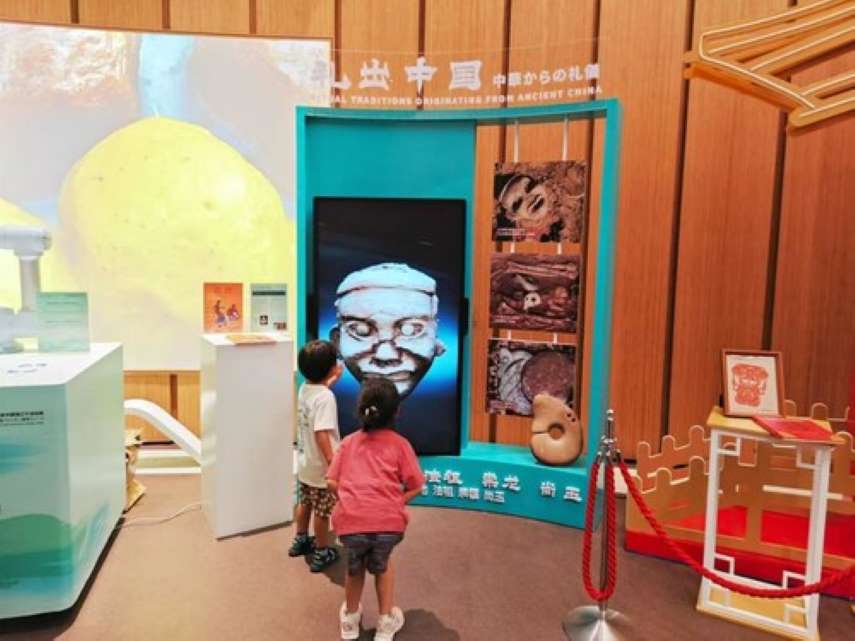
The application of modern cutting-edge technology to ancient artifacts was the highlight of the Liaoning Week. Shenyang Qiyuan Technology Co., Ltd., from the Science & Technology Park of Shenyang Ligong University, presented an innovative 3D holographic display. Guests were able to virtually view ancient artifacts from Niuheliang, such as the head of a goddess figurine, jade pig-dragons, and jade pendants of dragon and phoenix, without physically having them.
The experience was a captivating opportunity that transported guests to 5,000 years ago, and was a remarkable feast for the eyes that was enjoyed by everyone. It was an astounding way to experience ancient artifacts by presenting them in a modern way through technology, merging the ancient beauty and the current day, which was simply breathtaking.
New Discoveries about China’s Ancient Relations through Archaeological Research
An excerpt from Liu Guoxiang’s article, “Archaeological Discovery of the Jade Dragon of the Hongshan Culture,” was shared at the exhibition. Dr. Liu, Vice President of the Chinese Academy of History, described the cultural significance of the jade relics from Niuheliang. These relics were stylistically similar to artifacts from Lingjiatan and Liangzhu, which indicates that over 5,000 years ago, there were cultural exchanges between the Liao, Yellow, and Yangtze river basins.
In stating that the Hongshan artifacts were evidence of a much wider system of cultural exchange, Dr. Liu Liu’s research argued that the artifacts were not simply expressions of local culture, but, rather, the result of interactions that were instrumental in shaping the complex, unified Chinese civilization still in existence.
A Peek into the History and Prospects of Chinese Civilization
While welcoming guests, Yin Xuhong pointed out that Niuheliang and Liaoning are the places where one of the earliest and most continuously enduring civilizations in the world began. With exhibitions such as the “Journey of 5000 Years,” the Niuheliang center not only strives to showcase the remnants of ancient Chinese cultures and civilizations, but also seeks to provide the world a glimpse of the genesis of Chinese culture.
The Niuheliang center serves as a bridge to the ancient Chinese civilization and culture, and is a center to strengthen international cultural communication and exchange, which the Expo presentation aimed to achieve. Yin clearly wanted to send the message that anyone is welcome to discover the world-shaping civilization that Liaoning is ready to expose to the province and the entire globe.
Conclusion: The Evolution of Liaoning’s Ancient Civilization Heritage
Liaoning’s participation in the Expo 2025 in Osaka was not merely an exhibition of artifacts. It ushered visitors into an immersive experience spanning 5 millennia. The Niuheliang site is archeological proof of the depth of Chinese civilization and its enduring impacts on society today. Liaoning’s ancient civilization is being eloquently showcased to the world using technology and technology-driven archaeological endeavors, reconstructing history through layers of human culture.
While sharing its heritage, the world is captivated by Liaoning’s Niuheliang as it is a unique tale that beautifully connects contemporary society to ancient civilization. The Expo visitors, being captivated and inspired by the ancient civilization’s art and technology, left them further fascinated by the unparalleled power and beauty that civilization and culture can manifest.

