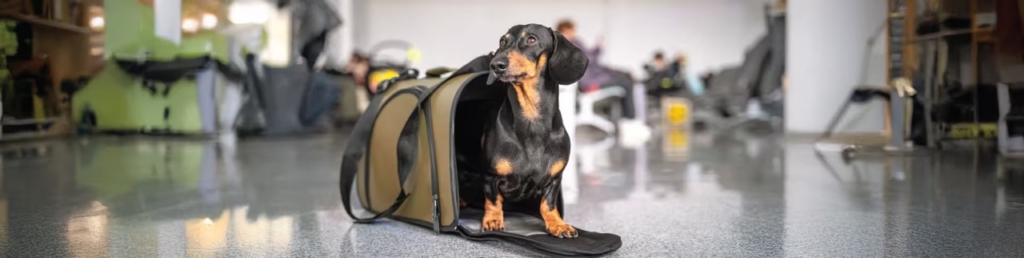
Etihad Airways is lowering the cost of bringing pets into the cabin, rolling out a limited-time $399 fare for its “Pets Onboard” service as more travellers choose to fly with their furry friends.
Passengers who book and travel by 31 May 2026 can access the reduced pet price per flight segment for small cats and dogs. Etihad remains the only UAE airline to permit pets in the cabin.
Lower “pet fare” targets travel trend
Amadeus has identified the “pawprint economy” as one of the dominant travel trends for 2026, with the global pet industry projected to reach $500 billion by 2030.
Etihad’s latest pet travel promotion is a way to expand the service to more pet owners who want to travel while maintaining its onboard service standards.
“For many of our guests, pets are part of the family, and we understand how important it is to travel together. The service allows small cats and dogs to travel in the aircraft cabin alongside their owners, helping reduce stress for pets while allowing guests to keep their pets close throughout the journey,” said Arik De, Etihad’s Chief Revenue and Commercial.
“By making our Pets Onboard service more accessible, we hope to welcome even more guests travelling with their pets while continuing to offer the warmth, care and peace of mind that define the Etihad experience.”
Etihad’s tight pet eligibility rules remain in place
Etihad’s pet requirements remain unchanged despite the lower fares. The only pets allowed are small cats and dogs with a combined weight of no more than 8kg, including the carrier, and a minimum age of 16 weeks.
Passengers can typically travel with one pet each, or two when flying together from the same household. Pets must be healthy, not pregnant, and able to move comfortably inside an approved carrier.
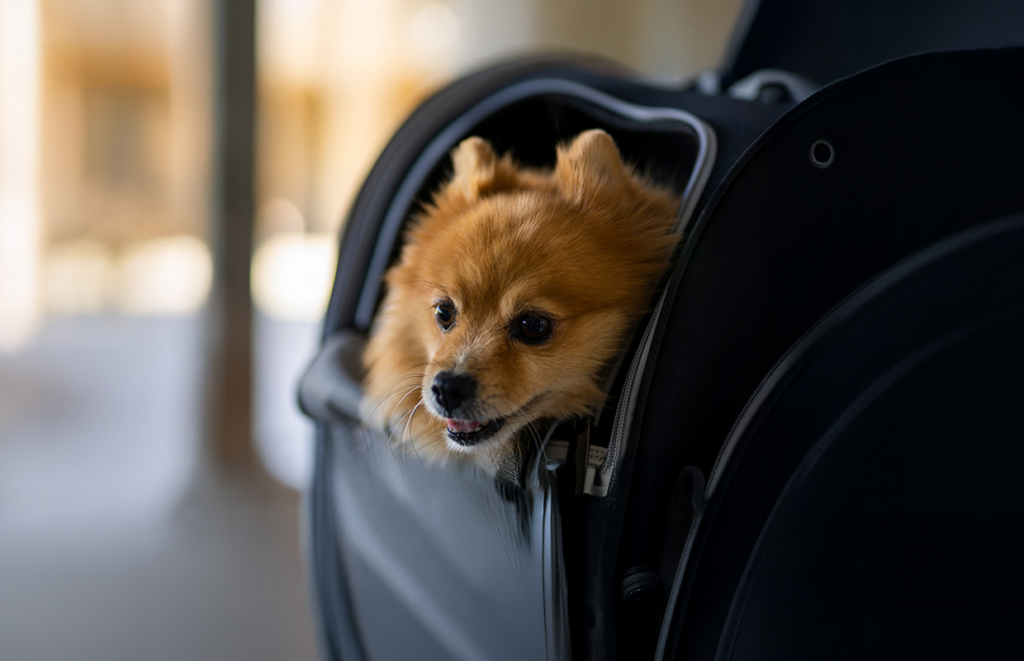
The airline’s carrier size restrictions are up to 40cm long x 40cm wide x 22cm high, to fit under the seat, or up to 50cm x 43cm x 50cm for passengers who have purchased an extra seat for their pet. Carriers must provide proper ventilation on at least three sides, be escape and leak-proof, and be lined with absorbent materials to prevent accidents in the cabin.
Breed restrictions also apply, with certain dogs, such as pit bulls, mastiffs, and rottweilers, excluded under the airline’s safety guidelines.
Etihad pet in cabin rules vary by class
The onboard requirements vary by cabin, but pets must remain in their carriers for the entire journey.
In the economy cabin, the pet carrier must remain under the seat in front or in an extra seat when purchased. Passengers travelling with pets are ineligible for exit row seats.
In the business class cabin, passengers must book an additional seat for their pets to allow more space for the carrier.
Approval and documentation required to fly with your pet on Etihad
Passengers must request approval to travel with their pets in advance—at least seven days before departure—and complete all documentation checks at least 72 hours before the flight.
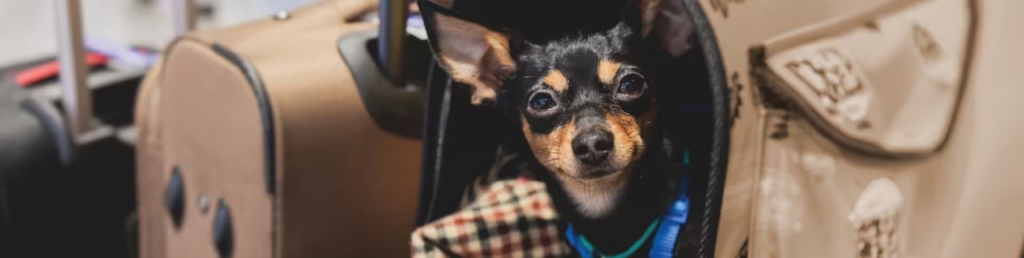
The service is limited to Etihad-operated flights and is subject to destination regulations regarding the transport of animals. Travellers are responsible for securing the necessary health certificates, vaccinations and import permits, which can vary significantly by country.
Falcons on board policy follows regional tradition
Etihad also allows passengers to travel with falcons, a long-established practice among Middle Eastern carriers, with a proud heritage rooted in a 9,000-year-old Bedouin tradition. Falcons are widely accepted on aircraft in the region—even on airlines that do not allow cats or dogs in the cabin—in keeping with their value and social status.
Etihad permits falcons in the cabin free of charge, as part of a passenger’s baggage allowance, provided they are properly hooded and secured. Alternatively, falcons can travel as checked baggage in the hold for an additional fee.
The number of falcons allowed depends on how many seats are booked, with one falcon allowed per seat in Economy. There is greater flexibility in premium cabins when extra space is purchased, with business class allowing passengers to travel with two falcons or three with an extra seat. First class passengers are permitted two falcons each.
Unlike cats and dogs, falcons are not subject to the same carrier restrictions, but they must still comply with handling and documentation requirements, including permits where required by destination authorities.
Service animals take precedence over pets
Etihad applies a separate framework for trained service animals, with stricter standards and higher priority in the cabin.
Certified service dogs can travel free of charge and are not required to remain in a carrier. Instead, they must be harnessed or leashed and positioned at the passenger’s feet, without obstructing aisles or emergency access.
Service animals must be trained by internationally recognised organisations, such as Assistance Dogs International or the International Guide Dog Federation. The passenger must provide documentation confirming the animal’s training and health status.
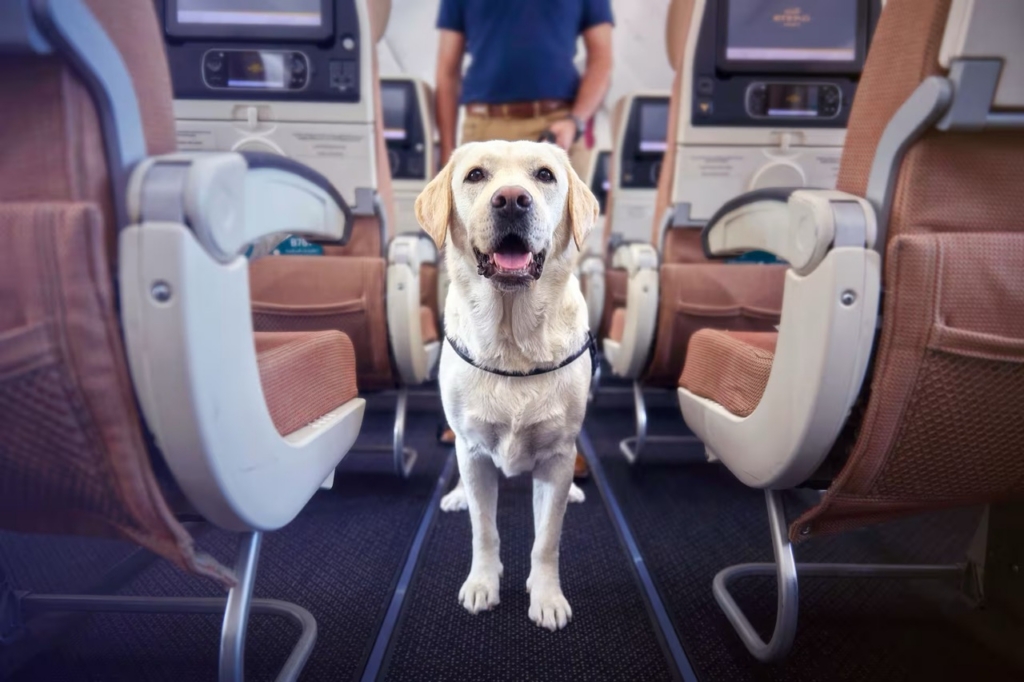
The airline does not categorise emotional support animals as service animals—they are considered pets and subject to the same fees and restrictions.
Service animals have priority over pets. This can affect seating arrangements and the availability of the Pets Onboard service. If the number of animals in the cabin would exceed the airline’s set limits for a single flight, Etihad will permit a service animal to board and deny boarding to a pet to comply with its accessibility requirements.
Airlines adopt pet-friendly policies to please passengers
Many US airlines allow passengers to fly with their pets in the cabin, and other global airlines are reviewing their pet policies, particularly after a surge in pet ownership in recent years.
Etihad’s unique “pet fare sale” is an innovative push to raise awareness of its pet-friendly policy.
Featured Image: Etihad Airways