Unlock the Editor’s Digest for free
Roula Khalaf, Editor of the FT, selects her favourite stories in this weekly newsletter.
Rising tensions between the US and Europe, on show in Davos, have lit a fuse under customary fear trades such as gold and silver, which were already doing roaring business as inflation hedges. Developed markets, including the S&P 500, have also stumbled. Emerging markets, however, are on a roll. That suggests that some investors, at least, believe that the US will manage to navigate the dramas of its own making without crashing the global economy.
MSCI’s emerging market index has sprinted out of the gate, adding almost 6 per cent so far this year and reaching record highs. This follows on from a hot 2025: last year was the first in eight that emerging market stocks outperformed the US, with the MSCI EM benchmark gaining 31 per cent, against 16 per cent for the S&P 500.
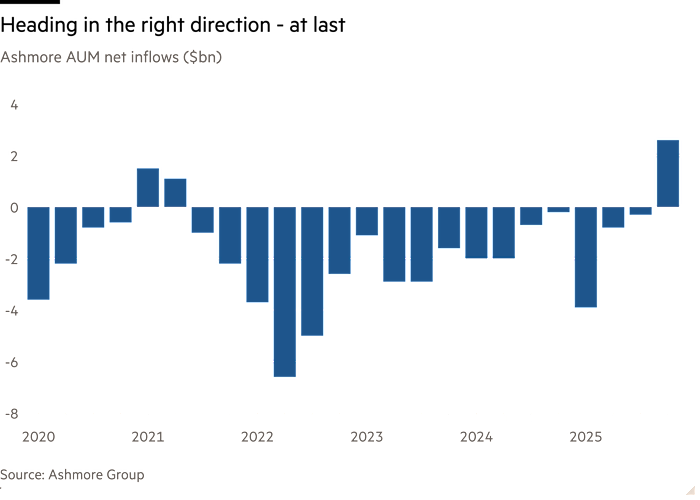
True, not all of this reflects a sanguine view of US prospects. Emerging markets have been gaining favour partly as an alternative to US assets. Amid high equity valuations, investors are seeking to diversify their concentrated exposure to the world’s largest economy. Emerging market specialist Ashmore last week reported the first quarterly net inflow into its funds in more than four years and pointed to investor jitters over the US.
But it is still largely expectations for the world’s largest economy that make the weather for markets such as South Korea, Taiwan and Chile. Economic growth in the US tends to translate into demand for exporting economies — and stock market rallies for local suppliers. US tech giants’ huge investments in AI, for instance, have boosted Asian chipmakers such as TSMC and Samsung.
Emerging market investors are essentially betting that the US economy will continue to grow at a decent clip, supporting growth elsewhere, and that inflation will be contained, though remaining above its 2 per cent target. That boosts export prices — tariffs aside — and lifts commodities, upon which many emerging markets depend heavily. Central banks, led by the Federal Reserve, are generally on an easing path, adding to hopes for growth. US financial conditions are at their loosest in four years, according to the Chicago Federal Reserve.

Stocks around the world suffered this week as Donald Trump increased the pressure over his plans for the US to take control of Greenland, but emerging market indices suffered less than their developed market cousins. This trade, which involves thinking through the repercussions that geopolitical swings might have on companies and cash flows, is anchored to the real world in a way that precious metals are not.
The emerging market index, on 13 times forward earnings, may look expensive relative to historical levels, but at least there is something for investors to judge its price by unlike, say, gold or silver where conventional valuation is less useful. While there may be some hesitation on piling afresh into US assets, the confidence in emerging markets suggests that investors are not actually panicking — yet.