On Feb. 9, Gasgoo noted that Elon Musk on X addressing the possibility of Tesla reaching a $100 trillion market capitalization. “Obviously, achieving such a result would take immense effort and a lot of luck,” Musk wrote. “I just want to say, it’s not entirely impossible.”
Tesla currently sits at roughly $1.5 trillion. Hitting the $100 trillion target implies a 65-fold surge. For context, the world’s ten most valuable companies—including tech giants like Nvidia, Apple, Microsoft, and Amazon—have a combined market cap of only about $26 trillion.
Tesla would need to swell to nearly four times the size of the entire industry combined.
Beyond Auto Manufacturing: Musk’s Ecosystem Vision
The $100 trillion target Musk has set for Tesla is far more than a story about selling more cars.
Behind it lies a grand blueprint to transform Tesla from an automaker into a technology ecosystem integrating artificial intelligence, robotics, energy, and manufacturing.
Tesla’s current business footprint already extends well beyond traditional automotive boundaries.
Wedbush analyst Dan Ives released the latest report on Tesla (TSLA.US):
Tesla’s robotaxis are expected to launch in over 30 U.S. cities by 2026. We estimate that AI and autonomous driving alone represent at least a $1 trillion market opportunity for the company. Moreover, these key initiatives will accelerate over the next 3 to 6 months. The reason is that federal regulatory headwinds Musk and his team have faced in Full Self-Driving (FSD) and autonomous driving over the past few years are set to ease. This shift is expected under a Trump administration. We expect the federal government to relax the autonomous driving regulatory framework by early 2026. This involves using executive orders to grant federal regulators more authority while weakening states’ say in rule-making.
As the roadmap for autonomous driving and robotics moves into full-scale production, we see Tesla’s market cap potentially breaking through $2 trillion within the next year. It could reach $3 trillion by the end of 2026 in an optimistic scenario… For the next 12 to 18 months, our bullish price target for Tesla stands at $800.
The robotics business is equally compelling. Authoritative estimates value the humanoid robot market between $5 trillion and $7 trillion.
Musk has said he is currently dedicating more effort to humanoid robots than any other single project. “We have to solve all the challenges of real-world AI, electromechanical engineering, and supply chain production. The supply chain for humanoid robots basically doesn’t exist yet,” he noted. “We have to start from zero and do massive vertical integration. Not a single actuator in the Tesla humanoid robot can be sourced from the existing supply chain. But I believe that if we succeed, the Tesla humanoid robot will be the greatest product in history.”
Additionally, Tesla’s energy storage business is growing steadily.
Beyond Tesla itself, the synergy across Musk’s empire is seen as a key driver for valuation growth. Cathie Wood argues that the convergence of Musk’s companies creates unique advantages. She points out that Tesla holds proprietary data from the roads, Neuralink provides biological data, and X offers real-time human conversation data. Combined, these datasets could create AI capabilities no one else can match.
“I think the market cap will eventually reach $100 trillion,” Wood said. “I think this will happen because technological convergence is driving the process. I see Tesla as the frontrunner.”
A Cautious Consensus in a Year Packed with Catalysts
Tesla’s valuation has become one of the most contentious topics in capital markets.
Yang Chuan, a distinguished research fellow at the Shanghai Financial and Development Laboratory, notes that Musk views 2026 as a “singularity year.” He predicts that five fields—AI, robotics, brain-computer interfaces, and aerospace—will hit their tipping points simultaneously. They will reinforce one another, with AI successively displacing both white-collar and blue-collar jobs.
Under this narrative, Tesla’s valuation has morphed into one of the most complex and controversial issues in the market. Its market cap reflects not just its status as an EV leader, but also a “long-term dream premium” for FSD, Optimus robots, energy solutions, and broader AI applications. Especially when variables like a potential SpaceX merger, space-based computing centers, and a Tesla phone acting as a new mobile terminal integrated with autonomous vehicles are factored in, the picture changes. Traditional static valuation models fail to capture the ecosystem’s true value.
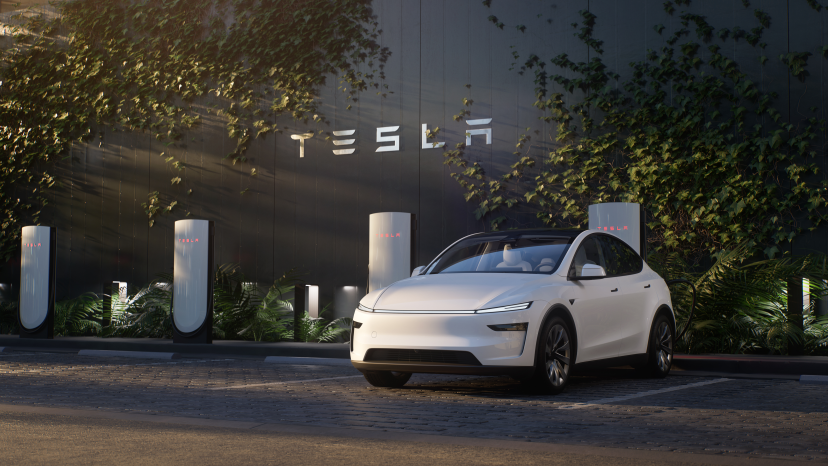
Image Source: Tesla
While Wolfe Research defines 2026 as a “catalyst-rich year” for Tesla, it optimistically predicts its robotaxi business could generate $250 billion in revenue by 2035. This would support an equity value as high as $2.75 trillion. However, it also lowered its earnings-per-share estimates for 2026 and 2027. Even those revised figures remain below market consensus.
This “tactically optimistic, strategically cautious” stance encapsulates the current split on Wall Street.
Market caution stems from cold, hard realities. On one hand, Tesla is aggressively “pivoting from virtual to real.” It is halting production of low-margin Model S/X models and focusing entirely on Optimus robots and the CyberCab. On the other, its core auto business is under immense pressure: revenue is slipping, profits have been halved, and gross margins are being eclipsed by Chinese competitors.
Institutional investors know that before dreams turn into cash, the only way to sustain a high valuation is to feed market expectations with milestone progress. Consequently, all eyes are on 2026: the start of Optimus mass production, the CyberCab launch, and the unsupervised expansion of FSD. Any delay in these could become the pin that pricks the bubble.
The conclusion is that Tesla’s market cap game has evolved from financial forecasting into a bet on belief in the future. Traditional valuation models fail here because they cannot calculate the option value of “changing the world.”
Yet, this new analytical framework also issues a stern warning: the current stock price has already priced in the full expectation of significant success. If the pace of technological advancement or commercialization lags behind expectations, the foundations of this trillion-dollar tower—built on dreams—will face a severe test.
Musk’s $100 trillion target is, at this fragile equilibrium point, once again pushing the market’s lever of belief.