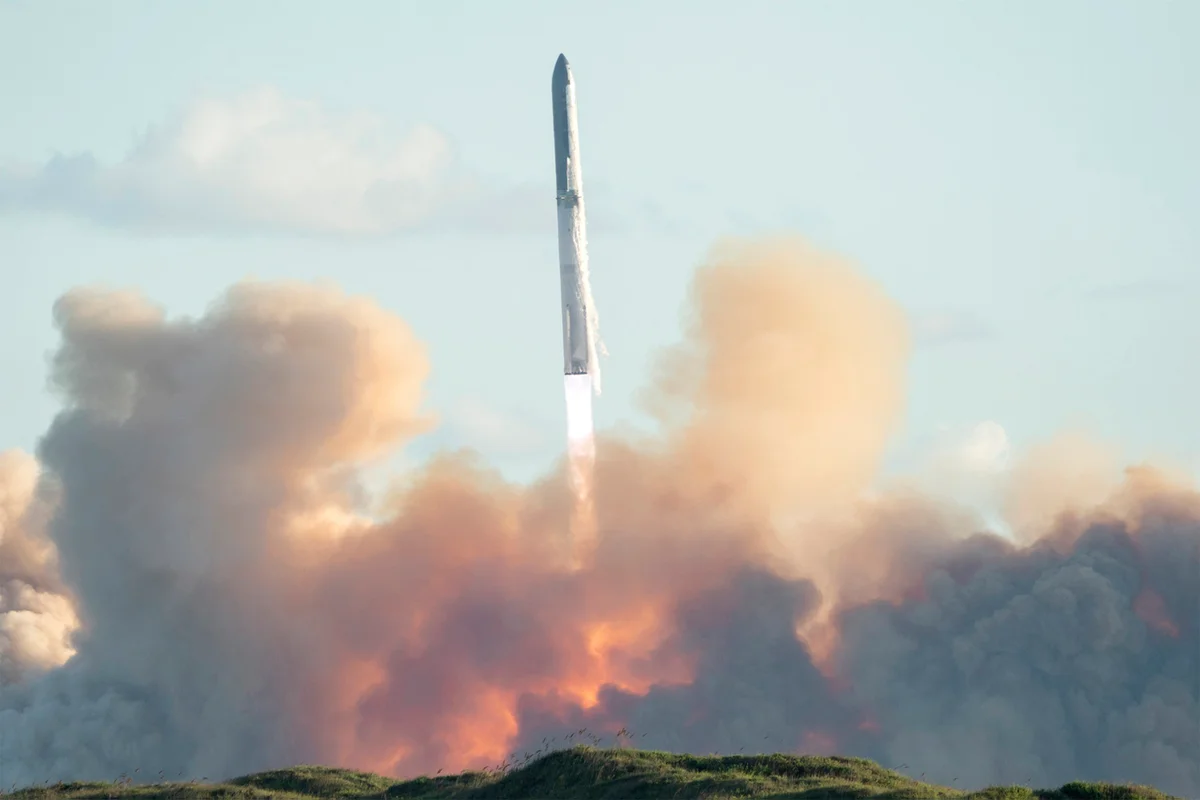

Elon Musk says SpaceX will prioritize a city on the moon instead of a colony on Mars
SpaceX’s decision to focus on establishing a lunar city ahead of building a Mars colony represents a significant shift in Elon Musk’s space exploration ambitions
Gabriel V. Cardenas/AFP via Getty Images
On Sunday Elon Musk said that SpaceX is prioritizing the establishment of a “self-growing city” on the moon over and above his long stated ambition to settle Mars.
In a post on his social media platform X, Musk wrote that a lunar city could be built within the next decade. “The mission of SpaceX remains the same: extend consciousness and life as we know it to the stars,” Musk wrote.
The pivot signals a shift in focus for SpaceX, which Musk has long claimed will help establish human civilization on Mars using the company’s still in development megarocket Starship. This is far from the first time Musk has changed SpaceX’s time line for a Mars mission—in 2016, for instance, he suggested a landing could be achieved by 2018, and he later pushed a potential touchdown to 2022.
On supporting science journalism
If you’re enjoying this article, consider supporting our award-winning journalism by subscribing. By purchasing a subscription you are helping to ensure the future of impactful stories about the discoveries and ideas shaping our world today.
Then Musk tweaked the timing again, indicating in 2025 that the company was aiming to launch five uncrewed Starships to Mars this year and that they would be loaded with robots made by his car company Tesla. Importantly, 2026 was considered optimal because where Earth and Mars would be in their respective orbits would cut the journey time to approximately six months. Such ideal alignments occur like clockwork every two years, setting a natural cadence for new Mars missions.
But development of Starship has proved more troublesome than Musk projected, with the rocket experiencing catastrophic failures across multiple test flights in recent years. Additionally, SpaceX is on the hook for a Starship-based crewed lunar landing as the linchpin of NASA’s Artemis III mission, which is meant to be the first human foray back to the moon since 1972. Starship’s ongoing woes are now a key driver of delays for the launch of Artemis III, which NASA recently announced has slipped to no earlier than 2028.
Other factors that have potentially driven SpaceX’s shift are its merger with Musk’s artificial intelligence start-up xAI and a planned push to launch a million orbital data centers. In a February 2 blog post, Musk wrote that the latter project, combined with Starship, could eventually lead to manufacturing and launching satellites from the lunar surface.
In his X post on Sunday, Musk said that SpaceX would resume working toward Mars in the next five to seven years. But he pointed out that establishing a base on the moon would be more efficient.
“The overriding priority is securing the future of civilization and the Moon is faster,” he wrote.
It’s Time to Stand Up for Science
If you enjoyed this article, I’d like to ask for your support. Scientific American has served as an advocate for science and industry for 180 years, and right now may be the most critical moment in that two-century history.
I’ve been a Scientific American subscriber since I was 12 years old, and it helped shape the way I look at the world. SciAm always educates and delights me, and inspires a sense of awe for our vast, beautiful universe. I hope it does that for you, too.
If you subscribe to Scientific American, you help ensure that our coverage is centered on meaningful research and discovery; that we have the resources to report on the decisions that threaten labs across the U.S.; and that we support both budding and working scientists at a time when the value of science itself too often goes unrecognized.
In return, you get essential news, captivating podcasts, brilliant infographics, can’t-miss newsletters, must-watch videos, challenging games, and the science world’s best writing and reporting. You can even gift someone a subscription.
There has never been a more important time for us to stand up and show why science matters. I hope you’ll support us in that mission.