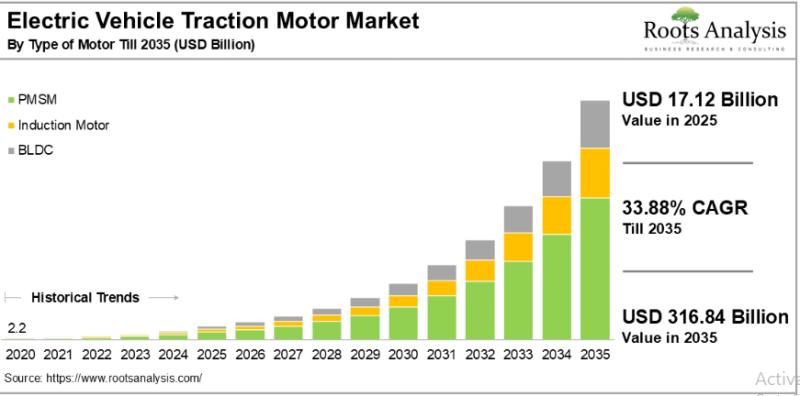
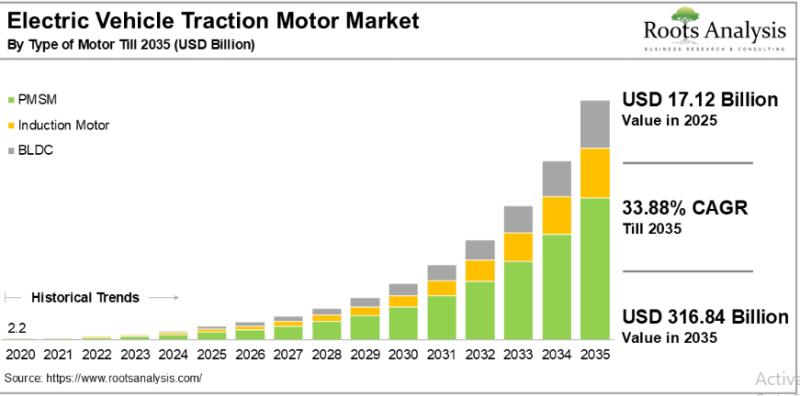
The global electric vehicle traction motor market, valued at $11.3 billion in 2024, is on track to reach $17.12 billion in 2025 and $316.84 billion by 2035, expanding at a compound annual growth rate of 33.88% over the forecast period. This exceptional growth trajectory reflects accelerating EV adoption worldwide, tightening emissions standards across major economies, and deepening investment in powertrain electrification from both established automakers and emerging players.
To explore the complete findings, request a free sample of the report at https://www.rootsanalysis.com/electric-vehicle-traction-motor-market/request-sample
Market Overview
An electric vehicle traction motor is the core propulsion component that converts electrical energy into mechanical torque, driving the wheels or axles of a vehicle. Unlike internal combustion engines, traction motors deliver maximum torque instantly from a standstill, enabling smoother acceleration and greater energy efficiency. They are significantly more compact and lightweight, attributes that have made them central to the modern EV powertrain design philosophy.
The market is expanding on the back of a convergence of structural forces: government mandates phasing out fossil-fuel vehicles, rising consumer demand for cleaner mobility, and rapid improvements in battery and motor technology that have collectively made electric vehicles more practical and cost-competitive. Investments in charging infrastructure are further reducing buyer hesitation, closing one of the last remaining gaps in the EV ownership experience.
Recent industry developments underscore the pace of activity. In October 2024, Nidec Motor Corporation and Ashok Leyland announced a partnership to accelerate electrification of commercial vehicles in India, with Nidec supplying its E-Drive motor-controller systems to support Ashok Leyland’s vehicle programs. Toyota unveiled its Urban Cruiser EV in December 2024, scheduled for a mid-2025 launch, while JSW MG Motor introduced the Cyberster electric sports car in the Indian market the same month, signaling growing OEM confidence in consumer EV demand.
Key Growth Drivers
Regulatory pressure on automakers. Stricter emissions regulations across North America, Europe, and Asia are compelling manufacturers to accelerate the shift from internal combustion engines to electric drivetrains. Governments are reinforcing these mandates with tax breaks, purchase subsidies, and fleet electrification targets, creating both a compliance imperative and a commercial incentive for traction motor adoption.
Battery technology improvements. Advances in battery energy density, charging speed, and cycle life have directly extended EV range and reduced downtime, which in turn raises demand for high-efficiency traction motors capable of making the most of available stored energy. Permanent magnet motors in particular benefit from this trend, as their low electrical losses and high torque density align well with next-generation battery systems.
Expansion of EV manufacturing capacity. Large-scale investment in EV production facilities globally is generating parallel demand for traction motor supply chains. As OEMs scale output, component manufacturers are investing in R&D to produce more effective, lower-cost motor solutions, driving down per-unit costs and broadening the addressable market.
Growth of two-wheeler and light-vehicle electrification. Beyond passenger cars, the rapid adoption of electric scooters, mopeds, and light commercial vehicles is creating a high-volume market for sub-100 kW traction motors. Favorable government policies and urban mobility trends are fueling this segment, particularly across Asia.
Infrastructure investment reducing range anxiety. Expanding public and private charging networks are removing one of the biggest psychological barriers to EV ownership. As consumers grow more confident about charging access, EV sales volumes rise, which feeds directly into traction motor demand volumes.
Market Segmentation
By vehicle type, battery electric vehicles (BEVs) dominate the electric vehicle traction motor market, holding a projected share of more than 74.56% through 2035. The global clean energy push and the elimination of internal combustion engines in BEV architectures make them the primary driver of traction motor volume. By motor type, permanent magnet synchronous motors (PMSMs) command approximately 67.98% of the market, favored for their high overload capability, efficiency, compact form factor, and low maintenance requirements. High torque at low speeds and efficient heat dissipation make PMSMs the preferred choice for premium and mid-range EV platforms alike.
On the power output dimension, the less than 100 kW segment holds the largest share at 64.6%, reflecting the massive global base of electric two-wheelers, urban passenger vehicles, and light commercial units that operate effectively within this power range. The market also covers segments from 100 kW to 250 kW and above 250 kW, catering to mid-range sedans, SUVs, and heavy commercial EVs respectively. By enterprise type, both large manufacturers and small-to-medium enterprises are active, with large players leading on scale and SMEs contributing niche innovation, particularly in motor control and efficiency optimization.
To request quote of this report, please visit: https://www.rootsanalysis.com/electric-vehicle-traction-motor-market/request-quote
Regional Insights
Asia currently leads the global electric vehicle traction motor market with a 34.19% share, driven by the sheer scale of EV adoption in China, Japan, and South Korea. All three countries have implemented substantial subsidy programs, tax incentives, and regulatory mandates that accelerate both consumer EV purchases and domestic motor manufacturing. China, the world’s largest EV market by volume, is the single largest contributor to regional demand. Cost reductions in EV components across the region are further feeding growth as local manufacturers scale aggressively.
Europe and North America represent significant secondary markets, with European nations advancing through binding CO2 fleet targets and national EV sales mandates. The United States continues to see federal and state-level incentives stimulating consumer demand, while investment in domestic battery and motor production has increased under recent industrial policy programs. Latin America and the Middle East and North Africa are emerging markets where EV infrastructure is still developing, but government interest in fleet electrification and favorable cost trajectories position them as meaningful growth opportunities through 2035.
Competitive Landscape
The electric vehicle traction motor market includes a broad set of established industrial players and dedicated EV powertrain specialists. Key manufacturers profiled in the report include ABB, AB SKF, BorgWarner, Bharat Heavy Electricals, Continental, DENSO, Emerson Electric, General Electric, GKN Automotive, Hitachi, Hyundai Mobis, Jing-Jin Electric Technologies, Mahindra Electric Mobility, Magnetic Systems Technology, Mitsubishi Electric, Nidec, Parker-Hannifin, Regal Beloit, Robert Bosch, Siemens, TM4, Turntide, Valeo, WEG, YASA, ZF Friedrichshafen, and Zytek.
The market is competitive across multiple fronts. Established players are securing share through strategic partnerships, acquisitions, and joint ventures, while simultaneously investing in proprietary R&D to differentiate on efficiency, thermal management, and power density. Geographic expansion into high-growth markets, especially India and Southeast Asia, is a key battleground as OEM supply contracts in these regions become increasingly valuable. Startups focused on advanced motor control and novel materials are attracting investor attention, adding pressure on incumbents to accelerate their own innovation cycles.
Browse Full Report Description + Research Methodology + Table of Content + Infographics here:
https://www.rootsanalysis.com/electric-vehicle-traction-motor-market
Contact Details for Roots Analysis
Chief Executive: Gaurav Chaudhary
Email: Gaurav.chaudhary@rootsanalysis.com
Website: https://www.rootsanalysis.com/
About Roots Analysis
Roots Analysis is a global leader in the market research. Having worked with over 750 clients worldwide, including Fortune 500 companies, start-ups, academia, venture capitalists and strategic investors for more than a decade, we offer a highly analytical / data-driven perspective to a network of over 450,000 senior industry stakeholders looking for credible market insights. All reports provided by us are structured in a way that enables the reader to develop a thorough perspective on the given subject. Apart from writing reports on identified areas, we provide bespoke research / consulting services dedicated to serve our clients in the best possible way.
This release was published on openPR.