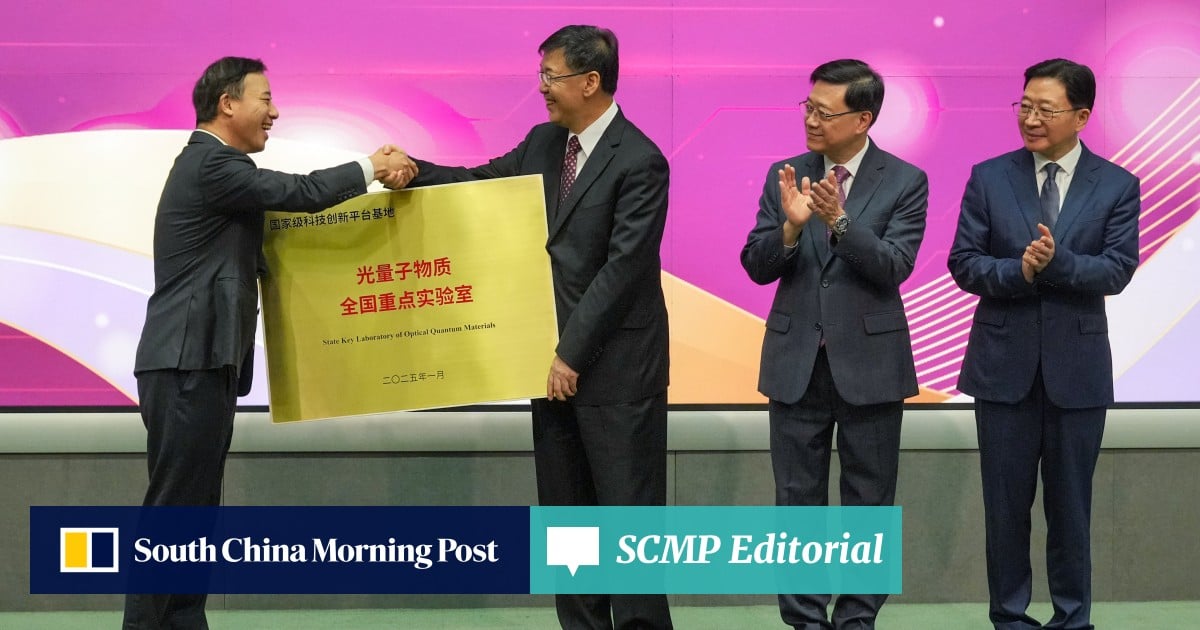
Hong Kong does not lack scientific talent and has long excelled in academic research. But its market has been too small to grow its own tech industries. However, as China emerges as a science powerhouse, the city now has a chance to raise its game and join the big league. Fifteen facilities in Hong Kong have been designated as state key laboratories, an institutional restructuring initiated in 2023 that will help them partner with leading mainland labs and industry giants.
At a launch ceremony, top local and mainland officials called on the city to ramp up research and innovation to boost its ambitions in becoming a tech hub and a “superconnector” linking China with the rest of the tech world. That is both a gift and a challenge.
The key labs, three of which were newly established, are mostly operated by the city’s top universities, which are in a unique position to provide leading research by the best and brightest local talent.
The University of Hong Kong this year climbed to 11th place in the QS World University Rankings 2026, its highest ranking so far. Chinese University rose to 32nd, also its best position since rankings began in 2010, while the Hong Kong University of Science and Technology moved up to 44th.
In the past, cross-border collaboration was ad hoc. For example, engineers at Polytechnic University helped design and build precision tools for a moon mission under the nation’s space programme. But a more systematic approach is needed for even the best research to find commercial and industrial applications.
That is what the national system of designated key state labs has been set up to achieve since it was restructured on the mainland in 2018. It now plays a key role in the nation’s drive to become a pre-eminent global leader in science and technology by 2035.
Visited 1 times, 1 visit(s) today