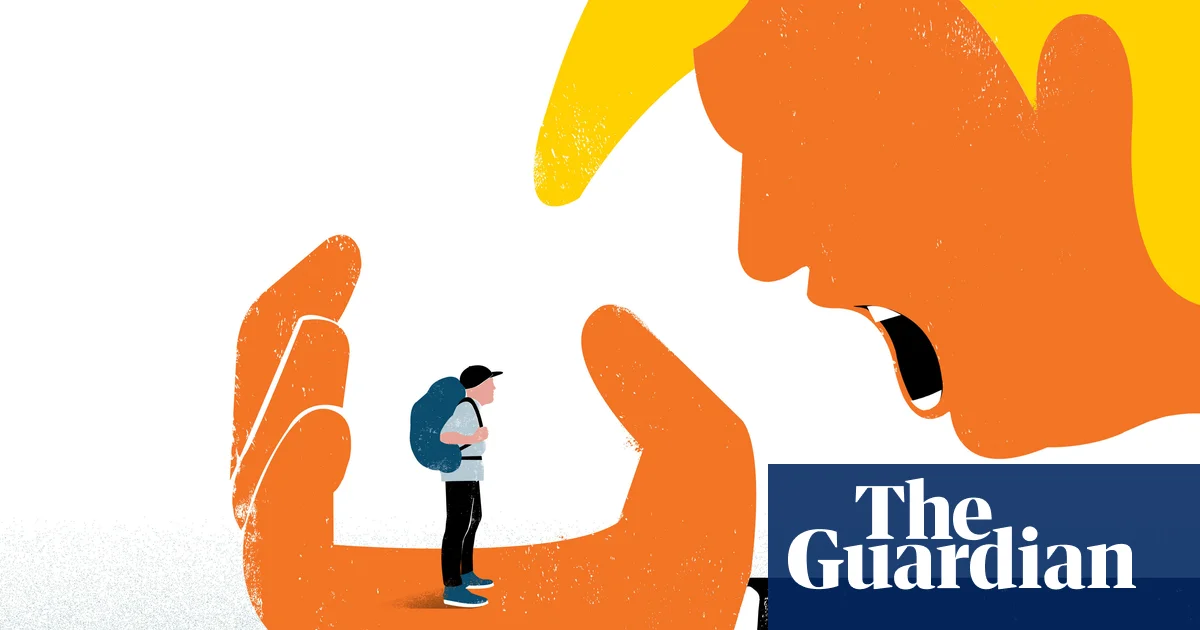
When Karen Newton left home in late July 2025, she knew that international travellers were being locked up in immigration detention centres in the US. “I was aware,” she nods. “But I never thought it would have any impact on my holiday.” Karen, 65, had a British passport and a tourist visa. She hadn’t been abroad for eight years, and was keen for some guaranteed sun. “I really just wanted to get away from the house.”
She and her husband, Bill, 66, had an ambitious itinerary that would take them through California, Nevada, Wyoming, Montana and then on to Canada over two months. Las Vegas wasn’t to Karen’s taste: “Way too commercialised.” She much preferred Yellowstone, where they saw Old Faithful, the famous geyser, as it shot boiling water into the air, and got up close with some extraordinary wildlife. “There was a bison right next to the car. Another time, a wolf walked past.” Her eyes sparkle at the memory. “It was just amazing.”
The dream holiday ended abruptly on Friday 26 September, as Karen and Bill were trying to leave the US. When they crossed the border, Canadian officials told them they didn’t have the correct paperwork to bring the car with them. They were turned back to Montana on the American side – and to US border control officials. Bill’s US visa had expired; Karen’s had not.
“I worried then,” she says. “I was worried for him. I thought, well, at least I am here to support him.”
She didn’t know it at the time, but it was the beginning of an ordeal that would see Karen handcuffed, shackled and sleeping on the floor of a locked cell, before being driven for 12 hours through the night to an Immigration and Customs Enforcement (ICE) detention centre. Karen was incarcerated for a total of six weeks – even though she had been travelling with a valid visa.
Karen has no criminal record. She is a grandmother who spent eight years working as an admin assistant at a primary school before her retirement. “I don’t even have parking tickets in the background anywhere,” she says. “I am not a dangerous criminal. I didn’t enter the country illegally and I had everything I needed to be there.”
So why did ICE detain her, and keep her locked up for so long? A possible answer began to emerge over the weeks she was incarcerated. As Karen got to know the guards at the Northwest ICE Processing Center where she was held, she kept hearing the same thing from them: that ICE officers are paid a bonus every time they detain someone. “Individual ICE agents get money per head that they detain – the guards told me that,” Karen says.
It’s no secret that the Trump administration has been pouring money into ICE. Its annual budget – $6bn a decade ago – is now $85bn; ICE is now the highest -funded law enforcement agency in the US. Since last August, new recruits can expect to receive a signing-on bonus of up to $50,000. Karen’s experience has left her convinced that ICE agents are being given even more incentives – to arrest and detain anyone they possibly can, even blameless tourists who have all the paperwork they need to be in the US.
Within days of Donald Trump’s second inauguration on 20 January 2025, his administration ordered ICE officials to detain more people, with new quotas that would increase the total number of arrests from a few hundred to 1,200-1,500 a day. Reports immediately began to emerge of international travellers being detained by ICE officers.
On 25 January, German tourist Jessica Brösche was stopped by ICE and held for 45 days (including eight days of solitary confinement). Early in February, Germans Lucas Sielaff and Fabian Schmidt were also detained. In late February, the British backpacker Rebecca Burke was incarcerated for 19 days in the same ICE facility where Karen would later spend six weeks. (Like Karen, Burke had been trying to leave the US when she was detained.) Canadian actor Jasmine Mooney was held in an ICE detention centre for two weeks in March. In July, New Zealander Sarah Shaw and her six-year-old son were detained for three weeks.
These stories may be the tip of the iceberg: we only know about them because they involve people who were prepared to talk publicly about being seized by ICE. They are generally young people who were held on suspicion of being in the US to work without the correct visa. That’s why, when Karen heard some of their stories before she left the UK, she assumed their experiences had no relevance to her: she was a retired person taking a holiday. In the end, Karen was detained for longer than almost every one of them.
I meet Karen in her home, on a quiet road in Hertfordshire. She sits in the corner of her sofa, next to a magnifying light and a trolley that holds a sewing box, thread and everything else she needs for her cross stitch. The walls of her home are adorned with frames containing her embroidery. The first thing you see when you come through the front door is a framed 9,000-piece puzzle of the Tower of Babel that took her two years to finish. “I don’t like staying away from home for a long time,” she tells me, over tea and Jammie Dodgers biscuits.
When they were turned back from Canada, and US border control agents saw that Bill’s visa had expired, Karen fully expected to be allowed to return home. The Newtons immediately offered to pay for their flights – they had funds available to cover the tickets – but the officials “weren’t interested”, she says. Instead, they were taken into an office and made to wait there, from 10.30am until nightfall.
At first, Karen was bewildered. “There was no reason to hold me,” she says. “Bill’s an adult. Why am I held responsible for him?” When she asked why she was being detained, an officer told her his supervisor had instructed him to hold her. The hours ticked by. “It was scary. You have no way of knowing what’s going to happen. It got darker and darker. And then other agents turned up with all these chains and handcuffs.”
Karen and Bill were shackled at the wrists , waist and ankles and bundled into a vehicle. Karen doesn’t know how long they were on the road for. “It just seemed to be a never-ending day.” They arrived at Sweetgrass border patrol station in Montana in the middle of the night, and were held there for three days, sharing a cell without beds; they slept on mats on the floor, under foil blankets. “I was very nervous and frightened the whole time. And I was chilled to the bone – I couldn’t warm up.”
They were interviewed separately. Karen was not offered a lawyer; she wasn’t entitled to one, she says, because she had been detained, rather than arrested. She didn’t think she needed one, anyway. “I just thought, ‘When they listen to me, when they come to their senses, they are going to let me go.’ I thought they might escort me to the airport and put us on a plane – hopefully both of us. But that didn’t happen.”
Bill had been working in the US with a valid work permit, but did not have a green card – fed up with the appeals process, he had decided to leave and retire back in the UK. Karen was told that she was “guilty by association”, and that she had broken the terms of her valid B2 tourist visa by helping her husband pack for the trip. “It just went from crazy to ridiculous. It felt like they just wanted an excuse to detain me.”
There was a way to make things easier, the agent said: Bill and Karen could volunteer for self-removal. Last May, the White House announced Project Homecoming, a scheme whereby so-called “illegal aliens” could opt for self-deportation. Anyone who agrees to it gets their flight home paid by the US government, as well as an “exit bonus” payment of $1,000. (The Department of Homeland Security announced on 21 January 2026 that the bonus had increased to $2,600 to “celebrate one year of Trump”.) Project Homecoming was funded by repurposing $250m previously intended to be spent on refugee aid.
“He said, ‘If you volunteer for self-removal – and because of the special relationship the US has with the UK – it will be over very quickly,’” Karen continues. They’d have to sign a document that would mean they would be banned from the US for up to 10 years, and waive their right to go before a judge. If they chose not to, and waited for their day in court, they would be prolonging the ordeal, she was told.
“I said to him, ‘I’m on holiday. I want to go home.’ I would have taken the shortest route, whatever it was, which he said was volunteering for self-removal.” So they signed. Karen had no way of knowing that she was only on day three of what would turn out to be 42 days of detention.
The Newtons were transferred in shackles once again. A border control SUV drove them from Sweetgrass to Spokane, in Washington state, where they waited for an hour before being put on what Karen calls a “prison van”, and taken to the Northwest ICE Processing Center in Tacoma.
“It’s called a detention facility, but it’s really a prison,” she says. “Locking doors, guards everywhere, cells, everything clamped to the floor – it’s how I imagine a prison to be. Prison would actually be better, because if you’re in prison, you get a sentence – they tell you how long you are going to be there.”
Karen was given a grey sweatshirt and jogging bottoms to wear and issued with an ID card and wristband. She didn’t allow herself to be afraid. “I didn’t want to give it headspace. I was just in disbelief, incredulous that this could happen.”
In the early hours of the morning, she was separated from Bill, and taken to the women’s unit: a vast room filled with bunk beds and metal picnic tables. The guard on duty asked if she was able to climb a ladder to get on a top bunk; Karen said she wasn’t. “I can’t do heights. And I am in my 60s – it’s not something I wanted to do.” The guard told Karen sharply that she was fed up with “this crap”. She led Karen to a cell on the mezzanine level, where an inmate was occupying the lower bunk. “The guard said, ‘Your choice is either the top bunk or the floor.’ So I set myself up on the floor. That’s where I stayed for the next month.”
Karen had pain in her hips and back from sleeping on a thin mattress on the floor, and constipation because she was afraid of going to the toilet in a place where anyone could watch her. Her cellmate, Maria, spoke no English, but they got along; Maria was an older woman, and Karen felt safe with her. After a month, Maria asked to be transferred to a cell on the ground floor because her knees couldn’t handle the stairs up to the mezzanine level, so Karen eventually took over the bottom bunk.
Time passed slowly at Tacoma, but Karen says she lost all sense of it. From her cell, she was unable to see the one small clock affixed above the guard’s desk in the main hall. The unit had no windows, and the lights were always on, so it was difficult to tell night from day. Once, Karen woke up and went to make herself a cup of tea. She sat at one of the metal tables to drink it, and one of the other inmates asked her if she was having trouble sleeping. “I said, ‘I slept all right.’ And she smiled and said, ‘What time of day do you think it is?’” The clock on the wall said 11.30; Karen had assumed it was 11.30 in the morning. “I thought I’d had a night’s sleep, and I hadn’t. I must’ve been in bed for three hours.”
Karen tried to keep herself busy with the jigsaw puzzles and books that were left out for inmates. She kept to herself much of the time; most of the other women didn’t speak English anyway. But those who did shared traumatic stories of being separated from their young children, and agonising details of delays in their legal fight to stay in the country. Some had been living in the US for decades, building lives and families. A few of them had been detained for more than a year. “People think it is just criminals that are being deported, but they’re just a lot of people who went there for a better life. Is that really criminal?”
While the Northwest Detention Center is an ICE facility, it is run by GEO, a private company. Aside from her experience with the first guard who took her to her cell, Karen says the staff were “nice enough” to her. None of them could understand why she was there. “One of them said to me, ‘You need to find a pro bono lawyer and sue.’” Another guard turned out to be British. “I had several conversations with her. She said, ‘I can understand them holding your husband, but I don’t understand why they would hold you.’”
It was during these conversations that Karen was told repeatedly that ICE agents are paid a bonus every time they detain someone. “I was told this by multiple sources,” she says. “There is all the incentive in the world to find a reason – any reason – not to let someone go.”
When I contacted ICE to ask if they could confirm or deny whether individual officers are paid a bonus for every person they detain, a spokesperson said, “Bonuses for ICE officers are not based on arrest or detention numbers. Pay and bonuses for ICE officers are administered in accordance with office of personnel management policy. ICE officers risk their own safety day in and day out because they took an oath to enforce the nation’s immigration laws, not to make large sums of money.”
After a couple of weeks, one of the guards asked Karen when she was going to see her husband. Until then, she’d had no idea that she was entitled to. The guard told her she needed to apply for permission. At first her application was turned down, but she eventually did get to see Bill. “It was bittersweet. It was nice to see he was OK, but in a way, I wished …” Her voice trails off. “It brought it home more. It was a slap in the face. You’re in a prison, and now you’re going to have to go back to your unit.”
Karen had messaged their son, Scott, when they were initially held at the border. “We have been unavoidably detained,” she’d texted, “I will let you know when I am home.” But her phone was soon taken away from her. It was several weeks before she rang him from the detention centre. Why did it take her so long? “It was humiliating.” Her eyes fall. “I was ashamed to be locked up.”
When she finally called Scott, he was angry with her for not having rung sooner: he had been worrying ever since the first day. He had already contacted the UK Foreign Office, who eventually told him there was no way his parents could be released while the federal government shutdown was ongoing; it ran from 1 October to 12 November. Karen knew this couldn’t be true: she saw people leaving the detention centre every day. (In fact, ICE deported 56,000 people during the 43 days of shutdown, when most government business was halted.)
Both Karen and Bill separately tried to contact the British consulate. After weeks of effort, Karen managed to speak to someone, but the consular official told her they couldn’t interfere. “She said she’d look into it, but we never heard from her again. They were absolutely terrible.” Every week, ICE agents would visit the unit to update inmates about any developments on their cases, and tell them when they were going to leave the detention centre. “Their stock answer was ‘two weeks’ or ‘soon’.” One week, ICE didn’t turn up at all.
Karen began to feel hopeless. “I was talking to others and thinking, ‘Maybe I should have gone the route of asking to see a judge?’ I was thinking, ‘Did I do the wrong thing?’”
And then, out of the blue on Thursday 6 November, when the guards were doing a headcount and the inmates were supposed to be locked in their cells, Karen’s door suddenly opened. “I thought it was some sort of glitch.” She peeked out of her cell and saw a guard, who informed her that she was being released, and handed her a bag for her to return her used bedding. She was taken away from the unit to the “intake” area of the detention centre, and given her own clothes to change into. It was here that she was told Bill was being released, too. “Such a huge relief.” But Karen would spend several more hours locked in a cell without him before they were finally reunited, handcuffed and shackled once more, shuffled outside, and driven to Seattle-Tacoma international airport.
Karen arrived home in Hertfordshire to find her car battery flat and her houseplants dead. After failing to pay two months’ worth of bills, her credit score has been affected. There were mounds of post, and six weeks’ worth of emails that she says she is still trying to catch up on. Their luggage, which was confiscated when they were detained, has never been returned. “Every so often I think of something else that was in my suitcase that I’m never going to see again.” She’s made a claim on her travel insurance to see if they are prepared to cover the cost of the possessions seized at the border.
But Karen has become grateful for little things. “It was just lovely to be in my own bed,” she sighs. “One day Bill commented on the poor weather, and I said, ‘Yes, but you know what? We can go out in it if we want to. We’re free.’ You only really appreciate your freedom when you’ve had it taken away.”
Trump entered his second term in office promising a crackdown on unauthorised migrants. Ever since, tourists have suffered – and so has America’s tourism industry. The US saw 4.5m fewer visits from international travellers in 2025; visits from Canada were down by more than 22%, from Germany by more than 11% and from the UK by 15%. The World Travel & Tourism Council, the global body representing the industry, estimated that the decline in international tourism last year cost the US $12.5bn in lost revenue.
It is expensive to detain people, keep them locked up for weeks on end, encourage them to declare themselves illegal aliens in exchange for a cash bonus and cover the costs of their transportation home. (Karen received the $1,000 bonus but, like others who have opted for self-deportation, Bill never received the promised payment.) Karen is still bewildered that they were prepared to spend so much money incarcerating her.
“I think it’s Trump insisting they generate figures on how many people they are detaining. I can’t think of any other reason. ICE just do it because they can, and because they are told to round up people and deport them. It seems to have gone down the slippery slope of just kicking everyone out who isn’t American – and now even Americans are getting in trouble. It’s really scary.”
Rebecca Burke, the British graphic artist detained by ICE when she was backpacking through North America, was released after 19 days once her story became international news. Karen may have been released sooner had she shared her story earlier. But when she was in the detention centre, she had balked at the idea. “I was mortified at the thought,” she says. “It was only afterwards I thought, ‘No, I do need to speak up. How many other people like me have been detained and not said a word? If we don’t speak up, nobody is going to know, and it will happen to somebody else.’”
She has a message for other tourists considering a trip to America: “Don’t go – not with Trump in charge. It’s totally out of control over there. There’s no accountability. They don’t seem to need a reason for detaining you.”
But this year is set to be a big one for international travel to the US. As one of the hosts of the 2026 Fifa World Cup, the country is expecting to see tourists from across the globe. “I worry about young people going out there for the World Cup – I really do. I imagine a group of young guys getting drunk at a game, getting arrested. I could see them easily ending up in the same place as I did. They’d find some reason to detain them. If it can happen to me, it can happen to anybody.”