Dollar is heading into today’s US payrolls report in a vulnerable position—not necessarily because the labor market is collapsing, but because markets are currently focused on risk appetite rather than pure Federal Reserve pricing.
Markets are expecting a sharp moderation in hiring after March’s surprisingly strong 178k payroll gain. Consensus forecasts point to job growth around 60k–65k in April, with the unemployment rate seen holding steady at 4.3%. Average hourly earnings are expected to rise 0.3% mom, while annual wage growth is projected to ease slightly toward the 3.5%–3.7% range.
Ironically, that softer range may actually be exactly what risk markets want. A “Goldilocks” payrolls report—cooler but not recessionary—could remove another layer of macro uncertainty and allow the powerful global risk-on rally to continue running.
| Indicator | March | April Forecast |
|---|---|---|
| Non-Farm Payrolls | +178k | +60k to +65k |
| Unemployment Rate | 4.3% | 4.3% |
| Average Hourly Earnings (MoM) | +0.3% | +0.3% |
| Average Hourly Earnings (YoY) | ~3.8% | 3.5%–3.7% |
The key complication is that leading indicators are not fully supporting the slowdown narrative. ADP private employment rebounded strongly to 109k from 61k previously, while the four-week average of initial jobless claims fell back toward historically low levels around 203k. ISM Services employment also remained in expansion territory at 53.6. The main soft spot came from ISM Manufacturing employment, which slipped further into contraction at 46.4. The broader labor market picture still looks resilient enough to create upside surprise risk for the headline payrolls number.
| Indicator | Latest Reading | Signal |
|---|---|---|
| ADP Employment | 109k | Stronger than expected |
| ISM Manufacturing Employment | 46.4 | Contraction |
| ISM Services Employment | 53.6 | Expansion |
| 4-Week Avg Initial Claims | 203k | Historically low |
But the bigger issue for markets may not be the jobs number itself. NFP trading is often less about economics and more about positioning psychology. The initial one-to-five-minute spike after release is frequently dominated by algorithmic stop-hunting and violent reversals. The more important move usually emerges later, during the so-called “NFP drift,” when traders digest revisions, wage growth, and what the data actually means for the broader market environment.
That environment currently remains heavily tilted toward risk-taking. Equities continue hovering near record highs as investors increasingly price a de-escalation in the US-Iran conflict, lower oil prices, and a broader normalization of global conditions. In that context, even a moderately soft payrolls report may be interpreted positively if it reduces fears of renewed Fed hawkishness without triggering recession concerns.
That creates an unusual setup for Dollar. Under normal circumstances, stronger payrolls would support the greenback through higher yields and tighter Fed expectations. But today, stronger data could simply reinforce risk appetite and encourage more flows into equities and higher-beta currencies instead. Conversely, a modestly softer report may weaken Dollar directly by supporting the view that the Fed can eventually pivot without the economy collapsing.
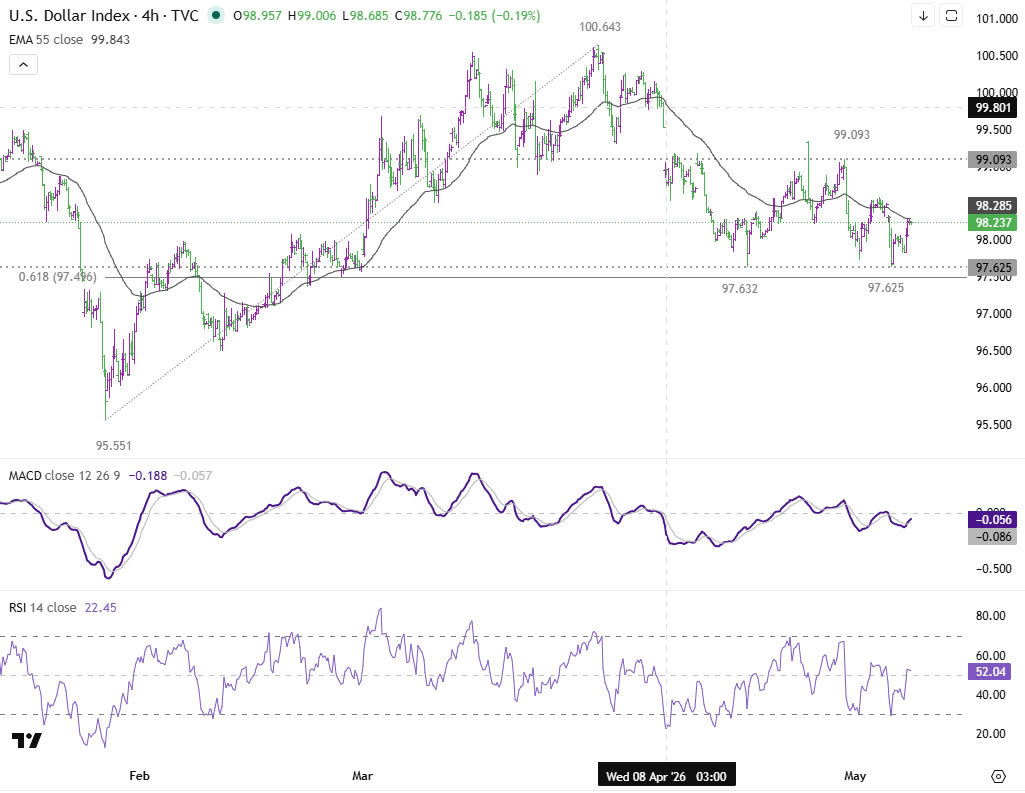
Technically, Dollar Index’s recent decline from 100.64 has stabilized temporarily just ahead 61.8% retracement of 95.55 to 100.64 at 97.49. But the broader near-term trend still favors further downside while 99.09 resistance holds. Decisive break below 97.49 could trigger another leg lower toward the 95.55 area.