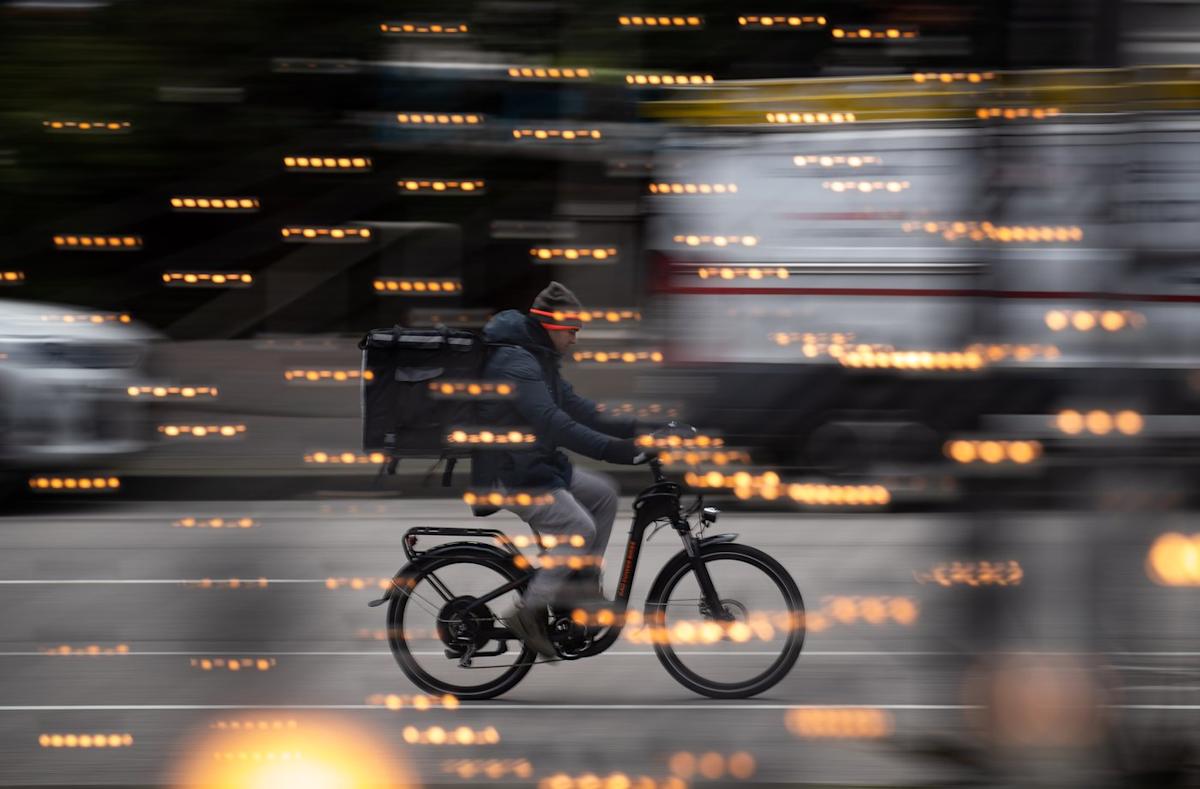
Whether it’s a last-minute Halloween costume or a 2 a.m. cough syrup shortage, delivery apps are promising to bring more than just food to your doorstep.
Many Canadians quickly became accustomed to having groceries and takeout delivered to their homes during the COVID-19 pandemic, setting the stage for food delivery apps to flourish.
While food deliveries are still going strong, the pace of growth has slowed. So the companies behind the apps are turning to retailers to fuel growth — partnering with large-scale chains such as Dollarama, PetSmart and Sephora.
Today, calling them food delivery apps may be a misnomer, said Vince Sgabellone, food service industry analyst at research firm Circana. While most delivery apps started in the restaurant industry, their ambitions have grown beyond takeout, he said.
Skip, a Canadian delivery app, dropped the second part of its name — The Dishes — last year, rebranding itself as a company not limited to restaurants.
“They’re explicitly saying, ‘We’re not just all about the food,'” said Sgabellone.
“Canadians are really time-starved,” said Paul Sudarsan, senior vice-president of partnerships at Skip, in an interview. “We’ve gone back into the office, or we’ve gone back into routines.”
Sudarsan said consumers were searching for items beyond food on the app, which is one of the reasons why Skip expanded its services. The company recently partnered with Shoppers Drug Mart and Dollarama, among other major retailers and grocers.
Sgabellone said the expansion efforts come as food delivery apps have hit maturity in the restaurant space.
“Delivery is still there, it’s still an important part of the food service industry, but it’s not growing by leaps and bounds anymore,” he said.
Food deliveries make up about six per cent of total traffic at restaurants, which is double 2019 levels, but still not huge, a 2025 Circana report showed.
Retail can mean new revenue streams, Sgabellone said.
“If they want to expand their business … that means they have to open up new channels, and that means new retail segments,” he said.
Uber Eats has expanded to retail, convenience, electronics and personal care — hosting brands such as Spirit Halloween and Sephora on its platform. Meanwhile, DoorDash has forged partnerships with the likes of Staples Canada and Giant Tiger.
These apps are capitalizing on the growing need for convenience, Sgabellone said. You don’t have to get in your car and drive to a nearby store or deal with people at a mall, he added.
“There is that instant satisfaction opportunity,” he said.
For Uber Eats, expanding into retail seemed like a natural progression.
“Delivery is now a habit. It’s not a trend anymore,” said Klaas Knieriem, head of retail for Uber Eats in Canada.
That’s especially true for younger Canadians in urban areas who are growing up with convenience that’s just a few clicks away, he said.
Richard Baker, president and founder of Food Distribution Guy, said delivery apps are tapping into a potential multi-billion dollar opportunity by expanding into retail. He said even if these apps capture a small share of the market, it would be significant.
Even just grocery deliveries make a lucrative market for the apps, he said.
“That’s just going to keep growing and growing,” Baker said. “Gen Zs, for example, (as) they get older, they start their own families, they’re accustomed to this technology.”
Knieriem said Uber Eats’ decision to venture beyond food wasn’t about saturation in the restaurant space, but about capitalizing on changing consumer habits.
Uber Eats now categorizes retailers alongside restaurants under different subsections on the same app.
“We’re not taking our foot off the gas from the restaurant market, because that’s why the app is also called Uber Eats,” Knieriem said.
Most large-scale retailers already have their own delivery channels set up to dispatch products to their customers, or sell via Amazon. But delivery apps aren’t competing with them.
Knieriem said Uber Eats’ selling point is the “on-demand value proposition,” with as little as 30 minutes of delivery time, while Amazon is promising later in the day or next-day delivery.
There’s a slightly different use case for customers of DoorDash, said Fuad Hannon, the company’s vice-president of new verticals.
“The traditional grocery order, for example, is a weekly hundred-plus-dollar run,” he said.
At DoorDash, Hannon said consumers are looking for top-ups, such as last-minute eggs or milk on a weekday, which they need as soon as possible — without having to drive or walk 10 minutes to their nearest store.
Delivery apps are also onboarding mom-and-pop businesses, such as local florists or a local electronics shop.
But Sgabellone thinks there’s likely going to be some figuring out, similar to the restaurant industry, as the apps carve out their space in the retail sector.
He said there’s a cost to businesses for using delivery apps and it may not be right for every business. But it can be a moneymaker if the retailer reconciles its margins with the delivery fee structure.
“The restaurant industry has figured it out now to a large extent,” Sgabellone said. “I think these retailers are going to figure it out as well.”
This report by The Canadian Press was first published Oct. 5, 2025.
Ritika Dubey, The Canadian Press