Igor Tudor knows better than to think he is your first choice. It is the story of his coaching career. In 12 jobs, he has only been hired at the start of the season three times. His reputation is like that of The Wolf in Pulp Fiction. If you’re hiring Tudor, it’s because someone’s in a panic and there’s a bloody mess to clean up.
Udinese were on a 10-game losing streak in April 2018. They were sliding towards relegation for the first time in almost a quarter of a century. Luigi Delneri got the sack. Massimo Oddo couldn’t revive them. Udinese were flat-lining. Tudor found a pulse. They had four games left. The first one was dramatic. Udinese were seconds away from beating Benevento, only for Bacary Sagna to score an equaliser for Roberto De Zerbi’s team in a dramatic 3-3 draw. But then Udinese beat Verona and Bologna, both 1-0, and Tudor was their saviour.
The Croat left, only to return a year later. Udinese had not learnt their lesson. They needed him again. A point was all that kept them out of the relegation zone. Not even Davide Nicola, the coach best known for rescuing Serie A teams in times of trouble, managed to shock Udinese back to life. Only Tudor could do that. Udinese took points off both Milan clubs, beat the teams around them and ended in 12th place, their joint-highest finish in the past 13 years.
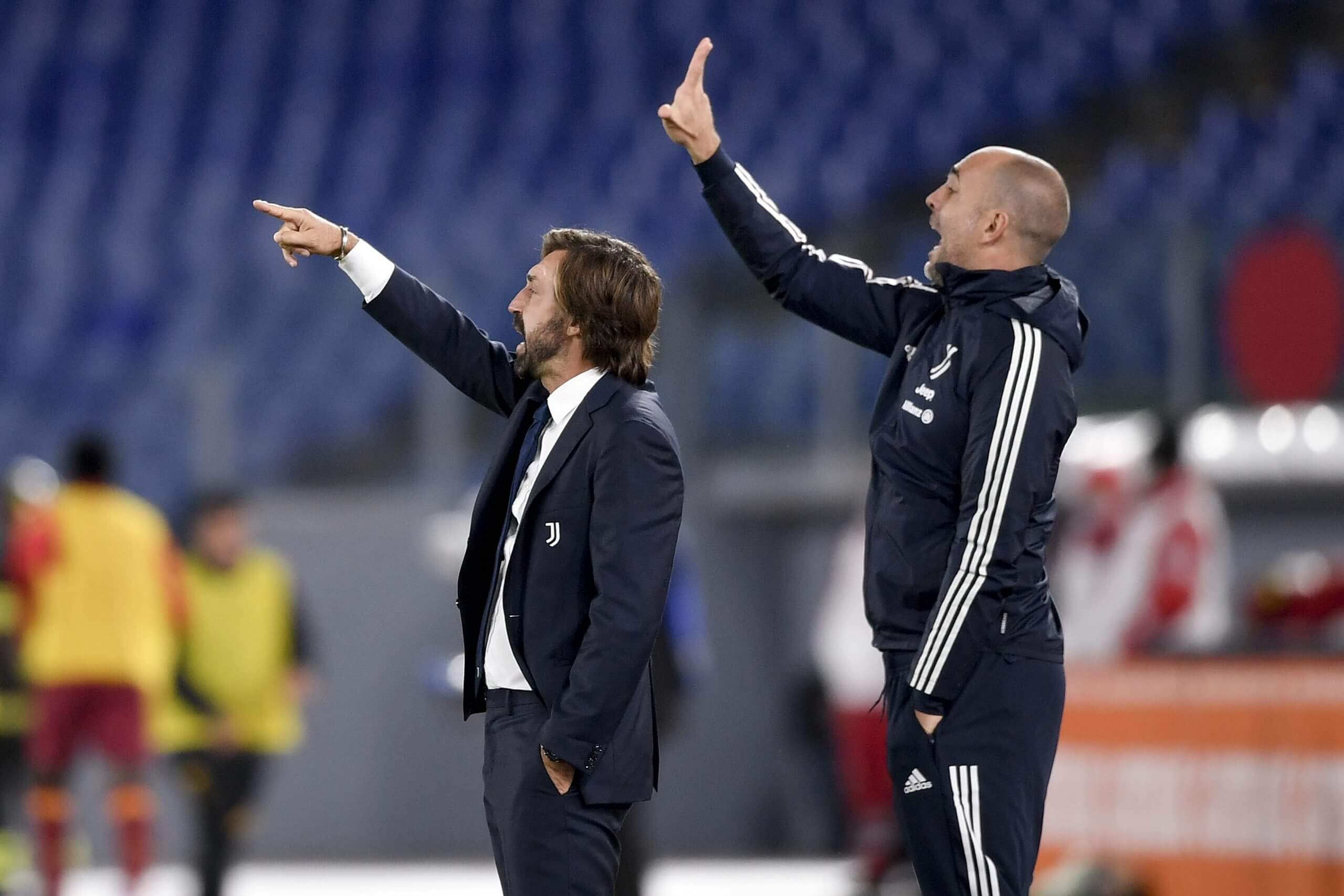
In the interim, Tudor has tried to shrug off the stereotypes and step out of the pigeonholes. Italy has a tendency to place coaches in categories. He was, for a long time, portrayed as an escape artist, like Nicola and Davide Ballardini. A Harry Houdini figure from Split. To leave it behind, he did something unexpected. When Juventus fired Maurizio Sarri in 2020 and promoted Andrea Pirlo, Tudor was invited to become his assistant.
Igor Tudor during his time on Andrea Pirlo’s coaching staff at Juventus (Daniele Badolato/Getty Images)
Not many head coaches accept becoming a No 2. But this was Juventus, the club Tudor served as a sharp-elbowed centre-back for the best part of a decade. Pirlo had never coached before. He’d been hired, initially, to take charge of the under-23s. Il Maestro lacked experience. Tudor, by contrast, didn’t, and Juventus’ executive team, which included Fabio Paratici, later of Tottenham Hotspur, thought he might be able to lend a hand.
While Juventus’ nine-year title-winning streak ended that season, they played a modern hybrid style of football with Rodrigo Bentancur and Dejan Kulusevski (the pair made more than 40 appearances each and their now Tottenham team-mate Radu Dragusin played four times), beating Barcelona at the Camp Nou and winning the Coppa Italia. Since that 2020-21 campaign, Juventus have not bettered the 78 points they racked up in the league. Some thought Pirlo deserved more time. He was fired after only one year.
But Pirlo’s career since at Fatih Karagumruk in Turkey, then Sampdoria in Italy’s second division, and now Dubai United has raised questions: how much of that season at Juventus was down to him and the presence of players such as Cristiano Ronaldo? And how much of it was down to his assistants, Tudor and Antonio Gagliardi?
A partial answer came when Tudor stepped in for Eusebio Di Francesco at Hellas Verona in September 2021. They had lost every game and, as happens every year since they were last promoted, pundits had taken one look at their squad and predicted relegation. Tudor instead made them a revelation. It was their best season in years, a ninth-place finish, 53 points.
Verona’s attack was the joint-fourth best in the league in Tudor’s time. Atletico Madrid manager Diego Simeone’s son, Giovanni, scored 17 times, his best goalscoring season, and got a move to Napoli soon afterwards. Other players’ careers were launched by Tudor, as was his own.
The same executives who picked De Zerbi to coach Marseille in 2024 picked him two years earlier. Only once in the past eight seasons have Marseille collected more points than under Tudor in 2022-23. Yet he was not made to feel welcome.
“What Igor went through, I wouldn’t wish on my worst enemy,” Marseille president Pablo Longoria reflected in newspaper Le Provence after his departure. “He found himself in a club where everyone was against him: inside and outside. Fans were whipping up tension against him. They were calling for Jorge Sampaoli to come back, others asked for power to be given to the players. There were calls to fan groups to get rid of the coach. When I returned to Marseille, the pre-season was like the 37th round of the league, where you’re playing for your life. That’s not normal. And again, I didn’t see the situation coming.”

Marseille fans did not make Igor Tudor feel welcome, despite some good form (Valerio Pennicino/Getty Images)
Whistled from the start of his Marseille career, Tudor silenced the sceptics in an atmosphere far more hostile than the one awaiting him in north London. His first defeat actually came against Tottenham in the Champions League group stage, when the team was undone by a Chancel Mbemba red card and a couple of Richarlison second-half goals. In Ligue 1, Marseille didn’t lose until October. After a sticky patch, they then went on a long winning streak into the New Year. The boos turned to cheers, as Marseille knocked Paris Saint-Germain out of the Coupe de France and qualified for the Champions League again.
Tudor then left of his own accord, citing personal reasons. “Working at Marseille is like working at another club for two or three years,” he said. Exhausting. De Zerbi would probably agree.
The experience at the Velodrome encouraged clubs of similar stature to reach out to Tudor. When Sarri quit as Lazio coach in March 2024, Tudor’s first game as his replacement featured a stoppage-time winner against Juventus. It was another reminder to his old club of what he could do after being on staff the last time they won something and having caused an upset with Verona, too.
Although Juventus took their revenge, winning 3-2 on aggregate in the Coppa Italia semi-finals (as Arkadiusz Milik broke Lazio hearts with an 83rd-minute second-leg goal), he did very well. Sure, Roma got the better of them in the derby, but that 1-0 defeat was the only loss Lazio suffered in the nine league games Tudor oversaw. They climbed from ninth to seventh, as Napoli collapsed, and qualified for the Europa League. Tudor then walked, again of his own accord. His vision for the club was incompatible with that of the owner and sporting director.
Tudor thought Lazio’s squad desperately needed overhauling. He wanted to keep Daichi Kamada, who instead moved to Crystal Palace as a free agent when his contract expired. “He asked us to change eight players,” Lazio owner Claudio Lotito said. “That was too many for a group we consider to be up to the task. But he left like a decent person. I want to make that clear.”
Clubs come to Tudor when they’re on a cliff edge. He is not afraid to stare into the abyss. He won’t allow it consume him. Instead of asking him to stop teams falling out of the league, his recent briefs, Tottenham aside, have been about preventing teams from spiralling out of the lucrative European places.

Igor Tudor performed solidly in his short stint at Lazio (Marco Luzzani/Getty Images)
A year ago, Juventus broke the glass and pushed the emergency button. Heavy 4-0 and 3-0 defeats against Atalanta and Fiorentina damaged Thiago Motta so badly that the next big thing in Italian coaching was out of a job after just seven months.
Juventus were fifth at the time, but the momentum was with the teams around them. Bologna, for instance, were looking better without Motta under Vincenzo Italiano and were about to win their first trophy in more than 50 years. Roma were resurgent with Claudio Ranieri back and Lazio looked good led by Tudor’s replacement Marco Baroni. All in all, there were four teams within four points of one another battling for one spot. Juventus claimed it, losing only one of Tudor’s nine league games at the helm.
It went down to a tense final day at Venezia, where Juventus went behind, got in front, lost the lead again and then won late. Qualification for the Champions League rolled his contract over. Juventus had a get-out. But their participation in the Club World Cup was less than a month away and Damian Comolli, another ex-Tottenham employee, had only recently replaced the sacked Cristiano Giuntoli, becoming general manager and later chief executive.
Sticking with Tudor was, in some respects, a little underwhelming but given how steeped he is in Juventus’ DNA, it was not viewed unfavourably either. The Club World Cup was an opportunity for him to get to know the players even better and to, quite unexpectedly, have an audience with Donald Trump in the Oval Office.
Juventus started this season taking nine points from nine. The 4-3 in the Derby d’Italia against rivals Inter and a 4-4 draw against Borussia Dortmund in the Champions League were spectacular. But the team were overperforming the expected goals (xG) data, suggesting their form might not be sustainable. Kenan Yildiz, their star playmaker, could not pull a rabbit out of the hat every game. Gleison Bremer, the club’s best defender, went down with a torn left knee meniscus and the strikers stopped scoring.
Tudor railed against refereeing decisions. He got angry with the fixture computer for piling games against Inter, Dortmund, Verona, Atalanta, Villarreal, Milan, Como, Real Madrid and (his final match in charge) Lazio one on top of the other.
Eight games without a win persuaded Comolli, who had not hired him in the first place, and the rest of the executive team that a change was needed. The cover of Luciano Spalletti’s book, which Tudor was reading in his office, showed his replacement.
The 47-year-old departed believing he could have turned it around. The calendar was softening up, after all. But he wanted more from Juventus’ senior players. It was a young group in need of leadership, expensively and poorly assembled by Giuntoli.

Igor Tudor was able to get goals out of Randal Kolo Muani at Juventus (Jonathan Moscrop/Getty Images)
The new structure of the club was still taking shape, and financial fair play rules limited what Juventus could do in the summer. They were, for instance, unable to make Randal Kolo Muani’s signing from PSG permanent. He moved to Tottenham on loan instead. Kolo Muani scored five goals in 11 games under Tudor. That’s five more than he’s mustered for Spurs in 18 Premier League appearances.
Make no mistake, Tudor is ready for this job. He has saved clubs in worse positions with worse players and less time available. He has withstood the kind of hostility in Marseille you’ll never find in England and proven fans wrong. He has been around big-name players in each of his spells at Juventus, from Zinedine Zidane to Cristiano Ronaldo.
“Alessandro Del Piero used to get mad if we lost a game in training,” Tudor told DAZN in August. “That was the famous Juventus way. I’m the same in life. It’s about talking in facts and leading by example. I’m a man of few words and don’t turn the other cheek when someone is out of line. You have to always be on it in training, because that way the game itself is easier.”
It’s the mentality Paratici tried to impose in north London, only to acknowledge Tottenham are a club with their own mentality, their own DNA. Tudor has been dealt as challenging a start to his interim role as the one he faced at Lazio. The injury situation is bad, too, and he will perhaps have to adapt the 3-4-2-1 he has used since his days at Verona to fit the players available to him.
At Juventus, the motto is “winning isn’t important, it’s the only thing that counts”. How Tottenham win football games between now and the end of the season doesn’t matter. They have to win, whatever it takes. And Tottenham have decided, not without justification, that it takes Igor Tudor.