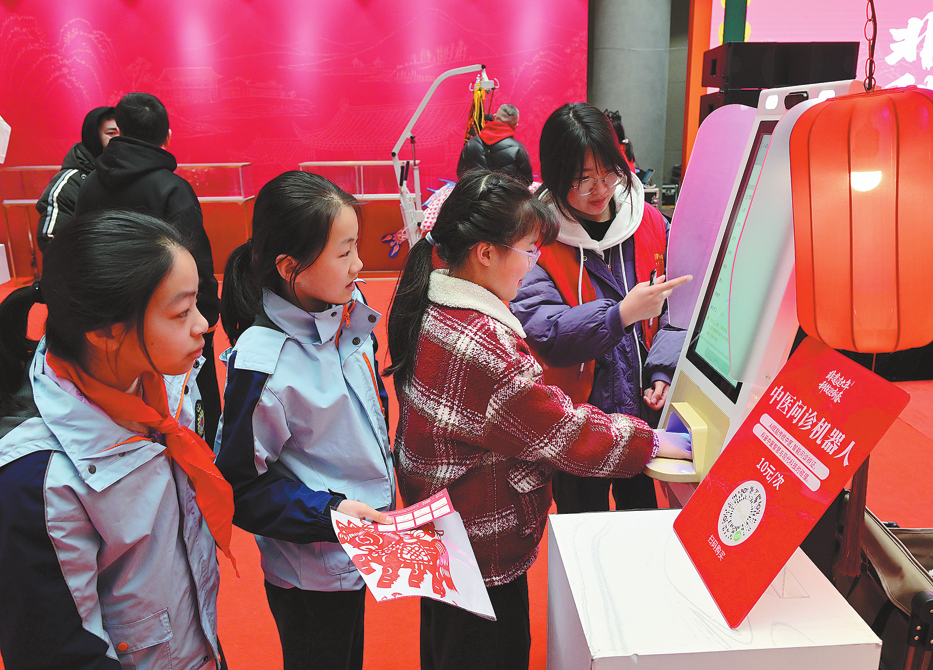

China is accelerating efforts to modernize its traditional Chinese medicine industry, including embedding artificial intelligence to boost research and development and expand access to quality TCM services, as policymakers seek to transform the centuries-old sector into a technology-driven industry with stronger global reach.
Support for the industry featured prominently during the just concluded annual two sessions, where the government pledged to “advance the inheritance and innovation of TCM and strengthen the integration of Chinese and Western medical practices”, while also calling for greater efforts to promote TCM globally, according to the 2026 Government Work Report.
The two sessions refer to the annual meetings of the National People”s Congress and the National Committee of the Chinese People’s Political Consultative Conference.
The push forms part of a broader modernization strategy outlined in the draft outline of the 15th Five-Year Plan (2026-30) and an industrial policy released earlier this year by eight government departments, including the Ministry of Industry and Information Technology, the National Health Commission and the National Administration of Traditional Chinese Medicine.
The implementation plan for high-quality development of the TCM industry (2026-30) sets quantitative targets for the sector, including building 60 high-standard herbal raw-material bases, establishing five national innovation centers and creating 20 smart manufacturing plants by 2030.
Policymakers and industry experts increasingly see artificial intelligence as a key driver of modernization.
“AI models can connect data across the entire industrial chain — from raw-material screening and R&D to quality control and manufacturing,” said Xiao Wei, a deputy to the 14th National People’s Congress and an academician at the Chinese Academy of Engineering.
Such digital tools could help address long-standing challenges in the TCM sector, including product standardization, stability and quality consistency, he said.
Artificial intelligence is already being deployed across multiple stages of the industry value chain.
Shijiazhuang Yiling Pharmaceutical Co Ltd, for example, said AI-driven research projects have shortened drug research and development cycles by about 30 percent.
In distribution, firms such as Kangmei Pharmaceutical Co Ltd are combining blockchain technology with AI to track herbal medicines from cultivation to retail, improving transparency and safety oversight across the supply chain.
China is also seeking to expand the global reach of TCM products and services.
“We will bring TCM and its culture more to the international community, while promoting mutual learning among traditional medicines,” Lei Haichao, minister of the National Health Commission, said at a news conference during the fourth session of the 14th NPC on Saturday.
As of July 2025, TCM was practiced in 196 countries and regions, while acupuncture had been recognized in 113 member states of the World Health Organization, according to data from the National Health Commission.
China’s exports of TCM products reached $5.09 billion in 2025, customs data showed.
Despite the modernization push, analysts say the sector still faces structural challenges.
Variations in herbal quality across growing regions, limited adoption of international standards and ongoing scientific debates about efficacy continue to limit broader global acceptance.
“The next five years will be a critical period for the transformation and upgrading of China’s TCM industry,” Guo Lanping, who is head of Institute of Chinese Materia Medica, China Academy of Chinese Medical Sciences, said in an interview with Xinhua News Agency.
“With the implementation of the policy measures, the industry is expected to move further toward higher quality and greater modernization,” she added.
lijing2009@chinadaily.com.cn