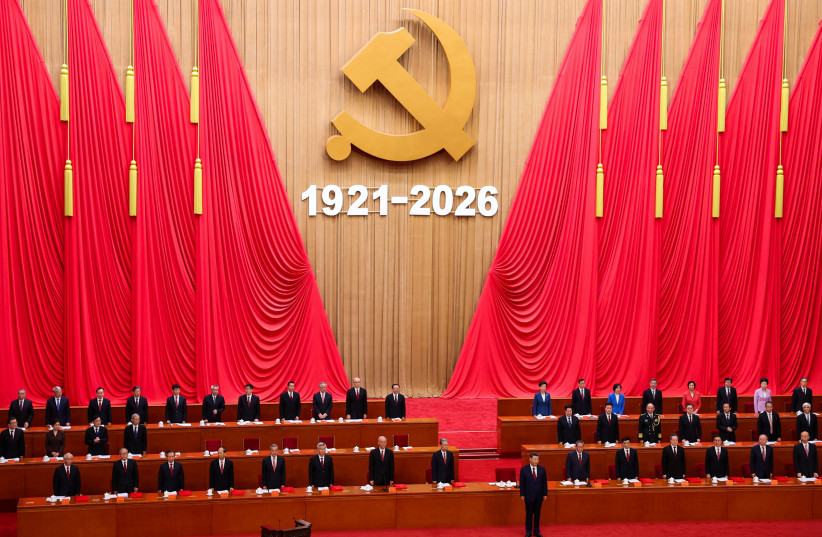
At 12:01 p.m. Beijing time on July 6, 2026, a Chinese strategic nuclear-powered submarine launched a long-range ballistic missile carrying a dummy warhead toward designated international waters in the South Pacific.
According to China’s official account, the missile landed accurately within the designated maritime area. Beijing described the launch as a routine element of its annual military training, conducted safely and in accordance with international law. Yet the precise launch location, flight path, impact coordinates, range, missile type, and submarine class were not publicly disclosed.
Those omissions are important. They are also part of the story.
The United States said it received only a few hours’ notice and insufficient technical information before the launch. Washington argued that the notification fell considerably short of the standards observed by the other recognized nuclear-weapon states. Australia, New Zealand, Japan, and Taiwan also expressed concern about the launch, its limited transparency and its potential effect on regional stability.
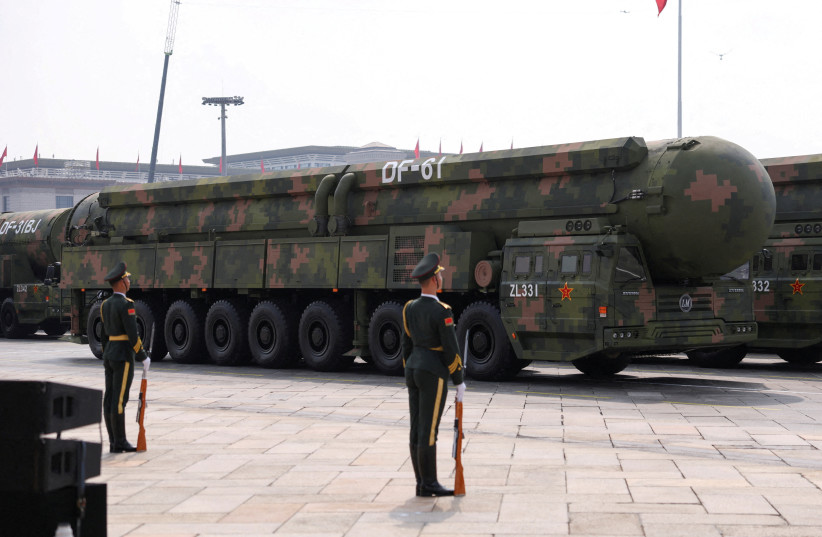
The missile carried a dummy rather than a nuclear warhead. Nevertheless, the platform and the capability being demonstrated were inherently strategic. Analysts believe the launch may have involved a Type 094 ballistic-missile submarine and either a JL-2 or the more advanced JL-3 submarine-launched ballistic missile.

The exact configuration has not been officially confirmed. If it was a JL-3, its estimated range of up to approximately 10,000 kilometers would represent a major increase in China’s ability to hold distant targets at risk while operating closer to protected Chinese waters.
The political timing was equally striking. On the same day, Australian Prime Minister Anthony Albanese and Fijian Prime Minister Sitiveni Rabuka signed the Ocean of Peace Alliance in Suva. The agreement established Fiji’s first formal mutual-defense alliance and committed Australia and Fiji to assist one another if either were attacked.
There is no publicly established evidence that China timed the missile test as a direct response to the agreement. Still, the concurrence of the two events captured the changing strategic character of the Pacific: China demonstrating a survivable, sea-based strategic capability while American partners were strengthening their regional network of formal security commitments.
The launch was therefore far more than another weapons test. It was a visible marker of the transition from an international system in which American military predominance was largely assumed to an era of sustained strategic competition between the United States and China.
No longer just about land
That competition is not limited to ships, missiles, or territorial disputes. It extends across the foundations of 21st-century power: artificial intelligence, advanced semiconductors, computing infrastructure, space systems, energy, autonomous platforms, industrial capacity, and secure supply chains.
For decades after the Cold War, the United States possessed a combination of advantages unmatched by any competitor: the world’s most capable military, a global network of bases, leading technology companies, deep capital markets, a powerful research ecosystem, and an extraordinary ability to project force across continents and oceans.

China has spent more than two decades constructing a long-term strategy to narrow those gaps and, in several fields, to change the terms of competition altogether.
The People’s Liberation Army Navy is now the world’s largest navy by number of battle-force ships. The Pentagon projected that it would reach approximately 395 ships by 2025 and 435 by 2030, not including dozens of smaller missile-armed patrol craft.
The significance lies not only in fleet size but also in the industrial system behind it: China possesses enormous commercial and military shipbuilding capacity and can construct naval platforms at a scale that the United States and many of its allies currently struggle to match.
China has also developed a dense network of land-based ballistic and cruise missiles, anti-ship systems, hypersonic weapons, space-based sensors, cyber capabilities, electronic warfare systems, and increasingly sophisticated unmanned platforms.
The objective is not simply to replicate the American force structure.
It is to constrain it.
Rather than competing only platform against platform, Beijing has developed an integrated military architecture designed to threaten forward bases, complicate carrier operations, disrupt command networks, and limit an adversary’s freedom of action across the Western Pacific.
This approach is commonly associated with anti-access and area-denial. But its contemporary form is broader: it combines long-range precision strike, surveillance, space, cyber, electronic warfare, and artificial intelligence into a single operational problem for the United States and its allies.
Principal testing ground
The Indo-Pacific has become the principal testing ground for this emerging balance.
China has intensified military activity around Taiwan, including large-scale air and naval exercises, simulated blockade operations and increasingly frequent crossings of previously observed informal boundaries. It has expanded coast guard and maritime militia operations in the South China Sea, pressured the Philippines and other regional claimants, operated carrier groups beyond the First Island Chain and increased naval cooperation and joint patrols with Russia.
The July 6 submarine launch added a nuclear dimension to this pattern.
For decades, the strategic deterrence of the major nuclear powers has rested on the Nuclear Triad: land-based missiles, strategic bombers, and ballistic-missile submarines. Each component serves a different function, but the sea-based element is especially important because of its survivability.
A ballistic-missile submarine hidden beneath the ocean is difficult to locate and destroy. It can preserve a country’s ability to retaliate even if its land-based forces and command infrastructure are attacked. That credible second-strike capability is one of the foundations of stable nuclear deterrence.
China has historically maintained a smaller nuclear force than either the United States or Russia and formally retains a no-first-use policy. However, the scale and sophistication of its nuclear modernization are changing rapidly. The Pentagon assessed that China had more than 600 operational nuclear warheads by mid-2024 and remained on track to exceed 1,000 by 2030.
China is simultaneously expanding its land-based missile silos, mobile launchers, bomber capabilities, and sea-based forces. The July 6 launch should therefore be understood as part of the maturation of a more credible and survivable Chinese Nuclear Triad, not merely as the test of an isolated missile.
Yet the larger strategic lesson extends beyond nuclear weapons and beyond China.
National power in the emerging era will not be measured only by the number or sophistication of military platforms available on the first day of a conflict. It will also be measured by a country’s capacity to absorb shocks, protect critical infrastructure, replenish inventories, secure supply chains, update software, learn from operational experience, and produce improved capabilities throughout a prolonged confrontation.
Strategic resilience
The war in Ukraine exposed this reality with unusual clarity. Precision-guided weapons, artillery ammunition, air-defense interceptors, drones, sensors, and electronic-warfare systems have been consumed at rates that challenged assumptions built during decades of limited wars. Systems that took years to develop and stockpile could be depleted in weeks or months.
The relevant question is therefore no longer only which side possesses the superior weapon at the beginning of a conflict.
The more consequential question is which side can learn, adapt, and manufacture faster by day 100, day 500, and beyond.
This is the essence of strategic resilience.
It also leads to a concept that should become increasingly central to Western security policy: Joint Resilience.
Traditional alliances have often been measured through treaties, troop deployments, military bases, and weapons sales. These remain essential, but they are no longer sufficient. Future alliances must also be capable of creating shared strategic depth before a crisis begins.
Joint resilience means trusted and diversified supply chains, interoperable digital architectures, shared research and development, co-production of critical systems, distributed manufacturing, common data standards, resilient communications, cyber cooperation, and the rapid integration of artificial intelligence and autonomous systems.
It means moving from a relationship based primarily on transferring completed products to one based on jointly creating, producing, maintaining, and continually improving capabilities.
This is where alliances become a distinctive strategic advantage for the United States.
China possesses immense scale, industrial discipline, and a rapidly modernizing military. But the United States possesses something that cannot be measured solely in ships, missiles, or factories: an extensive network of allies and partners across Europe, the Indo-Pacific, and the Middle East.
The strategic value of that network is not automatic. It must be activated, modernized, and connected. Allies must become more than diplomatic supporters or customers. They should contribute to a resilient, distributed ecosystem of technology, production, intelligence, and operational learning.
Back to Israel
This brings us to Israel.
During the 23 years in which I had the privilege of participating in the development of defense capabilities for the State of Israel, I repeatedly learned that lasting military advantage is never created by technology alone.
It is created by people, trust, shared responsibility, and the ability to build enduring partnerships.
Many of Israel’s most important capabilities were strengthened through deep cooperation with the United States. That relationship has never been based solely on transactions or immediate operational requirements. At its strongest, it has rested on shared values, mutual confidence, and a genuine understanding that each country contributes to the security and resilience of the other.
Israel is geographically small, but its security environment has produced a distinctive innovation model. Operational users, engineers, researchers, defense organizations, and private companies operate within unusually short feedback loops. Battlefield needs can be translated into technological requirements, prototypes, and operational systems with exceptional speed.
Israeli innovation was not born from comfort. It was born from necessity.
In an era in which adaptation speed is becoming a defining measure of national power, that experience is a strategic asset not only for Israel, but for the broader alliance system of the free world.
The United States brings unmatched global reach, industrial depth, resources, research capacity, and scale. Israel brings operational urgency, agility, technological creativity, and the ability to transform emerging problems into deployable solutions.
The next stage of the US-Israel relationship should therefore extend beyond traditional security assistance, procurement, and bilateral development programs. It should become a model of joint resilience: shared development, reciprocal production capacity, protected supply chains, common technological infrastructure, and the ability to accelerate solutions across both defense ecosystems.
China’s submarine-launched missile test in the Pacific was a reminder that the future strategic order is already taking shape.
It will not be determined solely by which country builds the largest fleet, the longest-range missile, or the most advanced individual platform.
It will be determined by which nations can combine technological superiority with industrial endurance, which can learn and adapt under pressure, and which can transform networks of trusted partners into real strategic power.
In this new era, alliances are not merely relationships between nations.
They are a fundamental pillar of deterrence.