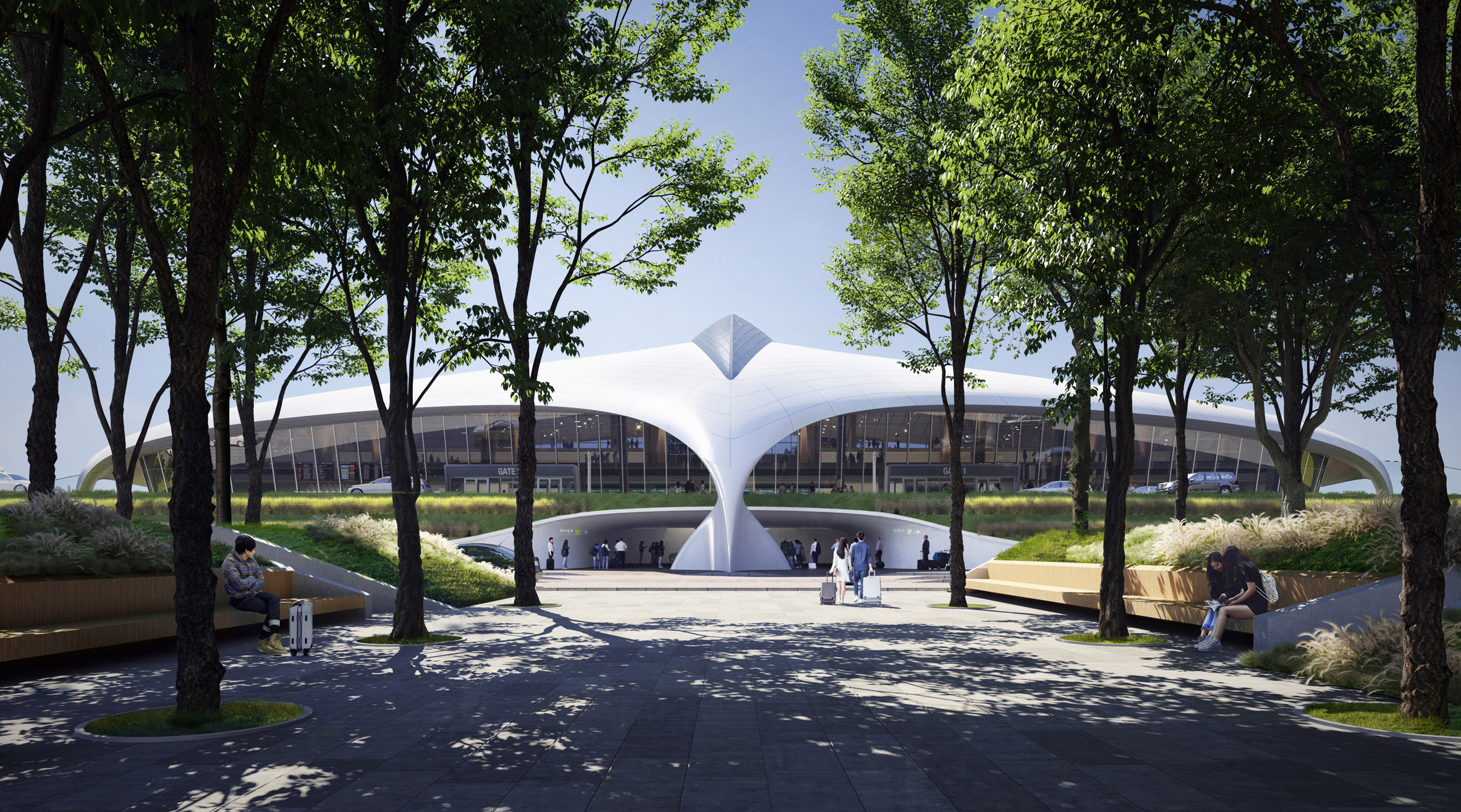
Lishui Airport (LIJ), located in Zhejiang Province, China, has officially begun operations, marking the region’s first direct link to China’s national aviation network. Initially designed in 2008, the airport has finally been completed after 17 years of construction.
The “bird-like” building has been designed to handle a million domestic passengers annually, to start with, with a planned extension for an international terminal due in the coming years.
The eye-catching 12,000 square metre terminal building has been designed to appear as a giant white bird resting among the mountains, with a double-layered roof clad in silver-white aluminium evoking a scene of “mist-covered hills and birds in flight”.
China’s Lishui Airport finally opens for business
Located in a mountainous area of southwestern Zhejiang, about 10 miles (15 kilometres) from the city of Lishui, the new airport site spans 2,267 hectares (nine square miles). The terminal building measures approximately 12,000 square meters (130,000 square feet) and includes eight aircraft parking bays.
In its initial phase, the airport is designed to handle up to one million passengers annually, with a cargo throughput capacity of 4,000 tons (8 million pounds).
As reported by Global Construction Review, the new airport has been built in a valley between mountains and is the result of extensive land reclamation and landscaping. Consequently, Lishui Airport has been described by architects as ranking amongst the most topographically complex airport projects in East China in recent years.
The airport was originally due to open in 2024, but due to the complex nature of the site, the opening was delayed until late 2025. The construction required significant earthworks with cut-and-fill differences reaching nearly 100 meters (300 ft) in certain areas.
According to Chinese firm MAD Architects, the lead designer of the airport, “the architectural concept draws directly from the surrounding landscape.
The terminal follows the natural contours of the site, its gently sloping form integrating into the terrain. Soft, continuous volumes and fluid geometries give the building the appearance of a white bird resting quietly among the mountains and forests.”
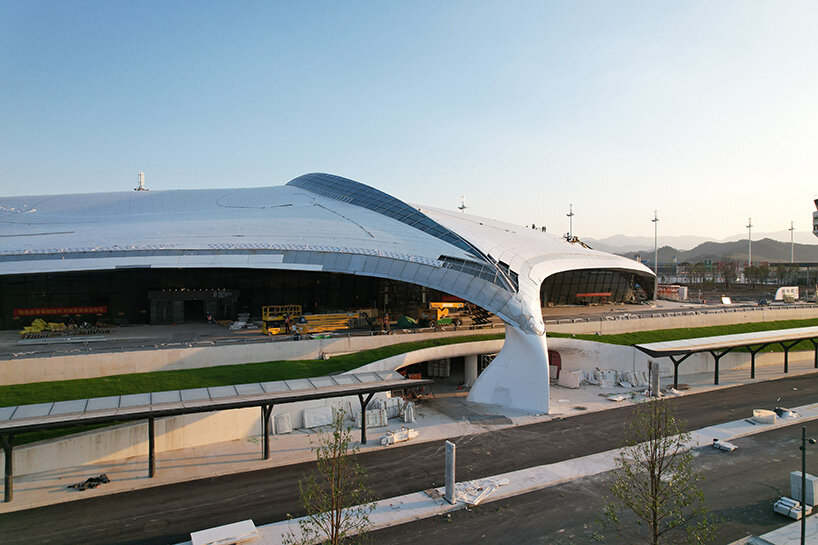
“The terminal’s double-layered roof is clad in silver-white aluminium panels, creating a compact yet expressive silhouette that responds to changing light and weather. The roofline evokes the imagery of mist-covered hills and birds in flight, allowing the architecture to register as part of the broader landscape rather than an isolated object.”
Lishui Airport’s uniquely designed terminal
According to the architects, the terminal is organised around a one-and-a-half-story sectional strategy, anchored by a double-height entrance hall that links the ground-floor arrival spaces with the upper-level departure lounge. “This compact vertical organisation streamlines passenger circulation while maintaining visual continuity across levels,” says MAD.
Additionally, below the front of the terminal, a sunken parking structure follows the natural terrain of the surrounding countryside. A landscaped central promenade runs beneath the building, guiding passengers intuitively towards the departure hall and “resolves the challenges posed by the mountainous site through architectural continuity rather than separation,” it adds.
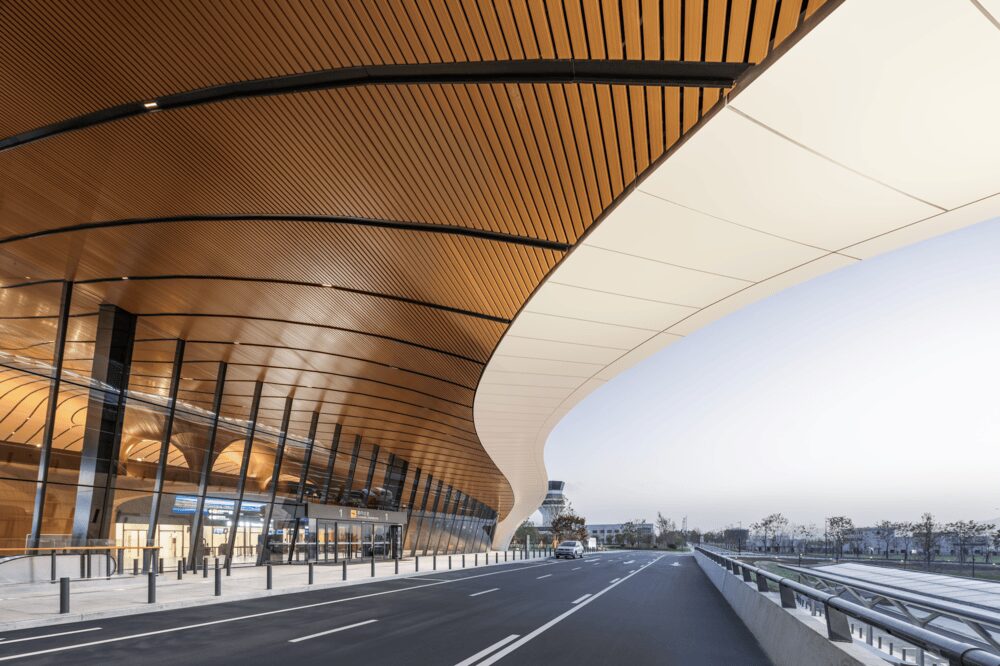
Internally, 14 umbrella-shaped structural columns support the lightweight roof, while “wood-toned interior grilles introduce warmth and a visual rhythm. At the roof’s apex, a spindle-shaped skylight brings daylight deep into the terminal, animating the interior with changing natural light.”
Transparent curtain walls have also been incorporated to define the boundary of the building, which helps to frame views of the surrounding mountains.
The first-floor lobby varies in height, ranging from approximately 4.5 m (14.7ft) to 13 m (42.6ft), which, according to the architects, creates a carefully calibrated spatial experience that avoids the excess scale typical of large transport halls while reducing energy consumption.
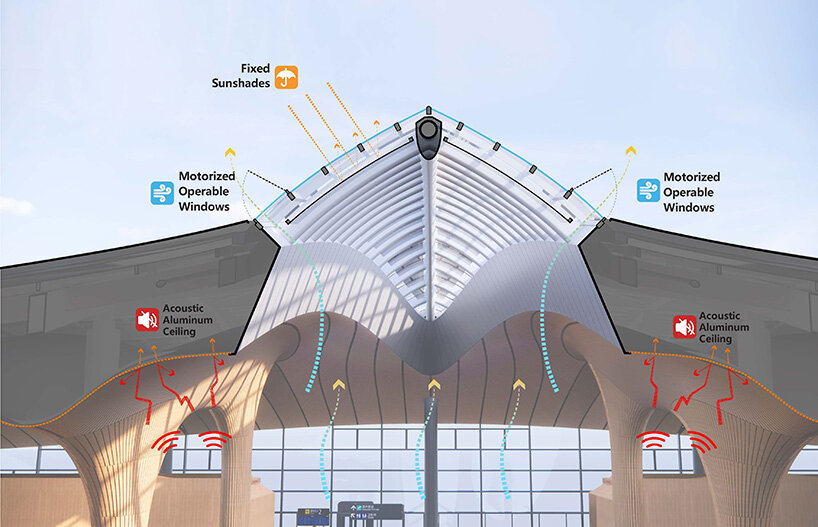
Narrow acoustic slots integrated between interior panels help absorb noise, contributing to a quieter and more comfortable waiting environment.
“We used materials with warm tones and natural textures to create a bright and airy interior,” said Ma Yansong, MAD Architects’ founder. “By adopting a one and a half story layout, the airport remains compact, while supporting daily comfort and engaging in a dialogue with nature.”
An airport for both today and the future
The design of Lishui’s terminal has been designed with future growth firmly in mind. Under the airport’s long-term master plan, passenger capacity is projected to reach 1.8 million by 2030 and five million by 2050, with provisions for the addition of an international terminal.
By the end of 2026, Lishui Airport will operate multiple domestic destinations, establishing connections to major economic centres across China as well as key tourist regions, while positioning the airport as both an infrastructure gateway and a civic threshold to the city.
As of Friday, 20 February, the airport has flights scheduled to operate to nine Chinese cities via six airlines, including Xi’an, Shanghai, Beijing, Kunming and Guangzhou.
While airports have traditionally been viewed as mutually exclusive from the city they serve and detached from urban life, according to MAD, Lishui Airport has been designed as the antithesis to that model.
The airport has been designed to be a transportation hub that also operates as a civic space, an ecological landmark, and a place of psychological transition, “offering travellers a moment of calm within the movement of travel.”
The completion of Lishui Airport follows other recent domestic and international projects worked on by MAD Architects. These include the Fenix Museum in Rotterdam (Netherlands), as well as a new “feather-like” terminal at Changchun-Longjia International Airport (CGQ) and a “snowflake-like” Terminal Three at Harbin Taiping Airport (HRB), both in China.
Featured image: MAD Architects