Hi, everyone! Happy New Year of the Fire Horse! This is Lauly, your #techAsia host this week. It’s been a while. I’ve just come back to work from a nine-day Lunar New Year holiday. I stayed in Taipei with my family and tried very hard to think of something new for my toddler to do every morning and afternoon. Believe me when I say I missed working. I was so punctual — even a bit early — to drop him off at kindergarten on the first day after the holiday.
While I had planned to read a book during the break (which, as expected, I failed to do), I received a message from industry friends telling me that they had seen me and my colleague Annie Cheng Ting-Fang mentioned several times in Patrick McGee’s book Apple in China, because of our coverage of the Apple supply chain. I appreciate Mr McGee’s generosity and feel honoured to be included in his work.
Some of our stories that he cited were published in 2018 and 2019, shortly after I joined Nikkei Asia. I still think of that as one of the craziest and most chaotic times in my journalistic career. The US-China trade war was just starting to escalate, and companies like Apple were reluctantly evaluating whether to move their supply chain outside of the world’s biggest manufacturing powerhouse, something that was unthinkable before the trade war.
I remember vividly the day Washington announced it had added Huawei to the so-called “entity list”. I was racing up an escalator to attend an industry fair in downtown Taipei, as I was running late. When I finally got there, out of breath, I saw a message from Annie, who had also just arrived, about Washington’s move. We quickly met up and discussed the jaw-dropping news.
Instead of heading into the venue like everyone else, we sat against a wall and frantically started looking for people to talk to and trying to understand what being “added to the entity list” meant. We then rushed to meet a source for lunch, and while I had thought of cancelling the appointment at the very last minute, in the end I was glad we didn’t. The source actually knew a lot about the story we were chasing, and we were able to turn out a solid scoop on Huawei’s efforts to stockpile chips. That day was like riding on a rollercoaster.
Back to this week, Unimicron, the world’s largest supplier of chip substrate by capacity, said in its earnings call that everyone should be prepared for a supply crunch, as it estimates high-end glass cloth — an essential material for making chip substrates — will remain in short supply throughout this year, confirming Nikkei Asia’s previous reports.
As early as June 2025, Nikkei Asia revealed how high-end glass cloth, or T-glass, from Japan’s Nittobo is one of the key bottlenecks threatening to hold back the AI boom. This reporting was followed by an exclusive interview with Nittobo’s CEO and another extensive scoop last month on how Apple and Qualcomm are also starting to worry about constrained supplies.
On top of memory chips, other components are also suffering from supply shortages. It’s like many of my sources have said: The challenge this year is supply chain management, specifically solving one bottleneck after another.
More and better chips

China’s top chipmakers, including SMIC, Hua Hong Semiconductor and several smaller, Huawei-linked chip companies, are racing to increase production of advanced chips, including those at the 7-nanometre or even 5-nm performance level, according to this exclusive report by Nikkei Asia’s Cheng Ting-Fang, Lauly Li and Cissy Zhou.
The ambitious capacity expansion is part of a national, government-backed effort to feed the growing domestic demand for AI computing infrastructure, according to multiple sources familiar with the matter.
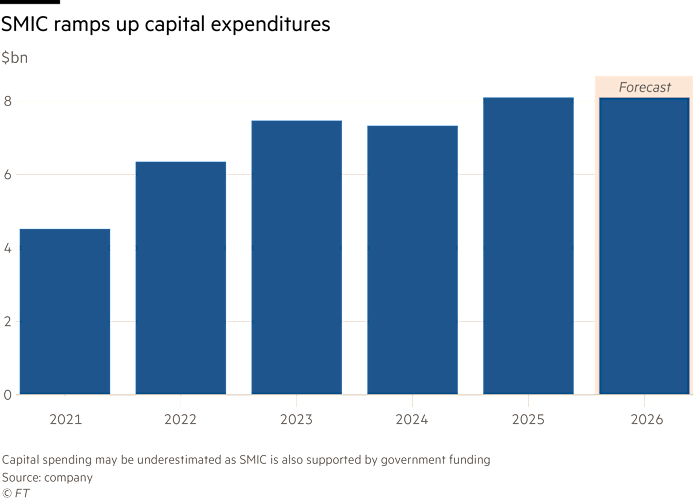
SMIC, or Semiconductor Manufacturing International Corp, and Huawei are spearheading this expansion. The former said its capex in 2026 will be at a similar level as 2025’s record $8.1bn to support strong localisation demand.
China is on course to build its own semiconductor ecosystem — from chip designers and manufacturers of logic and memory chips to chip packaging and testing suppliers — to support the overall AI supply chain.
Less-than-model behaviour
Anthropic has accused three Chinese AI labs of “industrial-scale” attacks, raising national security concerns for the industry, write the Financial Times’ Eleanor Olcott and Cristina Criddle.
The AI start-up, which developed the popular coding tool Claude, said on Monday that DeepSeek, Moonshot and MiniMax conducted “industrial-scale distillation attacks on our models”.
Distillation refers to the practice of training smaller models on the outputs of more advanced systems, allowing developers to replicate high-level performance without the same computing resources.
It has become an increasingly sensitive issue as Chinese AI groups grapple with sweeping US export controls that restrict their access to Nvidia’s most advanced chips, including its Blackwell series.
Those curbs have forced companies to adopt alternative strategies, such as training models overseas, using older or smuggled semiconductors, and cutting costs through engineering efficiencies.
San Francisco-based Anthropic said it had identified 24,000 fraudulent accounts that had generated over 16mn exchanges with Claude, which it alleged the companies used to “train and improve their own models”.
DeepSeek, Moonshot and MiniMax did not respond to requests for comment.
Made-in-India AI?
Highlights of the five-day AI Impact Summit that recently wrapped up in New Delhi included more than $200bn in investment pledges, high-profile partnerships and declarations of disruptive transformations. The question now is whether the country can live up to its pitch as the AI “use-case capital” of the world, writes Nikkei Asia’s Ananta Agarwal.
Developers at the summit demonstrated a range of pilot uses for AI ranging from weather forecasting for farmers to faster auditing and compliance tools for businesses. The aim of such applications is to lift efficiency in some of India’s most underproductive sectors, namely agriculture and small and midsize enterprises. Unlocking the full potential of such applications, however, will require great effort and a high level of localisation, given that more than 120 languages are spoken in the country and more than 90 per cent of the workforce is in the informal sector.
Changing the channel
Panasonic is transferring its TV business in the US and Europe to Chinese company Skyworth, marking the second Japanese company in a month to reduce its presence in the segment in the face of intensifying Chinese competition, writes Nikkei Asia’s Yuki Misumi.
Panasonic will turn its focus to sales back home and production of high-end models. The comprehensive collaboration with Skyworth includes product development and production in an effort to reduce costs. The agreement currently covers North American and European markets, but it also plans to explore locally optimised strategies for some Asian markets, including further potential collaboration with Skyworth.
Its move follows Sony’s announcement last month that it will outsource its TV business to a joint venture led by China’s TCL, while Sharp and Toshiba in recent years also ceded control of their TV businesses to foreign companies amid rising Chinese competition.
Suggested reads
-
Roomba maker iRobot readies mini model for Japan to fend off Chinese rivals (Nikkei Asia)
-
Scarcity value puts a rocket under China’s AI challengers (FT)
-
Nvidia reports 73% revenue jump but warns on China uncertainties (Nikkei Asia)
-
Suzuki-backed flying car start-up tests Tokyo service (Nikkei Asia)
-
D-Matrix founder says more AI adoption key to unlocking further investment (Nikkei Asia)
-
China’s AI labs unleash new models and bubble tea to lure in customers (FT)
-
US sets preliminary duties on solar imports from India, Indonesia and Laos (Nikkei Asia)
-
Mid-career talent drives South Korea’s start-up surge (Nikkei Asia)
-
‘Latecomer’ Hyundai races Tesla on robots and self-driving cars (FT)
#techAsia is co-ordinated by Nikkei Asia’s Katherine Creel in Tokyo, with assistance from the FT tech desk in London.
Sign up here at Nikkei Asia to receive #techAsia each week. The editorial team can be reached at techasia@nex.nikkei.co.jp