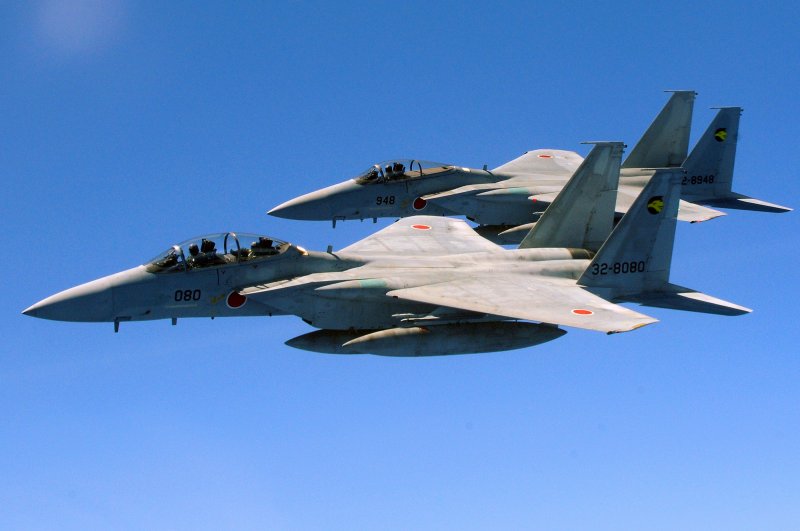

Chinese and Japanese Fighters Clash Over East China Sea Sam LaGrone July 5, 2016 10:47 AM – Updated: July 6, 2016 9:17 AM Two Japanese Air Self Defense Forces F-15s in 2009. US Air Force Photo Two Japanese Air Self Defense Forces F-15s in 2009. US Ai
Tensions in the Asia-Pacific once again escalated in early December after Japan accused China of directing weapons-control radar at Japanese fighter jets flying south of Okinawa. According to the Japanese Ministry of Defense, Chinese military aircraft locked their fire-control systems onto Japanese F-15J fighters conducting routine patrol flights over international waters. Although no physical confrontation occurred, radar locking is regarded internationally as a highly provocative and dangerous act, one that could easily lead to unintended incidents. The episode has intensified an already fragile security environment between the two regional powers, whose relations remain strained by territorial disputes and strategic rivalry.
Tokyo stated that two separate incidents took place. In both cases, Chinese J-15 carrier-based fighters operating from the aircraft carrier Liaoning not only approached Japanese jets but activated weapons-targeting radar—an action widely interpreted as an aggressive demonstration of force. Japan insists its aircraft never left international airspace nor entered Chinese territorial zones. China, however, countered by accusing Japanese jets of entering the perimeter of its military drills.
The event comes at a time when Chinese military rhetoric has sharply intensified. Beijing routinely criticizes Japan for what it calls the “militarization” of the region, especially after Tokyo introduced a new defense strategy that dramatically increases military spending and expands long-range missile capabilities, while deepening security cooperation with the United States and Australia. China views Japan’s evolving security posture as a direct challenge to its regional ambitions and a departure from the self-restraint that shaped Japan’s post-World War II defense policy.
Tensions were further inflamed by recent comments from Prime Minister Shigeru Ishiba, who suggested Japan could support its allies militarily in the event of a conflict over Taiwan. Beijing reacted sharply, viewing any hint of foreign involvement in the Taiwan issue as interference in its internal affairs. Against this backdrop, even isolated aerial confrontations are now interpreted not as technical incidents but as components of a broader geopolitical struggle.
AP News reports that the international response has been mixed. Australia, through Foreign Minister Penny Wong, called for calm and emphasized the need to prevent escalation. As a close strategic partner of Japan yet a country with deep economic ties to China, Canberra seeks to avoid broader regional destabilization. The United States expressed solidarity with Japan, reaffirming security commitments without issuing overly confrontational statements—yet even measured diplomatic backing from Washington carries weight in the current geopolitical environment.
China’s actions fit into its wider strategy of projecting military power across the Pacific. Over the past year, Beijing has significantly increased the tempo of carrier-group operations near Japan and Taiwan. These maneuvers serve not only to test neighboring countries’ responses but also to demonstrate China’s growing ability to operate far from its shores. Japan has reported multiple “near-miss” encounters with Chinese aircraft in recent months, including episodes involving dangerous proximity and aggressive maneuvers.
The aircraft carrier Liaoning—central to this incident—has become a key symbol of China’s expanding naval aviation program. Its frequent deployments into the western Pacific underline Beijing’s determination to challenge U.S. naval dominance and extend its military reach into strategically contested waters. These developments make it clear that China’s ambitions extend beyond the South China Sea.
For Japan, such episodes represent far more than provocations—they constitute a real and growing security risk. Tokyo remains in a delicate position: China is its largest trading partner, yet Japan can no longer ignore Beijing’s expanding military posture. In response, Japan has accelerated defense reforms, increased military spending, and upgraded its strategic capabilities. The country is shifting away from decades of pacifist constraints and moving toward a more assertive security role, consistent with the current geopolitical climate.
This context makes it clear that the radar-locking incident was not an accidental or isolated occurrence. It reflects a new strategic reality in which China, Japan, and the United States are central actors in an intensifying contest for influence in the Indo-Pacific. In such an environment, miscalculations become perilous. A single misinterpreted maneuver or technical error could turn an isolated incident into a regional crisis.
The Asia-Pacific is approaching a point at which the balance of power is becoming increasingly unstable. China is expanding its military presence at an unprecedented pace. Japan is strengthening its defense posture and deepening cooperation with allies. Meanwhile, Washington views maintaining regional influence as essential to its global strategy. As these forces converge, each new episode—such as the December radar-locking incident—adds another layer of fragility to regional stability.
For now, both sides remain within diplomatic boundaries, issuing statements and accusations without moving toward direct confrontation. But the more frequent such encounters become, the greater the risk that one of them will eventually spiral out of control. Despite official assurances from both Beijing and Tokyo about the importance of stability, the reality on the ground tells a different story: both sides continue demonstrating military strength and probing the limits of each other’s patience.
