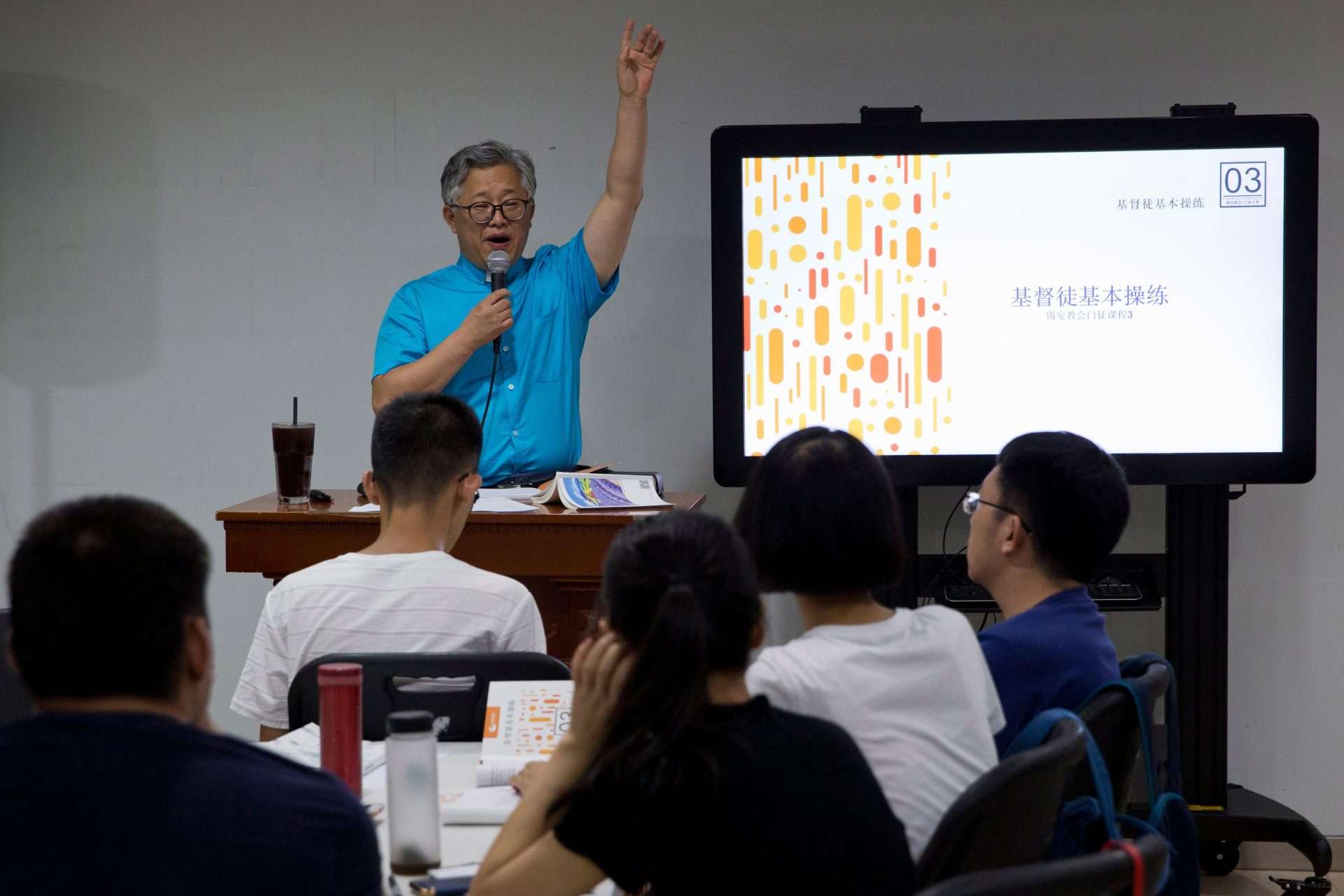
Pastor Ezra Jin Mingri leading a class at his church in Beijing in 2018 before its closure
Ng Han Guan / Associated Press / Alamy
Grace Jin Drexel insisted her father Ezra Jin Mingri, who led the Zion Church network, did not pursue any political agenda that could have prompted his arrest in October.
The Chinese government’s policy towards religion “is not about indigenisation” but persecution, according to the daughter of an imprisoned church leader.
“It’s about persecution of religion,” said Grace Jin Drexel, whose father Pastor Ezra Jin Mingri led the Zion Church network until his arrest on 10 October in Beihai, Gungxi Province.
The authorities detained nearly 30 other Zion Church leaders across China in the same operation, effectively dissolving what was one of the largest unofficial house church networks in the country.
Ms Drexel told The Tablet that the arrests were conducted by a centralised taskforce rather than regional authorities, and followed a renewed political emphasis on religious control following a study session on “sinicisation” by the Politburo of the Chinese Communist Party (CCP) in September.
Benedict Rogers, senior director of the advocacy group Fortify Rights, told The Tablet that the arrests were “part of a wider and more intense crackdown” on religion in China over the past year, arguing that it reflected the CCP’s “absolute intent to control religion”.
In January, the authorities arrested leaders of the prominent Early Rain Covenant Church in southwest China.
Pastor Jin and his fellow church members were reportedly arrested under the “Online Code of Conduct for Religious Professionals” published in September, for alleged “illegal use of information online”.
Since it was subject to an official ban in 2018 for refusing to install facial recognition technology in its main church building, the Zion Church has adopted a “hybrid model” of online and house-church meetings, which helped its rapid expansion during the Covid pandemic.
However, Ms Drexel insisted her father did not pursue any political agenda or use his position in the church to criticise the CCP.
“He would not join the government church because that would no longer be serving one master,” she said, adding that “it would be naïve” to think that he could work independently within a state-approved church.
Nevertheless, Jin “worked relatively well with the local government” even after the ban on the Zion Church in 2018, Ms Drexel continued. “I don’t think he felt it was his mission to bring down the leadership.”
The Chinese government recognises Buddhism, Taoism, Islam, Catholicism and Protestantism as distinct religions, though 90 per cent of the population professes no religious affiliation.
Official Protestant churches are permitted within the Three-Self Patriotic Movement, under the CCP’s United Work Front, and are subject to official requirements including the promotion of “sinicisation”.
Within the same structure, the Chinese Catholic Patriotic Association (CCPA) governs the state-approved Catholic Church. Its “election” of bishops without papal approval created an historic division between an official and an “underground” Church, with the latter periodically subject to repression by the Chinese authorities.
Since 2018, a provisional agreement between the Vatican and Beijing has governed episcopal appointments with both parties approving new bishops and each authority expected to recognise both official and formerly “underground” bishops.
However, critics of the agreement say that the Chinese authorities have repeatedly broken its terms – though these remain secret – and that it restricts the Church’s voice on human rights while abandoning clergy who still refuse to join the CCPA.
While the Vatican hoped the agreement would promote religious freedom in China, said Rogers, “the opposite has happened” because “underground” clergy face increased restrictions amid the wider measures against religion such as Pastor Jin’s arrest.
Proponents of the agreement emphasise the importance of ensuring that all Catholics in China are under the care of bishops recognised by Rome, observing that protests against the authorities’ conduct were largely ineffectual even before 2018.
Speaking at an event in Tallinn last week, the Holy See’s Secretary for Relations with States Archbishop Paul Gallagher acknowledged that “many people are critical of the Holy See for talking to the authorities in Beijing”.
In response to a question about Cardinal Agostini Casaroli, a diplomat who led the Church’s “Ostpolitik” negotiations with communist states in the 1960s and ‘70s, Archbishop Gallagher compared the “martyrdom of patience” Casaroli endured from his critics to the attacks on the provisional agreement.
“People are criticised for it, the previous popes, and also [Secretary of State] Cardinal [Pietro] Parolin, and people like myself,” he said, adding that he was glad not to be “exposed to the snipers as they are”.
Benedict Rogers told The Tablet that while there were limits to what protests could achieve for religious freedom in China, “international pressure can help in terms of improving the conditions people are held in”. Meanwhile, “silence definitely doesn’t help”.
Grace Jin Drexel, who is a US citizen, said that protests at her father’s arrest could show the CCP that it was “in China’s interest” to release him if it wishes to be considered “a respectable country”.
In his remarks in Tallinn, Archbishop Gallagher observed that Cardinal Casaroli felt “unfairly criticised” for his diplomatic work.
“Today, you don’t have to go very far to find some church historians who will ridicule [Ostpolitik] as the wrong way to have gone in the 1960s and 1970s, up to the collapse of the Soviet Union,” Gallagher said. “But it did allow, I think, the Church a degree of freedom.”
He continued: “It did allow in some parts of the former Soviet Union [and the] communist world for the Church to lay, perhaps, the foundations for a new beginning when those regimes collapsed completely.”