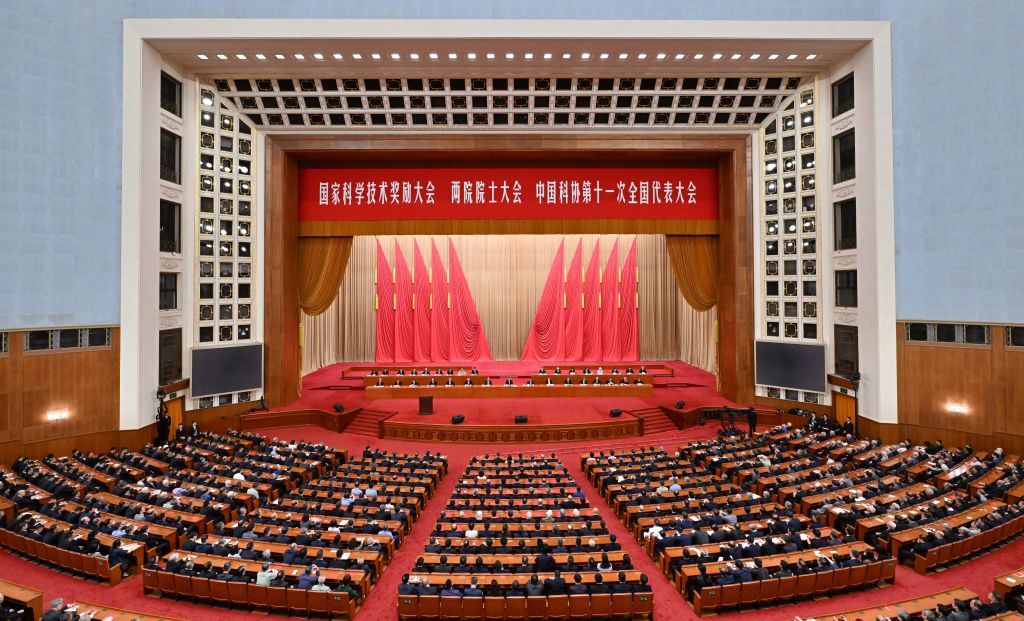
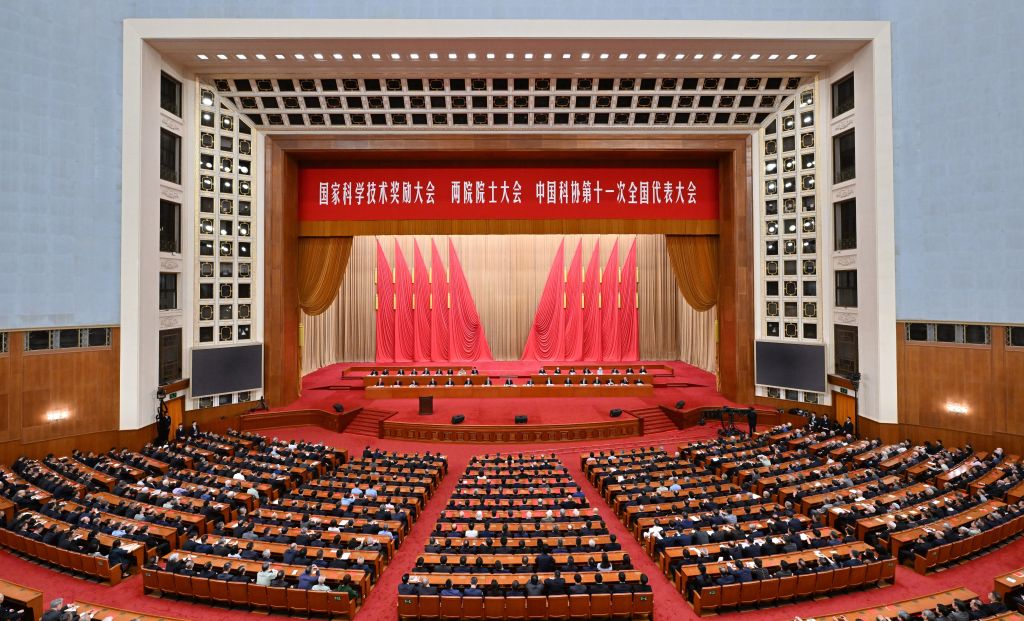
A meeting, which brings together the national science and technology award conference, the general assemblies of the members of the Chinese Academy of Sciences and the Chinese Academy of Engineering, and the 11th national congress of the China Association for Science and Technology, is held in Beijing, capital of China, July 8, 2026. (Xinhua/Yin Bogu)
Two veteran scientists won China’s top sci-tech award for the year 2025 on Wednesday for their groundbreaking contributions to the fields of lithium batteries and radar technology, respectively, as the country honored 258 projects and 11 experts for scientific and technological achievements.
Chen Liquan, 86, a researcher at the Institute of Physics under the Chinese Academy of Sciences (CAS) and an academician of the Chinese Academy of Engineering (CAE), and Ben De, 88, a researcher at the China Electronics Technology Group Corporation and also a CAE academician, received the nation’s highest scientific honor at a meeting in Beijing.
Chen, born into a rural family in southwest China’s Sichuan Province, grew up in the dim light of kerosene lamps, which sparked his lifelong pursuit of bringing electricity to the people. He is widely recognized as the founder, pioneer and leader of China’s lithium battery sector.
Chen built China’s first solid-state ionics laboratory from scratch. His team produced China’s first lithium-ion battery and established the country’s first pilot production line using entirely homegrown technology, equipment and raw materials.
He pioneered and realized the in-situ solidification battery technology approach, advancing sodium-ion batteries from fundamental research to commercial-scale deployment, and cementing China’s strategic lead in next-generation battery technologies.
Ben, born in a farming family in northeast China’s Jilin Province, entered Harbin Institute of Technology, located in Heilongjiang Province in the northeast, in 1957. He is acclaimed as the founder of China’s airborne pulse Doppler radar technology, a major pioneer of phased array radar technology, and a forerunner of space-based surveillance radar technology.
Ben successfully developed China’s first airborne pulse Doppler fire-control radar and its first large-scale long-range phased array early-warning radar. The two fundamental modern radar technologies he pioneered, pulse Doppler and phased array, have guided the development of China’s land, sea, air and space early-warning and detection systems.
Wednesday’s meeting conflated the national science and technology award conference, the general assemblies of the members of the CAS and the CAE, and the 11th national congress of the China Association for Science and Technology.
In addition to the two top honorees, 51 projects received the State Natural Science Award, 58 projects the State Technological Invention Award, and 149 projects the State Scientific and Technological Progress Award. Meanwhile, nine foreign experts were presented with the International Science and Technology Cooperation Award.
AWARDS HIGHLIGHT INNOVATION DRIVE
This year’s awards tell a compelling story about where Chinese science is heading.
For the first time since 1999, three first prizes of the State Natural Science Award were presented, which is a clear sign that the country’s strategic drive to bolster basic research and original innovation is paying off.
Take the single-atom catalysis project, for example. The original concept was first proposed by Chinese researchers and has since gained global recognition across fields including catalysis, chemical engineering, materials, biology and energy.
Another winning project precisely measured the strength of a single hydrogen bond using a quantum approach, opening up entirely new possibilities in condensed matter physics, while in the information field, researchers developed a phosphor-free pure-chip LED technology that has produced micro-displays and the world’s first yellow-light AR glasses.
Many award-winning projects are also directly tied to national strategic needs. One team developed a system that recreates extreme space conditions right here on Earth, using electrostatic, ultrasonic and electromagnetic fields to simulate microgravity and pioneering new ways to process high-temperature metals.
Another project pushed the limits of ultra-deep drilling, retrieving 8,187 meters of continuous terrestrial rock cores from the Cretaceous period in northeast China’s Songliao Basin. It is the world’s most complete record of its kind. The findings have helped Chinese scientists establish a high-precision, multi-disciplinary system for geological dating and paleoclimate reconstruction.
There are also the innovations that touch people’s daily lives. In agriculture, researchers tackled long-standing bottlenecks in hybrid rice seed production by developing new parent lines with superior outcrossing performance and super-high-yield hybrid varieties, while also advancing mechanized, high-efficiency seed production techniques.
The breakthroughs directly address the challenges of low per-unit yields, insufficient seed production capacity, and high seed costs, helping to secure China’s food security at the very foundation of the supply chain.
In healthcare, researchers developed a specialized bedside MRI device for stroke diagnosis, along with new methods to suppress complex flow signals around cerebral vessel walls. The system has slashed confirmation time for acute stroke from 40 minutes to under 10 minutes, enabling rapid, accurate diagnosis even at primary-level hospitals. This breakthrough has fundamentally changed the international diagnostic paradigm for acute stroke.