Last week, President Trump postponed a summit with his Chinese counterpart on account of the war with Iran. When Trump and Xi Jinping do meet, here’s an agenda item bound to figure prominently: rare earth elements. Right now, China holds a near-monopoly over these strategic metals that are key components in so much that makes the modern world go: smartphones, robotics, EV’s; also fighter jets, drones and radar technology. That is, China controls materials essential to America’s ability to wage war. Tonight, the story of an American company confronting this elemental crisis. It mines rare earth elements, processes them, and makes them into superpowered magnets. And it’s part-owned by us, American taxpayers, in an unusual deal crafted by the federal government.
An hour southwest of Las Vegas, in the guts of the Mojave, Mountain Pass, California, might be the ultimate front of our trade war with China. This massive cavity in the ground? Behold, the only active rare earth mine in the U.S. This is an unlikely battleground.
Jon Wertheim: Are we stepping on rare earths, as we speak?
Michael Rosenthal: Yes. Everywhere you look is, is rare earths.
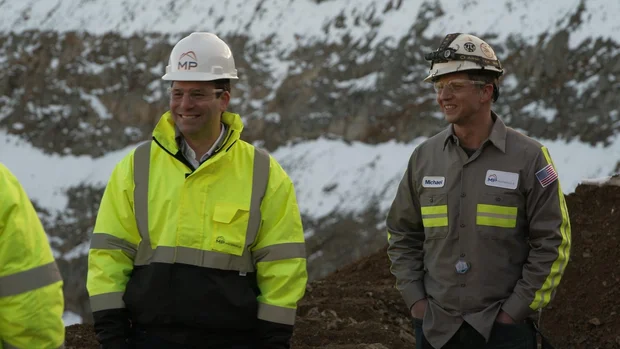
And Michael Rosenthal and James Litinsky are the unlikely men in charge, two Floridians in the snow, two finance types suddenly trafficking in mining and metallurgy.
Jon Wertheim: You have no background in geology and now, you’re running the biggest rare earth mine in the U.S.
60 Minutes 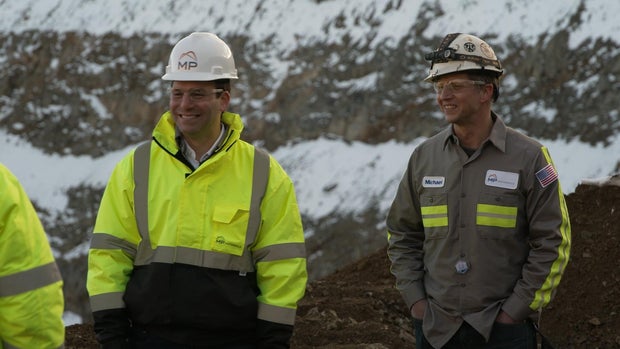
James Litinsky: Yeah. This is just such an important site. And the idea that this entire supply chain was on the other side of the world in China. It just occurred to us that someone had to help fix this problem.
The Trump administration is keenly aware of the problem of China’s rare earth dominance. Doug Burgum is secretary of the interior.
Secretary Doug Burgum: If you have a cellphone, have a laptop, if you drive a car then you’re touching rare earth minerals and rare earth magnets. It’s essential to everyday life, but it’s also essential to aerospace, telecom, defense systems…
Yes, defense systems.
According to the military, one F-35 fighter jet contains about a hundred pounds of rare earths, incorporated into its various parts.
Jon Wertheim: Just to be clear, the U.S. defense industry is subject to the whims of China and Xi Jinping for military technology?
Secretary Doug Burgum: Well, this is one of the reasons why President Trump created the National Energy Dominance Council with a broad set of objectives. One of those was to make sure that we had secure supply chains for critical and rare earth minerals.
Right now, we don’t have secure supply chains of rare earths because China has cornered the market.
Secretary Doug Burgum: They also weaponize it, because if anybody in the rest of the free world said, “Hey, we’re gonna start mining and we’re gonna start refining,” then they would target that particular mineral, dump a quantity onto the market, drive the price down. And companies, including U.S. companies that were profitable suddenly became unprofitable.
Before we proceed, let’s dispense with the misnomer: rare earths aren’t rare. Here’s what is rare: sites with high enough concentrations of rare earths — and accessible enough locations — to make extraction worthwhile. In their purest form, rare earths aren’t rocks but elemental metals – deep cuts on the periodic table, numbers 57-through-71 and two others, for those scoring at home.
Julie Klinger: …lanthanum, cerium, praseodymium, neodymium, samarium…
Julie Klinger is a professor of environmental studies at the University of Wisconsin-Madison and a rare earths expert who’s visited mines worldwide and written extensively on the subject.
Jon Wertheim: What are their qualities?
Julie Klinger: The thing that distinguishes rare earth elements are their fantastic magnetic, conductive, and optical properties. So they’re used often the way you might use spices in cooking because if you add just a little bit of a certain rare earth element, say, to a magnet, that enables that magnet to be both very small and very powerful.
60 Minutes 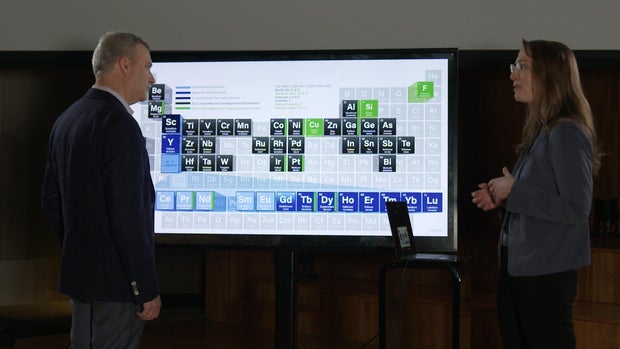
Geologists found rare earths at Mountain Pass in 1949. By the ’60s, individual rare earths were being mined, separated, and utilized, not least europium, which enhanced the color red in early television sets.
Then, in 1982, researchers found that, another, neodymium strengthens magnets.
Julie Klinger: And these super high-powered magnets are used in everything from, you know, making your cell phone buzz to the navigation components for drones and smart bombs to high speed rail and electric vehicles.
For decades, Mountain Pass was the world’s rare earth mine. But gradually, then suddenly, mining and magnet-making began moving offshore… familiar story: China could do it cheaper.
Jon Wertheim: The U.S. disinvested in rare earths.
Julie Klinger: Absolutely.
Jon Wertheim: Why?
Julie Klinger: It’s a dirty business. It’s a risky business. It’s a difficult business to really break even.
In the 1990s, Mountain Pass fell victim to economics and to environmental regulators, after radioactive water leaked into the desert. The mine languished for a decade, until a new company, Molycorp, tried, unsuccessfully, to compete with China and revive the business. James Litinsky was running a Chicago hedge fund, looking for value in distressed companies. When Molycorp filed for bankruptcy in 2015, Litinsky glimpsed opportunity.
James Litinsky: When you’re running a hedge fund it’s, there’s not much tangible to it. You’re movin’ numbers on a screen. And then I made the mistake of going out and looking at the site. Actually seeing the assets –
Jon Wertheim: Actually seeing what your investment looked like.
James Litinsky: Yes, yes. And I was just blown away by the scale of the assets.
“The assets”? This massive open pit, these concentric circles: a mine 3,000 feet across, 600 feet deep, with one of the world’s richest deposits. Litinsky turned to Michael Rosenthal, then working for a New York hedge fund. The two were close friends growing up. And they decided to partner.
Jon Wertheim: You appreciate the absurdity of the story.
James Litinsky: For sure.
James Litinsky: Two hedge fund guys buy a mine. What could go wrong?
For a while, plenty. When they bought the mine in 2017, it was under water, financially and literally. Thirty million gallons had puddled at the bottom. There were only eight employees.
60 Minutes 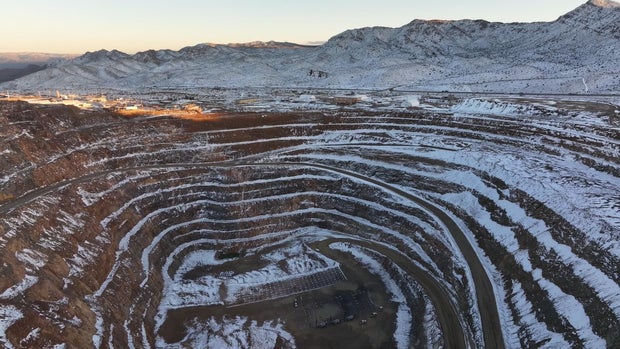
They called their new company MP Materials and got the mine back up-and-running: blasting earth, then crushing rocks into gravel, then milling it into fine powder.
Litinsky took over the business as CEO; while Rosenthal spent long days on site, becoming an expert on rare earth mining and refining.
Jon Wertheim: How do you characterize the division of labor here?
Michael Rosenthal: I get dirty, and Jim explains what we’re doing.
Today, Mountain Pass employs more than 700. Rosenthal manages the operation.
Jon Wertheim: I cannot get over how extensive and intensive all of this process is once you’re done with the actual mining.
Michael Rosenthal: Yeah. The mining is really the easiest part.
The hard part? Separating the rare earths from the rock, and then each other.
Two years ago, MP reached a milestone: after investing hundreds of millions of dollars, it was able to refine neodymium and praseodymium—to 99.9% purity.
James Litinsky: This is the refined product. This is the money room.
Jon Wertheim: This is it?
James Litinsky: This is it.
Each bag was worth around $120,000. There were 300 bags — roughly $36 million in inventory, when we visited.
Jon Wertheim: So this fine powder will end up…?
James Litinsky: Could end up in your pocket.
Jon Wertheim: Could end up in my iPhone.
James Litinsky: Yeah.
60 Minutes 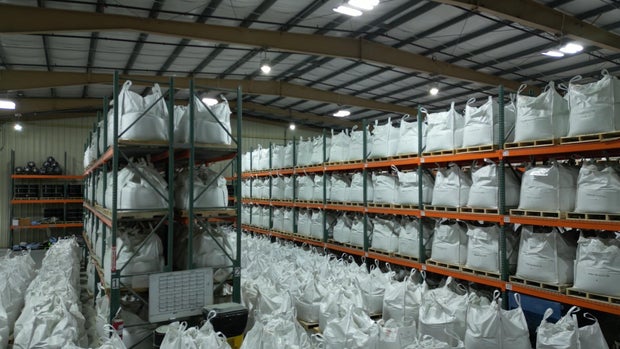
MP needed one last link to bypass China and reclaim the supply chain: making the final product, those high-powered rare earth magnets. So, in Fort Worth, Texas, MP built this facility, where pure rare earth powder from Mountain Pass gets melted, cooled, compressed, diced and eventually turned into, well, these…
In a matter of months, millions will be going into GM cars, and into Apple products, starting next year. MP was fulfilling its business plan, taking rare earths from mine-to-magnets Then last spring, it alchemized from a vertically integrated business to a pivotal player in our national security.
Last April, President Trump unveiled his global tariffs plan, so-called Liberation Day. China retaliated to devastating effect, choking off rare earths to the U.S. Ford Motors, for one — suddenly without magnets — had to temporarily stop making Explorer SUVs. After a series of trade truces between the U.S. and China, the rare earth spigot came back on. Litinsky says few realize how close we were to economic catastrophe.
James Litinsky: There were major manufacturers that didn’t even realize the extent of the rare-earth magnets that they had in their supply chain. We were seeing the economy on the verge of shut down.
With markets reeling, senior Trump administration officials summoned Litinsky and Rosenthal to Washington.
James Litinsky: We got called into the Pentagon and it was clear that there was a directive from the president to solve this problem as quickly as possible.
Jon Wertheim: What did the government want from you?
James Litinsky: The Pentagon wanted a Manhattan-style project to accelerate the entire supply chain of rare-earth magnetics in the country.
Jon Wertheim: That’s the analogy?
James Litinsky: Those exact words were used. “Manhattan Project” or “Operation Warp Speed.” We’ve gotta work to scale up everything that you’re doing as quickly as we possibly can.”
A Manhattan Project for rare earths resulted in an unusual deal. The Pentagon agreed to inject $400 million into MP Materials, and took a 15% ownership stake. (So, we, Americans, are all in the rare earth business now.) Plus—critically—the deal came with a guaranteed 10-year price floor for rare earths. So, even if China tries to flood the market again, driving down prices, MP is covered.
Jon Wertheim: Has there ever been anything like this?
James Litinsky: Well, exactly like this, maybe not. But if you look back, whether it was the railroads or aluminum for aviation prior to World War II or the semiconductor industry, there’s actually a long tradition of really critical industries where our country needs to bring on line infrastructure and I think this is one of those industries.
And the government had one more stipulation for MP: ramp up rare earth magnet production tenfold. To do so – MP is building an even bigger rare earth magnet factory also in Texas – that it says could produce enough to meet the country’s needs. It’s expected to be complete in 2028. Still…
Jon Wertheim: As we sit here today, what percentage of the world’s rare-earth magnets are made in China?
James Litinsky: Well north of 90%.
Jon Wertheim: So China in effect can still hold the world hostage here.
James Litinsky: They currently do.
Back in Washington, Secretary Burgum has been a vocal supporter of stockpiling America’s critical minerals. He defends the MP deal, even if it strays from the principles of market capitalism.
60 Minutes 
Jon Wertheim: You’re talking about equity positions in private companies and price floors, and in this case a demand that production increases 10X, tenfold. Wait a second. That has the whiff of socialism.
Secretary Doug Burgum: I wouldn’t call it socialism. I’d call it, I’d certainly call it pragmatism, because free markets work, but they don’t work if you have an adversary that controls a monopoly that control the prices–
Jon Wertheim: You’re talkin’ China.
Secretary Doug Burgum: I’m talkin’ about China. There’s no market setting the price. It’s China setting the price. To get this industry started again, we have to do some things to kick start the private capital.
Jon Wertheim: This kind of industrial policy you’re talking about, does this happen but for China’s retaliation to last April?
Secretary Doug Burgum: I think it was, it was a catalyst…
James Litinsky: Frankly, we probably needed a crisis to wake up. And so – I think if there’s a silver lining, in the sense what happened last year was a big-time crisis that we needed.
Jon Wertheim: I’m struck by how quickly the economics bleed into geopolitics. If China says, “Listen, we’re gonna go invade Taiwan, and if you stand in our way, we’re shutting off our rare earth magnets.”
James Litinsky: Well, that’s the risk as it stands today we need permission from the Chinese government to make things. We need permission from the Chinese government to make military things. And the practical reality is, that is not an acceptable condition. And so we have to change this dynamic.
The current U.S.-China trade truce is set to expire in eight months. Absent a new deal, our rare earth supply — short-term anyway — remains vulnerable.
Produced by Graham Messick. Associate producer, Alex Ortiz. Broadcast associate, Mimi Lamarre. Edited by Peter M. Berman.