-
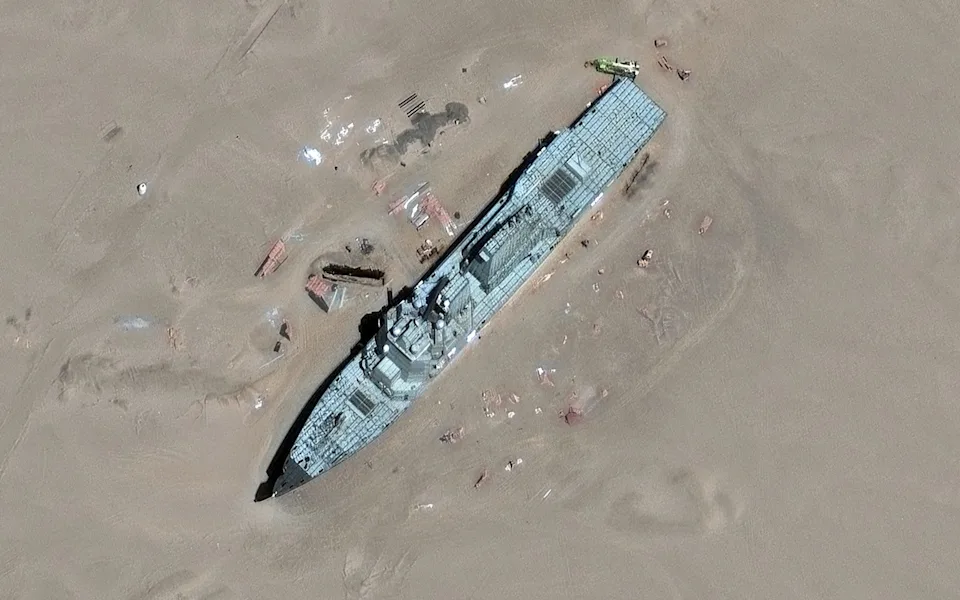
China has built an array of replica ships, aircraft and bases in its desert expanse.
-
New images show an extensive buildup of targets and a focus on the US and Taiwan.
-
One former military official said the scale of this training was “unprecedented.”
China is not just building replicas of US warships.
Satellite images analyzed by The Telegraph — a member of the Axel Springer Global Reporters Network that includes Business Insider — reveal it is also building models of fighter jets, naval bases and Taiwanese presidential buildings.
Beijing has been using these models to test its ever-growing stockpile of long-range weapons and new AI systems as it prepares to take control of Taiwan — a top priority of Xi Jinping, the Chinese president.
The accuracy of the replicas “signals a highly specific focus on potential adversaries rather than generic capability building”, said Damien Symon, a geo-intelligence researcher at the AI-analysis firm The Intel Lab, who first identified several of the maritime models.
While it is unknown if the US would officially come to Taiwan’s defense, most experts agree that Washington would probably step in. Without American support, Taiwan would struggle to remain autonomous.
China’s People’s Liberation Army (PLA) has also built to-scale models of Taiwan’s presidential office and key government buildings so soldiers can practice storming the capital in the most realistic setting possible.
“They’re basically creating replicas to provide them with the ability to maneuver through there on a training operation as though they were standing in Taipei,” said Sean O’Connor, lead satellite image analyst at defence firm Janes.
Satellite images last year showed that China had built a 280km-long tunnel connecting the different replicas of Taiwan’s government buildings to prepare for a scenario in which the country’s leaders attempt to flee underground.
While it’s not uncommon for countries to train with specific scenarios and enemies in mind, Monty Khanna, a former rear admiral in the Indian navy, said that the scale at which China had been training was “unprecedented.”
And these satellite images show just how expansive it is.
China built a 3-D model of the US Arleigh Burke-class guided missile destroyer to target in a remote desert, as seen here in May.Vantor / Telegraph
A 23-mile railway provides troops with moving targets like this mock warship.Google Maps
A mock runway in China has replicas of F-35 and F-16 fighter jets, as well as two rows of F-22s nearby.Google Maps
The next set of satellite images reveal a mock-up of the Yokosuka Naval Base — America’s largest naval base in Japan and one which would almost certainly be used in the event of a Taiwan contingency.
The US has more than 55,000 troops stationed in Japan — the largest number outside the US — as part of a security treaty between the two countries.
Experts previously told The Telegraph that the US forces especially in southern Japan would be the “tip of the spear” in a US response to a Chinese invasion.
As part of the Destroyer Squadron 15, there are 10 Arleigh Burke-class ships permanently stationed at Yokosuka.
“It’s one of the most important US bases. If China attacked Taiwan, the Yokosuka Naval Base would presumably be involved so they include a model of Yokosuka for anti-access aerial denial drills,” Lu Li-shih, a former lieutenant commander in Taiwan’s navy, told The Telegraph.
Satellite images show mock-ups of warships stationed at the fake naval base.
Thomas Shugart, a senior fellow at the Center for a New American Security and a former US Navy submarine commander, identified a crater next to the fake warships, likely caused by a ballistic missile. The vessels were damaged in further strikes.
In the Gobi desert, China built a mock-up of the Yokosuka Naval Base — the US’s largest naval base in Japan.Top: Google Maps; Bottom: Vantor / Telegraph
Along with Yokosuka, China has also built a replica of Taiwan’s Su’ao Naval Base, a key maritime hub on the country’s north-eastern coast, along with a model US Kidd-class destroyer moored at its port.
According to satellite imagery, the base was used in a live-fire test between January and February 2022 where a missile struck part of the pier and destroyed a black arch-shaped model that had probably been used to calibrate missile seekers.
While Su’ao isn’t Taiwan’s largest navy base, it’s one of only a few located along the country’s eastern coast — the farthest side of the island from China that is protected by a large mountain range.
Mr. Lu, the former lieutenant previously stationed at Su’ao, told The Telegraph that China probably chose to develop a model of this naval base because it was a more complex target.
“If they launch a rocket from China, it will have to go over Taiwan’s mountains, so they need to practice launching the rockets at a particular angle, which they might not have to do if they were targeting a navy base on the west coast like Zuoying,” said Mr. Lu, referring to Taiwan’s largest naval base located on the western coast facing China.
The damage to the Su’ao model, as well as Yokosuka and the ship models, indicates numerous successful test-missile launches.
“These aren’t close-range, controlled demonstrations. You’re looking at missile launches from kilometres away… That alone points to credible long-range strike capability,” Mr. Symon said.
The American ship models are probably being used as targets to test China’s wide array of weapons, including the YJ-21 and YJ-17 hypersonic anti-ship missiles and the DF27 ballistic missiles, which can reach up to 8,000km.
All are capable of reaching Taiwan from China, even if fired from the country’s more remote, inland launch ranges.
China has also built a mock-up of one of Taiwan’s largest airbases, which is also used as a civilian airport servicing the central city of Taichung.
Dating back to 2002, it is one of the oldest mock-ups that China has and is also one of its most rudimentary, consisting only of lines in the sand.
Mr. O’Connor said that the model was located right next to the Jiuquan Satellite Launch Center, China’s oldest rocket launch facility, which means it is probably used for weapons testing and to practice bombing runs.
China built a replica of one of Taiwan’s largest airbases, which doubles as a civilian airport for Taichung.Left: Google Maps; Right: Vantor / Telegraph
Storming the capital
China also appears to be training to seize Taiwan’s key government buildings, including its presidential office, foreign ministry and judiciary.
Satellite images show two separate mock-ups of the Bo’ai Special Zone in downtown Taipei where its government is located.
One of the mock-ups, which is located at the Zhurihe training grounds and dates back to 2014, focuses on the buildings, probably to simulate scenarios in which Chinese ground forces would storm the capital.
Imagery released on Chinese state media shows PLA soldiers on a training exercise in front of the presidential building model in 2015.
China has built replicas of Taiwan’s key buildings.Vantor/Telegraph
The second and newer model, located in the desert in Inner Mongolia, focuses more on the streets around the government buildings, with the angles of the roads and sizes of the city blocks closely imitating Taipei.
Mr. Shugart said that these models were very likely built for a “rehearsal.”
“That’s probably for practicing having ground troops taking those specific facilities,” he explained.
A mock-up in Inner Mongolia closely resembles the layout of Taipei, Taiwan’s capital.Top: Google Maps; Bottom: Vantor / Telegraph
In 2015, soon after the first replica of the presidential office was built, the PLA released a training video showing soldiers firing and charging towards it.
Along with military drills, experts also note that imagery of these models is a very effective way to send a message to all potential adversaries.
“It’s messaging to Japan that ‘if there’s a fight, you’re going to be in it.’ It’s messaging to the US that ‘if you try to intervene, we’re going to strike your bases.’ And messaging to Taiwan that ‘we are practicing to take your capital,'” said Mr. Shugart.
And the message is getting through. Countries across the world, especially in the Indo-Pacific have been increasing their defense budgets and boosting their weapons production and procurement, with many citing Chinese aggression as a key factor.
Pete Hegseth, the US defense secretary, said in May there was “rightful alarm regarding China’s historic military buildup and the expansion of its military activities in the region and beyond.”
The Axel Springer Global Reporters Network harnesses the resources of the company’s newsrooms to publish ambitious scoops, investigations, interviews, opinion pieces and analysis. It allows journalists — including those from The Telegraph, Business Insider, POLITICO, WELT, BILD, Onet and Fakt — to collaborate on major stories for an international audience of hundreds of millions across platforms: online, print, TV and audio.
If you enjoyed this story, be sure to follow Business Insider on Yahoo.