WHEN XI JINPING last visited North Korea, in 2019, international efforts to halt its nuclear weapons programme were still under way. China and Russia, North Korea’s longtime patrons, had backed stiffer UN sanctions on the country as part of an American-led campaign of “maximum pressure” on its leader, Kim Jong Un. Mr Kim had just held two summits with Donald Trump, then in his first term in the White House. And though the second of those summits ended in failure, Mr Xi expressed hope on his North Korean visit that the process would continue, commending Mr Kim on his efforts to denuclearise the Korean peninsula.
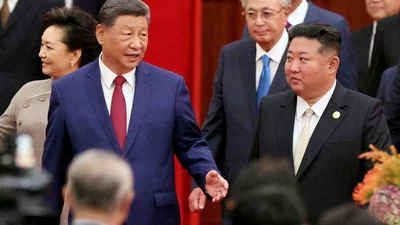
FILE PHOTO: Chinese President Xi Jinping and North Korean leader Kim Jong Un arrive for a reception marking the 80th anniversary of the end of World War Two, at the Great Hall of the People in Beijing, China September 3, 2025. REUTERS/Florence Lo/File Photo/File Photo (REUTERS)
China’s leader harbours no such hopes as he makes his second visit to North Korea, from June 8th to 9th. One of his main goals is to counterbalance Russian influence there, which has grown much stronger since Mr Kim sent troops to fight against Ukraine in 2024. Mr Xi also aims to reassert China’s clout as North Korea’s primary economic partner in case Mr Trump tries to resume his diplomatic outreach to Mr Kim, as many observers expect. Some even speculate that Mr Xi may be conveying overtures from Mr Trump. But stopping North Korea’s nuclear-weapons programme—which is far more advanced than Iran’s—appears to have fallen off China’s agenda. That could make it much harder for Mr Trump to convince Mr Kim to give up his atomic ambitions.
Russia’s president, Vladimir Putin, is partly to blame. In exchange for Mr Kim’s help in Ukraine, the Kremlin has provided financial and other assistance that has bolstered North Korea’s moribund economy as well as its military buildup. The two countries have upgraded their relationship to a more formal alliance by signing a mutual-defence treaty. In addition, Russia has in effect accepted North Korea as a nuclear-armed state, despite backing repeated United Nations Security Council resolutions to prevent that outcome. Sergei Lavrov, Russia’s foreign minister, has called it a “closed issue”.
All this unsettles Mr Xi, despite his own support for Russia’s war in Ukraine. Like Mr Putin he has long worried that regime collapse in North Korea could lead to a unified, democratic, pro-Western Korea. In such a scenario, American troops (of which there are 28,500 in the South) might move to the eastern land borders of Russia and China. Yet Mr Putin does not appear to share Mr Xi’s concern about North Korean aggression against the South, one of China’s biggest foreign investors and trade partners. Nor, it seems, does Russia worry as China does that North Korea’s nuclear threats could help convince Japan and South Korea (both American allies) to acquire atomic weapons of their own.
Mr Xi still worries about those risks, according to Chinese experts. But they say he has concluded that China cannot use its leverage to convince Mr Kim to renounce his nuclear programme without risking economic collapse there. And America cannot risk a military strike on North Korea. The North Korean leader has not publicly restated a commitment to denuclearising the Korean peninsula since the summit with Mr Trump in Hanoi that ended in failure in February 2019. He has also doubled down on his atomic-weapons programme since then, testing more than a dozen inter-continental ballistic missiles. And after watching America wage war on Iran, Mr Kim will surely feel vindicated in hanging on to his arsenal.
Shortly before Mr Xi’s arrival Mr Kim sent a clear signal that his atomic aspirations were not up for debate. On June 4th North Korean state media said that he had unveiled a nuclear-materials production factory and published images of him at what appeared to be a uranium-enrichment facility. It said North Korea’s production capacity for weapons-grade nuclear materials had more than doubled in the past five years. South Korean officials reckon North Korea now creates enough fissile material for an additional 10-20 warheads annually. On June 7th Mr Kim’s powerful sister, Kim Yo Jong, declared that North Korea’s nuclear-armed status was “irreversible”.
China’s tacit acceptance of North Korea’s nuclear status started to become clear when Mr Kim and Mr Putin attended a military parade in Beijing in September 2025, standing either side of Mr Xi. China’s official readout of Mr Xi’s meeting with Mr Kim at the time did not mention the denuclearisation of the Korean peninsula, as it had after previous meetings. The change was also evident in Mr Xi’s back-to-back summits with Mr Trump and Mr Putin in May this year. A White House readout on Mr Trump’s said the two leaders “confirmed their shared goal to denuclearise North Korea”. But China’s readout said only that they discussed the Korean peninsula. Then a joint statement released during Mr Putin’s Beijing visit made no reference to ridding the peninsula of atomic weapons and said that China and Russia both opposed sanctions and military pressure on North Korea.
As well as counterbalancing Russia, China hopes to complicate American military planning in the region, says Tong Zhao of the Carnegie Endowment for International Peace in Washington, DC. Mr Xi aims to exploit tensions between South Korea and America, which wants its own forces there to focus more on China, while South Korean forces shoulder more responsibility for the threat from the North. China is also keen to gain access via North Korea to the Sea of Japan, says Mr Zhao. Although China has recently tried to revive its economic links with North Korea by improving cross-border infrastructure, Mr Kim appears to have been slow-rolling those efforts. Direct flights and train journeys between Beijing and Pyongyang, which were suspended during the pandemic, resumed in March. But North Korea has yet to allow Chinese tourists to return.
Mr Xi also seems to think that he can handle the regional fallout of North Korea’s de facto nuclear status. Chinese experts say that by tacitly acknowledging it, China is unlikely to upset relations with South Korea. The left-wing government in Seoul supports engaging with Mr Kim, accepting the reality of his nuclear programme and taking a staged approach to denuclearisation. Some Chinese scholars even suggest that China could tolerate a nuclear-armed South Korea. That is because China hopes that if South Korea develops the weapons, they would not be directed at Chinese targets, and that the South Korean alliance with America might weaken. China would be far less tolerant of Japan acquiring atomic arms but thinks it is less likely because of domestic opposition there.
The big question now is what Mr Trump could offer to bring Mr Kim back to the negotiating table. Since returning to office, America’s president has referred casually to North Korea as a “nuclear power” and said he is willing to meet Mr Kim. His administration’s first National Security Strategy did not mention North Korea and, though its National Defence Strategy did, it made no mention of denuclearisation. But Mr Kim insisted in a speech in September that for talks to resume America must explicitly drop its denuclearisation demand.
In his first term, Mr Trump hinted that North Korea’s failure to commit to that goal could prompt American military strikes. Today America is bogged down in the Middle East; North Korea has more than enough nuclear firepower to deter an attack; and with Russia and China back on his side, Mr Kim’s bargaining position has never looked stronger.