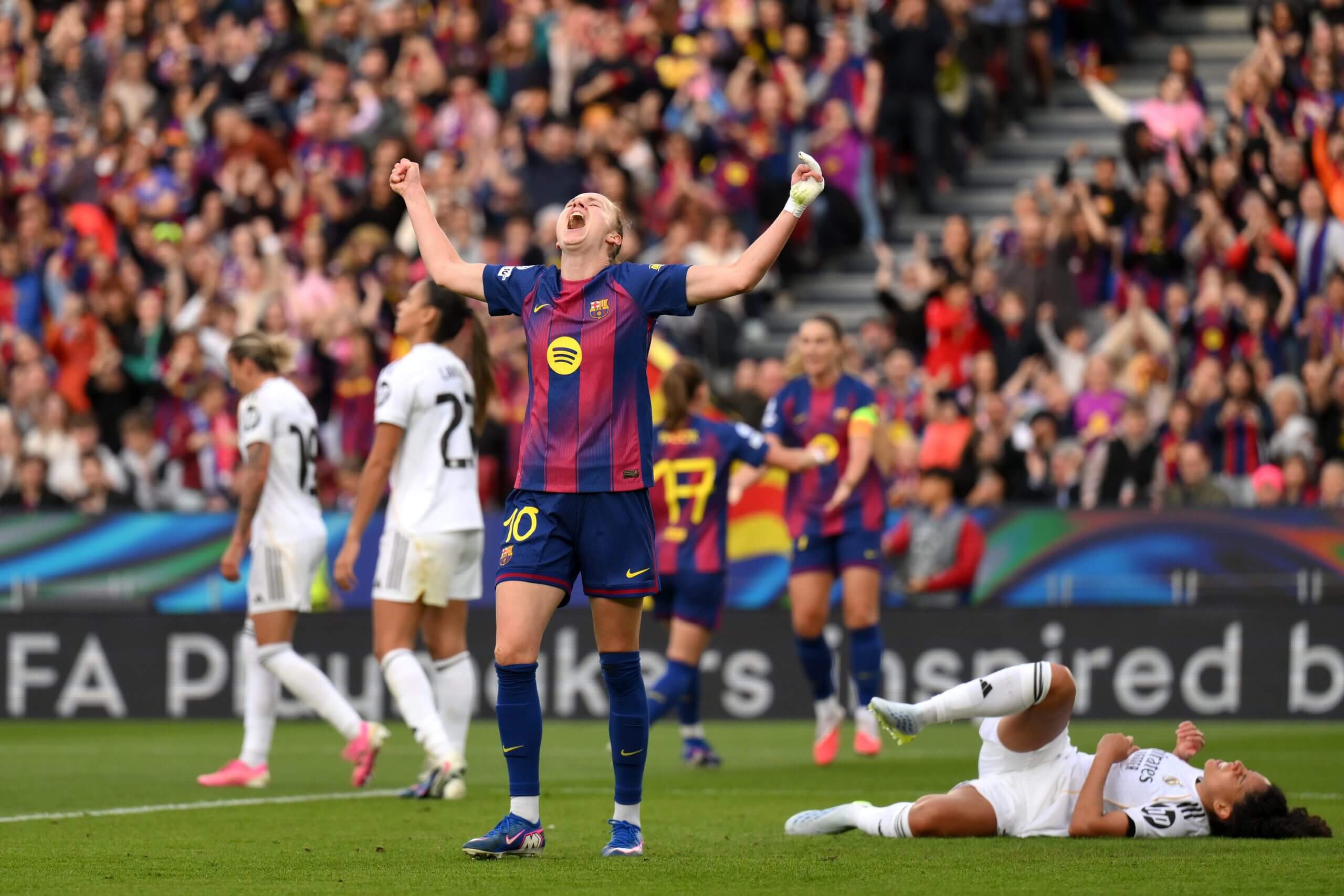
There are decisive wins. There are emphatic wins. And then there’s what Barcelona did to Real Madrid across two legs of the Champions League quarterfinals, burying a total of 12 goals, six in each meeting, to Madrid’s 2 on March 25 and Thursday. Barcelona’s 6-0 win Thursday also marked the women’s team’s inauguration of the renovated Camp Nou, which was filled with 60,067 supporters. Even more, star midfielder Alexia Putellas opened the scoring.
Both of Madrid’s Champions League responses came in the first match from 21-year-old Colombian forward Linda Caicedo.
Add to Thursday’s win the 3-0 league victory that Barcelona enjoyed over its Spanish rivals last weekend, and the appeal of El Clásico begins to take on a different, less entertaining meaning for both sides. (Unless you just really, really like watching Barcelona score goals.) And yet it’s inaccurate to say Barcelona lazed its way through these quarterfinals. Every touch of the ball, every run made and tenacious effort on goal was urgent and precise for the entirety of both legs.
For the players who were part of last year’s Barcelona side, which conceded a 74th-minute goal to Arsenal’s Stina Blackstenius that ultimately lost them the 2025 Champions League final, there has likely also been a fair bit of vindication behind those touches. Almost as if the club knows its dominance in the league, or even against Real Madrid in the quarterfinals, means nothing if it doesn’t take home a Champions League trophy at the end of it.
The victory was an outlier in an otherwise competitive set of matches. Here’s where things stand heading into the Champions League semifinals.
Barcelona cruised passed Liga F rivals Real Madrid with 12 goals over two legs. (David Ramos / Getty Images)
What are the semifinal matchups + any history between the teams?
Barcelona will find a respectable semifinal opponent in Bayern Munich. Like Barcelona, the German side is at the top of its league table by a wide margin and has reached the Champions League semifinals after defeating debutants Manchester United by a goal in each meeting — 3-2 on March 25 and 2-1 on Wednesday.
United arguably put up a more valiant fight than Real Madrid, particularly in both sides’ second legs, forcing Bayern to harness its maturity in the midfield and set-piece finishing to advance.
This semifinal meeting will be a redux of a league-phase clash from this Champions League campaign on Oct. 7 of last year. Barcelona was again a glutton for goal with a 7-1 win over Bayern. It is hardly productive to compare group stage to knockout matches, but both sides will surely remember Barcelona’s capacity to score against the top German side.
In the other semifinal, Arsenal, the reigning titleholder, will face eight-time titleholder OL Lyonnes. The last time the two met was also Oct. 7 in the group stage, when the French side walked away with the victory. The 2-1 affair was marked by an early goal from Arsenal striker Alessia Russo that was answered by a brace from Haitian attacking midfielder Melchie Dumornay.
Wolfsburg’s one-goal advantage heading into the second leg of its quarterfinal in Lyon offered the faintest of cushions considering the behemoth that is OL Lyonnes’ roster. Manager Jonatan Giráldez made two changes at midfield from the first match as U.S. women’s national team midfielder Lily Yohannes and Korbin Shrader earned starts over Dumornay and Damaris Egurrola, respectively.
Yet apart from Yohannes’ smooth finish in the 16th minute, OL Lyonnes struggled mightily to convert any of the 29 shots it took during regulation. French striker Marie-Antoinette Katoto’s extra-time goal was called back due to an offside ruling in the buildup. It wasn’t until OL Lyonnes’ 18th corner kick, in the 102nd minute, that it managed to break through. Dumornay, who subbed into the match for Yohannes (who was by then sitting on a yellow card) in the 69th minute pounced first. The ball hit her hand, and then two Wolfsburg players and the ground before she finished it, which VAR allowed after a long check.

OL Lyonnes’ midfielder Melchie Dumornay scored the series go-ahead goal for her side against Wolfsburg. (Jeff Pachoud / Getty Images)
Three minutes later, Lyon converted its 19th corner kick with an emphatic header off fullback Selma Bacha’s delivery. And to cap things off, with Wolfsburg’s hopes of a pass to the semifinals effectively smothered, Malawian winger Tabitha Chawinga found a fast break and dribbled straight at, and then around, Wolfsburg goalkeeper Stina Johannes before smashing the ball into the net.
The 4-0 score line conceals Lyon’s underwhelming performance for a vast majority of the game as much as it obscures Wolfsburg’s composure and efficiency with the few chances it created.
Arsenal no doubt paid close attention, and for a team known to begin games at high intensity (and with a much stronger conversion rate), it will certainly look to exploit any signs of attacking imprecision from Lyon.
Who are front-runners to reach the final?
Based on their form through the semifinals, Arsenal and Barcelona have both shown why they reached the final last year and why their names should be circled as favorites — but not likely by as much as you might think.
Against the most consistent and high-scoring team in the Champions League, Real Madrid gave the worst performance out of all the clubs in the quarterfinals. It struggled to find answers to the questions Barcelona demanded in ways Bayern Munich is unlikely to.
The Spanish giants will nonetheless be aided by their recent history with Bayern; even if the Germans manage a goal or two, they know how many ways their opponents can score (and how many goals each individual Barcelona attacker is capable of if need be), setting them on a steep upward battle at the end of the month.

Alessia Russo helped lead Arsenal past Chelsea. (Alex Burstow / Getty Images)
Following Real Madrid is Chelsea as underperformers in the quarterfinals. The London side has been in desperate need of a clinical finisher and exited the Champions League with a bang that came too late. Down 3-1 on aggregate, a stoppage-time goal from Sjoeke Nusken brought Chelsea within a goal of equalizing its league rival and forcing extra time. The only spark that followed was one of immense controversy when Chelsea manager Sonia Bompastor was sent off for protesting the lack of disciplinary action against Arsenal fullback Katie McCabe for pulling USWNT winger Alyssa Thompson’s hair.
Despite its loss, Chelsea did not make things easy for Arsenal, and unlike Chelsea, OL Lyonnes is spoiled with ferocious finishers who have proven their ability to turn up on a dime. Lyon will be considered to have to upset Arsenal despite the French side’s pedigree in the Champions League, but the fixtures will no doubt be tightly contested.

Momoko Tanikawa and Pernille Harder were key to Bayern Munich’s success in the quarterfinals. (Kate McShane / Getty Images)
Players to watch
Bayern Munich
Momoko Tanikawa: The Japanese forward is excellent in tight spaces, allowing her to find key passes that generate big chances in the final third.
Glódís Perla Viggósdóttir: Bayern’s captain scored a crucial goal off a set piece in the second leg against United, proving she’s just as much of an attacking threat as her center back counterpart Vanessa Gilles.
Pernille Harder: The prolific goal scorer has not missed a beat lately, notching seven goals in eight games in a variety of ways. Few other strikers are as composed in front of goal.
Arsenal
Stina Blackstenius: Does anybody enjoy themselves in the Champions League more than Blackstenius? The Swedish forward has just one goal in this year’s campaign, but her work rate and physicality often lead to counterattacks or open up players like …
Alessia Russo: Currently leading the tournament’s Golden Boot race, Russo has been effective as a No. 9 or No. 10 this season in the Champions League, which could make her tricky to scout.
Emily Fox: Even the flamboyance of a modern-day fullback doesn’t often earn it the same shine as attacking players, but Fox’s consistency makes her one of Arsenal’s most valuable players. Fox is reliable and effective on both sides of the ball.

Alexia Putellas celebrated her 500th appearance for Barcelona in the match against Real Madrid. (Lluis Gene / Getty Images)
Barcelona
Alexia Putellas: The first female Spanish player to score 30 goals in the Champions League, Putellas offers the qualities most teams would be fortunate to find in three different players: exceptional composure in the midfield, creativity that can undress a defense and an ability to score in a multitude of ways.
Ewa Pajor: The Polish striker, along with Harder, is just one goal behind Russo in the Golden Boot race. Pajor’s pace and tenacity in front of goal are exceptional, which speaks volumes considering the company that surrounds her.
Vicky López: Calling the 19-year-old attacking midfielder the successor to Aitana Bonmatí is emblematic, but it doesn’t quite capture what makes López’s game so special. There’s a sauciness to her technique on top of that La Masia foundation that keeps the tempo of Barcelona’s midfield high.
OL Lyonnes
Melchie Dumornay: Her performance in this Champions League should have already entered her name into conversations for Ballon d’Or finalist with the five goals she’s scored and the 24 balls she’s recovered throughout the tournament.
Selma Bacha: Easily one of the most gifted, naturally left-footed fullbacks in the world, Bacha offers just as much, if not slightly more, to OL Lyonnes’ attack as she does defensively. If anything tips that scale, it’s her quality set-piece delivery, which twice came in handy in the quarterfinal with Wolfsburg.
Lily Yohannes: The 18-year-old USWNT midfielder’s distribution — both her long passes and tighter ones — makes Lyon’s midfield tick. Her open-play goal Thursday and defensive efforts throughout the tournament (11 tackles, seven balls recovered) prove the versatility she offers.