Support CleanTechnica’s work through a Substack subscription or on Stripe.
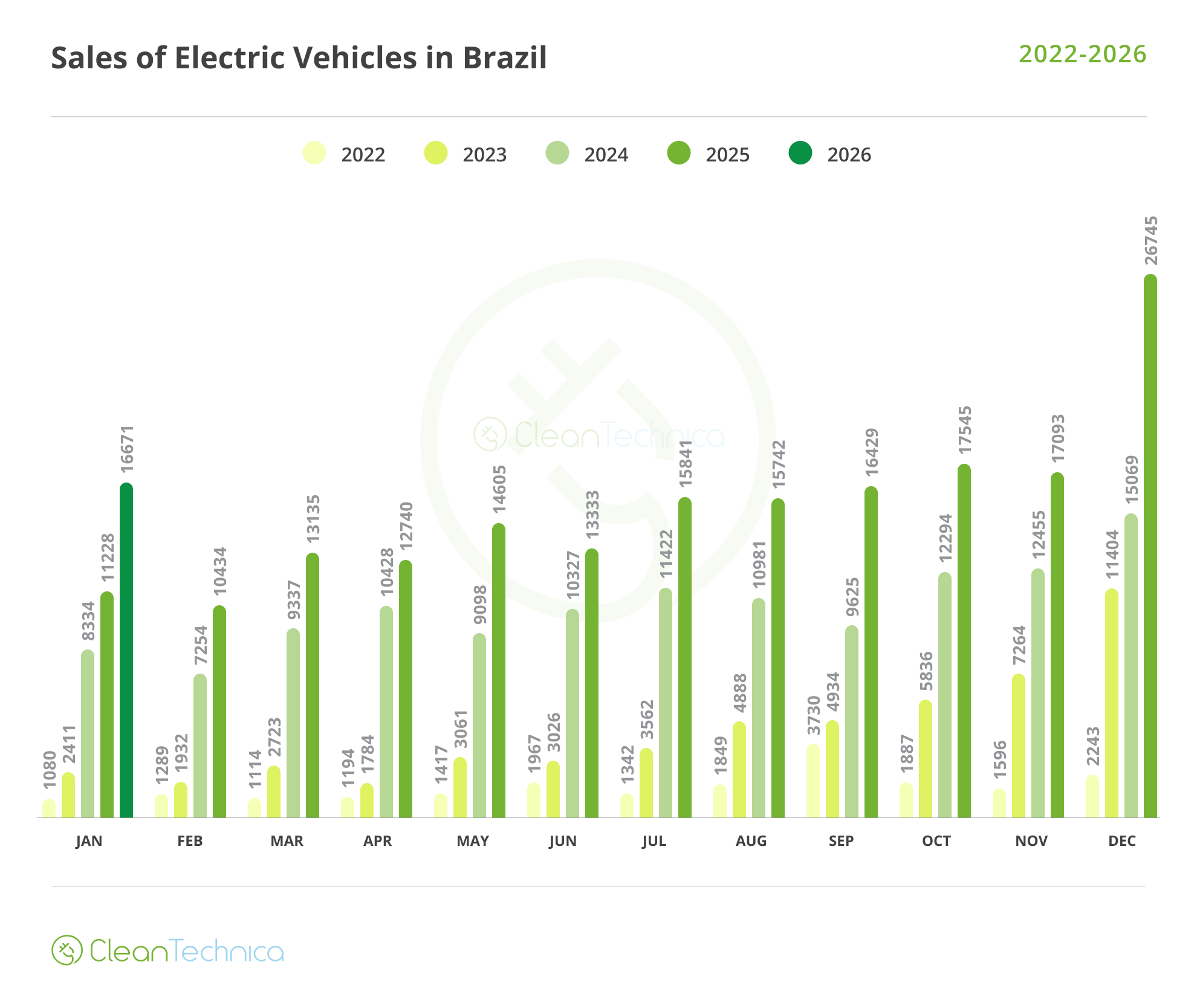
It’s been a while since we did an article on Brazil. Last time we checked in was in May 2025, when total EV sales soared to 14,600 units and market share rose to 6.5%. In the next few months, sales grew slightly and market share mostly stayed between 6% and 7%, meaning there wasn’t much to really report on.
This has been a long-term trend with Brazil. Sales ramped up rapidly in 2023, then stood mostly stagnant (with a slight decline) through 2024. They ramped up again in early 2025, surpassing 5% market share, only to plateau once again in the second half of the year.
But the tides are changing. The forces of electrification are taking a hold onto Latin America’s largest market, and I expect this market to look different, bolder, and more promising from now on. Let’s look at Brazil’s EV market and find out what’s going on, and what are these driving forces I have such high hopes on.
Market Overview
Brazil’s EV sales grew slowly but steadily through the first 11 months of 2025, with a peak in October with over 17,500 units. Then in December all hell broke loose as EVs surpassed 26,000 sales, 77% over December 2024 (which had been a record in itself). January 2026 saw a decline from December, reaching 16,671 EV sales, but January is always a slow month in Brazil’s vehicle market, and this represented a pretty solid 48% increase year on year (YoY).

Brazil’s EV market remains dominated by PHEVs, but BEVs have also grown steadily, representing almost exactly 50% of sales last month. Through 2025, BEVs represented 44% of EV sales, and PHEVs accounted for the other 56%.

Both December and January represented significant YoY increases in EV sales, and both also brought new records to overall EV market share, which now sits just shy of 10%. It’s interesting to note in this graph what I mentioned previously, which is Brazil’s tendency to present a sudden burst of growth (early 2024, early 2025) only to plateau for several months before another sudden burst of growth.

Something quite notable in Brazil is that since the overall market did not grow significantly both in 2025 and in January 2026, we are actually seeing combustion-vehicle sales (ICEV+HEV+MHEV) in decline. Overall vehicle sales in 2025 were merely 55,000 more than in 2024. Meanwhile, EV sales grew by 58,000, pointing to a very slight decline for combustion-based vehicles. 2026 seems to be starting in a similar tone: overall sales fell by around 600 units as EV sales grew by around 5,400, meaning combustion-only cars fell by around 6,000 units. Brazil’s peak-combustion came in the early 2010’s, so we’re way past that by now, and it’s positive to see combustion-only powertrains losing ~4% net sales at the start of this year, pointing to the fact that combustion vehicles will never reach the levels they once did.
Brand-wise, the market is dominated by BYD, with an impressive 59% market share. Such a primacy is common both in smaller countries and in markets just starting the path to electrification, but Brazil is huge and arguably pretty advanced, making BYD’s sustained lead all the more impressive. Following comes GWM thanks to the success of the Haval H6, and in third place we find the upcoming giant, the company trying to beat BYD at its own game all over the world: Geely. A notable mention goes to General Motors, whose strategy of re-branding Chinese EVs as Chevrolets (specifically the Chevrolet Spark EUV and the Chevrolet Captiva EV) has been reasonably successful in several markets, including this one.

Model-wise, we see once again the absolute domination of BYD, winning gold (BYD Song), silver (BYD Dolphin Mini), and bronze (BYD Dolphin). Below follows the aforementioned Haval H6 PHEV, and in fifth place the Geely Geome EX2, making quite the appearance in its first month on the market! A notable mention for the also recently arrived Leapmotor C10, available both in BEV and PHEV versions.

A Change in Tide: Local Manufacturing Explodes
There’s a trend that the best informed of our readers may already be seeing here. A lot of the most sold EVs in Brazil have something in common: they’re being locally produced (or, at least, locally assembled).
EV manufacturing in Brazil has ramped up at a, frankly, astonishing speed. A year ago, we were waiting for BYD to start production; today, at least three models are being locally built with ever-increasing national sourcing (Song Pro, Dolphin Mini, King) and three more are either starting local production or will do so in the coming months (Dolphin, King, Yuan Plus), as well as several Denza models later in the year. Aside from BYD, GWM is already producing the Haval H6 in its factory in Iracemápolis in both HEV and PHEV versions, and General Motors is already assembling the Spark EUV from SKD kits and will start to do the same soon with the Captiva EV (with more localized sourcing planned as sales increase). Stellantis is also starting local assembly of the Leapmotor C10 in its Ceará plant from CKD kits, and there are also rumors the Fiat Grande Panda BEV will be locally produced. Geely is poised to start local production of its best-selling Geome EX2 and also the SUV EX5 in Renault’s plant in São José dos Pinhais. At last, GAC is planning significant investments in Brazil, which it considers the “Gate to South America.” The brand will start construction on its new plant in late 2026. Though, before that, it may start assembling CKD kits in the HPE plant in Catalao, currently building for Mitsubishi and Suzuki but operating far below capacity.
There are important names missing here. Both Chery and VW have significant local presence in Brazil, yet neither of them is planning an incursion into the plug-in segment in 2026. Though, both are expanding in the non-plug-in hybrid market. The Japanese, unsurprisingly, are also missing in action despite significant local presence in Brazil, and neither Toyota nor Mitsubishi, Suzuki, or Nissan seem to be in any rush to compete in this growing market.
Local production is a key component for EV adoption in protected markets, and since Brazil is steadily ramping up tariffs on EVs and even SKD and CKD kits (to eventually reach parity with those of ICEVs), there would be little hope for electric cars in this market without it. But as EV production ramps up, national leadership gains all the more incentive to support the new technologies, and the risk of adverse legislation greatly shrinks.
Final Thoughts
When I decided to make this report, I was not aware of the speed at which EV production is ramping up in Brazil. I thought this country would take a while to pivot to electrification (because big ships take longer to turn and all that), but now I’m not so sure, and even if predictions are hard for such large markets, I’m hopeful we could see 50% EV share by 2030.
If anything, I’m extremely surprised that Stellantis is ramping up electrification ahead of Volkswagen Group, something antipodal to their current situation in Europe. My bet would be that VW is waiting for its new platforms to come out of China, and for 2026 will focus on HEV and MHEV powertrains, which are also growing at significant rates. I can’t understand otherwise how a brand that leads electrification in Europe has chosen to stay behind in Brazil. If true (and this is a big if), this could mean VW does not trust its European-made EVs are good enough to fight the Chinese in Brazil despite a level playground there.
GAC’s comments on Brazil being “the Gate to South America” serve to illustrate how Brazil could underpin the EV transition on the entire continent. All Mercosur markets plus several others are closely linked with this country, and as waivers on EV tariffs inevitably start to be phased out, the Luso-American Giant is likely to become the EV hub for South America.
I mention this in every Brazil article, but I believe PHEVs will have an outsized role in this country, perhaps more than any other in the world, due to its commitment to biofuel development. I consider ethanol-based PHEVs or EREVs with 150–200 km range a completely viable niche, and just as Brazil has the largest ethanol motorcycle fleet in the world, it could become home to the largest ethanol-hybrid fleet. With longer range PHEVs and EREVs potentially reducing fuel consumption by 80% or 90%, such a scenario does not seem far-fetched at all. This, of course, would be highly dependent on how easy it becomes to install fast-charging stations, and if they rapidly become as widespread as gasoline stations are today — then BEVs may yet prevail… which would be good news, as all that ethanol is probably better invested in making jet fuel.
At last, I think a very interesting thing to follow here will be the competition between traditional brands and the new Chinese competition. For now, the Chinese are obliterating, but I would expect the likes of VW, Stellantis, and perhaps even Renault to start fighting back in the near future, lest they lose their foothold on the continent. Since Brazil’s market is highly protected and the Chinese will not be able to simply import batteries and components, there’s a level playing field here that can be exploited by traditional brands, so long as they have the means to offer competitive vehicles to Brazilian and South American costumers. Despite not having a presence yet, I have higher hopes for VW than GM, as the latter relies on disconnected Chinese offers (the Spark EUV and the Captiva EV are not even from the same brand), whereas VW is building a comprehensive proprietary platform. Stellantis is betting the house on Leapmotor, but that could prove successful. And the Japanese, unsurprisingly, are missing in action.
What do our readers think? Is there hope for the likes of GM, VW, or Stellantis in Brazil? What about Toyota or Nissan? And when do you think we will be reporting 50% EV sales in Brazil?
Sign up for CleanTechnica’s Weekly Substack for Zach and Scott’s in-depth analyses and high level summaries, sign up for our daily newsletter, and follow us on Google News!
Have a tip for CleanTechnica? Want to advertise? Want to suggest a guest for our CleanTech Talk podcast? Contact us here.
Sign up for our daily newsletter for 15 new cleantech stories a day. Or sign up for our weekly one on top stories of the week if daily is too frequent.
CleanTechnica uses affiliate links. See our policy here.
CleanTechnica’s Comment Policy