King Charles III is pondering a tactical dilemma.
His best player, Harry Kane, hasn’t turned up to the tournament because he didn’t deem it important enough to make the two-week voyage.
“Oh, Camilla, damn and blast, I just don’t know what to do,” the man charged with picking England’s team for the World Cup bemoans.
The French team are playing in berets, Christian Pulisic has been temporarily blinded after a Croatian player threw smelling salts at his face, and Cristiano Ronaldo will later miss his flight home and people in Portugal will therefore assume he has passed away.
Sound familiar? Well, the names have been changed but all these things once happened in the biggest tournament that football has to offer.
Welcome to the wild and wonderful story of the 1930 World Cup.
There were only 13 teams in the first World Cup, or as the United States team manager called it at the time, the World’s Championship of Soccer Football.
More than half the teams were from South America: hosts and favourites Uruguay (who had won the very competitive 1924 and 1928 Olympic football tournaments, effectively World Cups by another name), plus Argentina, Paraguay, Peru, Chile, Bolivia (whose team played in berets) and Brazil, who are the only nation to have competed at every single World Cup (23 tournaments, including 2026).
Mexico, the U.S. and four European nations (Belgium, France, Romania and Yugoslavia) completed the line-up. It should have been 14 teams but Egypt literally missed the boat to get there and had to withdraw.
Football’s ongoing row about amateur-versus-professional status had led England, Scotland, Wales and Ireland to withdraw from FIFA in 1928, while Germany and Denmark refused to play for similar reasons. Spain, Italy and the Netherlands had offered to host the tournament, but when FIFA went for Uruguay (in what was the 100th anniversary of the country’s independence) they didn’t fancy it either.
With no qualification and nations basically just turning up if they fancied it, it was left to people like FIFA president Jules Rimet to persuade countries to take part, including his native France (they went, but the manager, Gaston Barreau, and best player, Manuel Anatol, still didn’t bother).
July 13 was the tournament’s start date but with travelling by sea the only means of getting there, some players began their journey on June 20 on a South American-bound ship setting sail from Genoa, Italy.
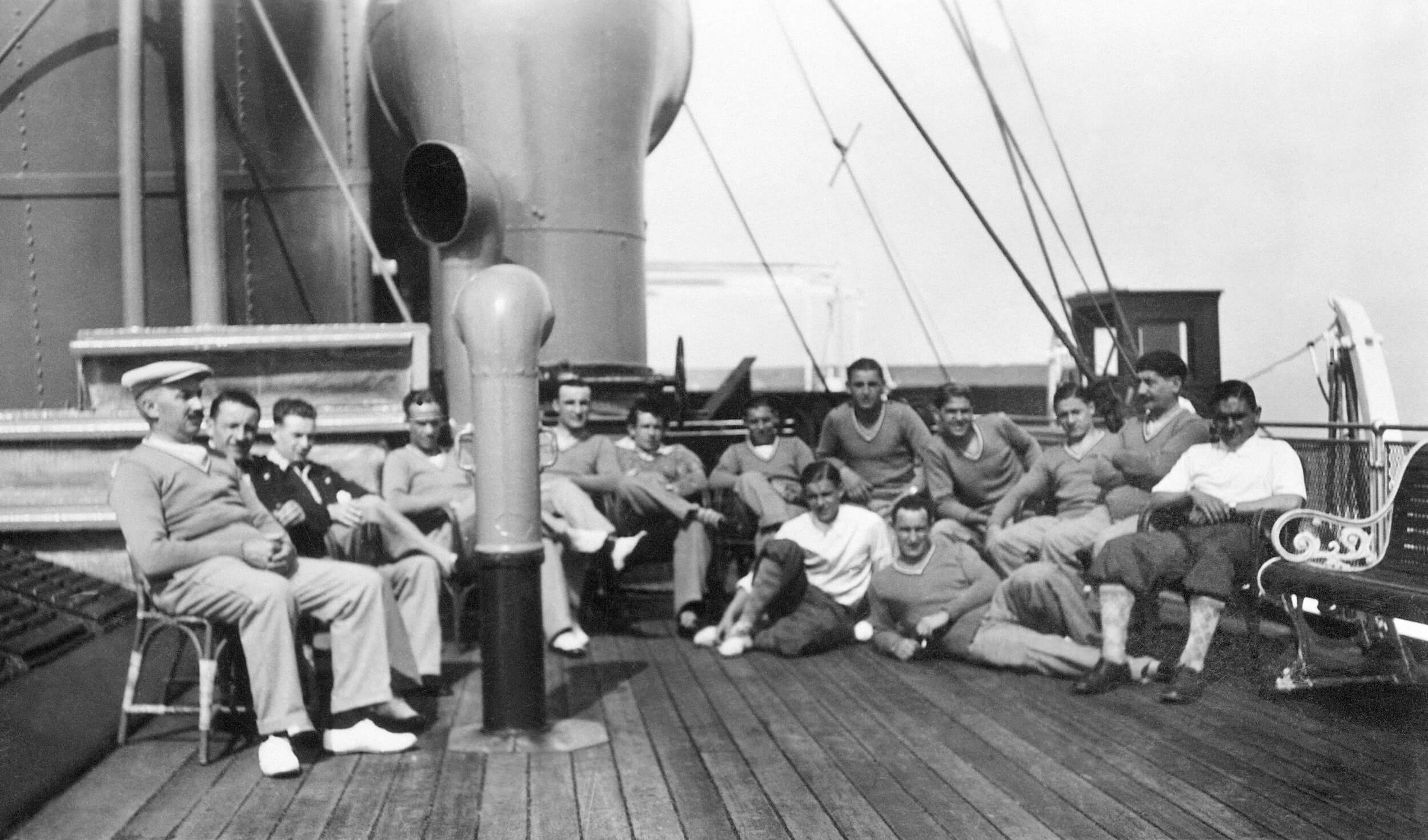
The Romanians, whose team was chosen by King Carol II, were first on board and picked up three teams along the way: France, Belgium and then, after crossing the Atlantic, Brazil.

France’s players aboard the ship taking them to the 1930 World Cup in Uruguay (AFP via Getty Images)
Also with them was Rimet, with the World Cup trophy, which was called Victory but later renamed after him, plus three European referees. There was a swimming pool on board, as well as comedy acts and musicians to keep everyone entertained, but the players mostly did a lot of running around the deck to try to stay fit.
The U.S. had an 18-day journey to Uruguay, setting off on June 13 and arriving on July 1 via a stop in Brazil. They didn’t return home for three months, as they would stay in South America to play a series of exhibition matches after the tournament.
While traditionalists have lamented the top four nations being seeded for the 2026 tournament, there were also seeds in 1930, with Uruguay, Argentina, Brazil and the U.S. kept apart in the draw. The 13 nations were spread across three groups of three and one four-team group, with the winners heading straight to the semi-finals.
On the day of the first World Cup matches, it snowed in Uruguay.
Lucien Laurent of France scored the first World Cup goal during a 4-1 victory over Mexico, although whether his celebration involved shushing the 4,000 in attendance at Estadio Pocitos, in the capital of Montevideo, is unknown.
At the same time, the U.S. were playing Belgium at the larger Estadio Parque Central (three Montevideo stadiums hosted all matches, with the huge 90,000-capacity Estadio Centenario not fully built until the ninth game of the tournament after bad weather in the build-up delayed construction).
An impressive U.S. side, who benefited from the presence of several professionals from England and Scotland, won 3-0. They were nicknamed “The Shotputters” because of their physical prowess and the match was played on a horrendous pitch described by their manager Wilfred Cummings as “a bed of wet sticky clay with pools of water too numerous to count”.
The U.S., Uruguay and Yugoslavia won their groups, as did Argentina, whose crucial match against France could be filed under D for dodgy.
Argentina took the lead in the 81st minute, but shortly afterwards, a French player went through on goal set to equalise… and the Brazilian referee immediately blew for full time, six minutes early. It was only after prolonged protests from the French side that the game later restarted, but it finished 1-0.
Argentina, having beaten the U.S. 11-2 at the Olympics two years earlier, were strong favourites when the teams met again in the semi-finals (with the fixtures having been drawn out of a hat after the group stage) in what was seen as a clash between the technically gifted South Americans and the direct, long-ball approach of the North Americans (although this was nullified by the pitch being 138 yards long, with some of their aerial kicks barely reaching halfway).
However, not content with clearly having a superior side, the Argentinians deemed it necessary to duly knock seven bells out of their opponents.
In the opening minutes, Ralph Tracey suffered a broken leg from a horrific challenge by Alejandro Scopelli — but incredibly, Tracey played on until half-time, actually missing two good chances to score (no excuse, is it), while another (Andy Auld) was temporarily blinded when an Argentine player knocked the smelling salt out of the American physio’s hands into his eyes.
Auld also had his lip ripped wide open, while one of his team-mates had a stomach injury for which he was later hospitalised and another “could hardly hobble” thanks to a severe knee injury. Teeth were also smashed out, reports suggest. It was utter carnage. The VAR system doesn’t sound so bad now, does it?
Amid the bloodbath, Argentina ran out 6-1 winners with five second-half goals as the depleted Americans attempted merely to preserve their lives as much as their tournament status. There was also a bizarre incident when U.S. physio Jack Coll (and accounts do vary on this) sprinted onto the field and dropped his medical bag, from which a bottle of chloroform smashed and the fumes knocked him out. He had to be revived and helped onto a stretcher.

The physio runs onto the pitch during the 1930 World Cup final (Ullstein Bild via Getty Images)
The other semi-final also finished 6-1 but with much less of a warzone feel. There was still controversy, though — in the lead-up to Uruguay’s third goal against Yugoslavia, the ball was headed out of play and promptly booted back on by a policeman, with none of the officials apparently noticing.
Still, at least these utterly incompetent referees all looked pristine while committing their crimes against football: they wore shirts, ties, blazers and knickerbockers. Quite the look.

Referee John Langenus, centre, takes charge of the 1930 World Cup final (Keystone/Getty Images)
The final between Uruguay and their neighbours and fierce rivals, Argentina, was also shrouded in violence, or at least the threat of it.
Guns and knives were frisked from Argentina fans on their way from the docks, while Belgian referee John Langenus requested a police escort and a ship ready to take him away after the match.
The teams, who had met in the 1928 Olympics final (it finished 1-1 and then Uruguay won the rematch 2-1), couldn’t even agree on which ball to use, so they played with one that had been manufactured in Argentina for the first half and a Uruguayan ball for the second half.
To top it all off, star Argentina player Luis Monti, a two-footed genius who played at centre half-back (i.e. midfield), received death threats, including during the match, against him and his family, warning him off trying to actually win the thing.
His granddaughter Lorena later said: “At half-time, when Argentina were leading 2-1, they said that if Argentina didn’t lose, they would kill my grandmother and my aunt.”
Monti played poorly and Uruguay duly won 4-2, with the final goal scored by a one-armed striker by the name of Hector Castro. He had lost his forearm as a teenager in an incident with an electric saw, leading to a nickname of El Manco (“the one-armed”).
As you might imagine, the ramifications of the result were sizeable. Uruguay’s players were each gifted a house by the government for winning, while in Buenos Aires, there were riots, a storming of the Uruguayan consulate and a woman was stoned for waving a Uruguayan flag.

FIFA president Jules Rimet hands over the first World Cup trophy to Dr Raul Jude, president of the Uruguayan Football Association (OFF/AFP via Getty Images)
There were also 15,000 very unhappy and bemused Argentines whose ship to Montevideo for the final was delayed by fog, so they arrived a day late to be informed their team had lost.
At least there was a happy ending for Monti, who moved to Italy and Juventus later that year, gained Italian citizenship and won the World Cup with Italy in 1934.
There was also, eventually, a happy ending for Romanian player Alfred Eisenbeisser, who on the long journey back to Europe fell ill with pneumonia and was immediately taken to hospital in Genoa when the ship docked.
The rest of the team carried on home to Bucharest with Ferraru, which led to rumours he had died. His poor mother arranged a wake to mourn his passing and then he duly walked through the door that morning. She fainted. The end. What a tournament.