Between 1964 and 2023, his company, Berkshire Hathaway, achieved an astonishing total return of 4,384,748%.
In an interview at Georgetown University, an audience member cut to the chase, asking, “What would you think is the most important thing — the key — in evaluating a company?”
Without missing a beat, Buffett responded, “The most important thing is to be able to define which ones you can come to an intelligent decision on and which ones are beyond your capacity to evaluate.”
Buffett emphasized that you don’t need to understand — or be right about — thousands of companies to succeed. Instead, as he put it, you only need to be right about “a couple.”
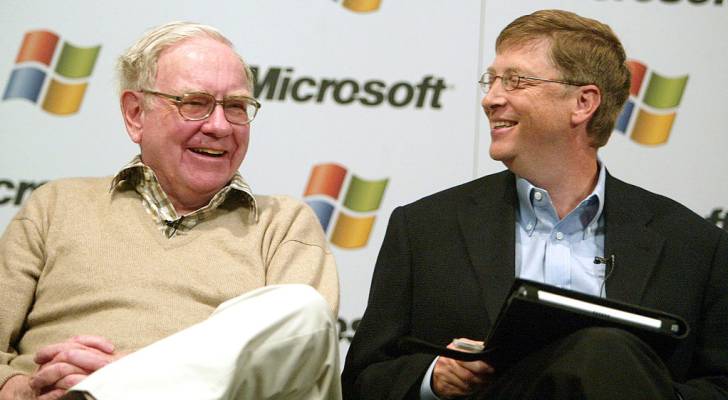
To illustrate his approach, Buffett shared a memorable exchange with Microsoft co-founder Bill Gates.
On July 5, 1991, Buffett and Gates were in Seattle when Gates, eager to share his enthusiasm for the burgeoning world of computers, turned to Buffett and said, “You’ve got to have a computer.”
“Why?” Buffett asked.
Gates replied with a practical suggestion, “Well, you can do your income tax on it.”
But Buffett, whose approach to wealth focused on reinvesting rather than receiving income, responded matter-of-factly, “I don’t have any income. Berkshire doesn’t pay a dividend.”
Gates pressed on, suggesting that a computer could help Buffett keep track of his stock portfolio. But Buffett, whose investment portfolio consisted solely of Berkshire Hathaway, simply responded, “I only have one stock.”
Undeterred, Gates insisted, “It’s going to change everything.”
This prompted Buffett to dig deeper. “Will it change whether people chew gum?” he asked.
“Probably not,” Gates admitted.
“Will it change what kind of gum they chew?” Buffett followed up, prompting Gates to again reply, “Nah.”
With that, Buffett summed up his thoughts: “Well, then I’ll stick to chewing gum and you stick to computers.”
Buffett used this story to highlight his investment philosophy. His success didn’t stem from understanding every emerging technology or industry trend; rather, it came from staying within his “circle of competence.”
In his view, you don’t need to know everything about every industry to succeed as an investor — you just need to thoroughly understand a few.
Chewing gum firmly falls within Warren Buffett’s “circle of competence.” In his 1993 letter to shareholders, Buffett identified Wrigley as “dominant” in the chewing gum market.
When food giant Mars sought to acquire Wrigley in 2008, Warren Buffett invested $6.5 billion — buying $2.1 billion of Wrigley preferred stock and $4.4 billion of its bonds — to help fund the deal.
The bet paid off handsomely: between interest payments, dividends, and gains on the bonds and shares, Buffett reportedly made an estimated $6.5 billion from his Wrigley investment.
Beyond chewing gum, Buffett has long been a fan of another staple: soda. Coca-Cola, a brand that’s been around since 1886, captured Buffett’s attention because of its vast market presence.
“Coca-Cola’s been around since 1886. There’s 1.8 billion 8-ounce servings of Coca-Cola products sold everyday now. If you get one penny extra — that’s $18 million a day, and $18 million times 365 is $6.57 billion annually… from one penny. Do you think Coca-Cola is worth a penny more than, you know, Joe’s Cola? I think so,” he explained.
True to his investment philosophy, Buffett’s conviction in Coca-Cola has stood the test of time. Berkshire first invested in Coca-Cola in 1988, and today, it holds 400 million shares of Coca-Cola, a stake now valued at $26 billion.
And even today, Buffett’s straightforward investment philosophy stands firm and relevant.
His approach reminds us that we don’t need to chase the latest trends to find success. Instead, Buffett advocates focusing on one’s circle of competence, sticking to businesses that are easy to understand and have enduring demand.
Rather than constantly predicting “the next big thing,” Buffett finds long-term value in companies with proven, lasting appeal.
It’s also easier than ever to start investing. Trading apps like Public allow everyday investors to capitalize on the stock market by investing in fractional shares for as little as $10. You can easily pack your portfolio with your favorite companies, with zero commissions.
To make informed decisions within your circle of competence, investors can use research tools like Moby, which provide expert analysis and market insights, helping users optimize their portfolios.
While Buffett is legendary for picking winning companies, he’s an even bigger advocate for a simpler, tried-and-true strategy: investing in an S&P 500 index fund.
“In my view, for most people, the best thing to do is own the S&P 500 index fund,” he famously stated. This straightforward approach gives investors exposure to 500 of America’s largest companies across various industries, providing diversified exposure without the need for constant monitoring or active trading.
Buffett believes so strongly in this strategy that he has instructed 90% of his wife’s inheritance be invested in “a very low-cost S&P 500 index fund” after he dies.
The beauty of this approach is its accessibility — anyone, regardless of wealth, can take advantage of it. With platforms like Robinhood, you can invest in ETFs like the Vanguard S&P 500 to get a start on your nest egg.
Robinhood has 24/7 support, and you won’t pay any commission fees on stocks, ETFs and options. Their platform also offers both a traditional IRA and a Roth IRA, so you can benefit from tax-efficient retirement investing.
New Robinhood customers can also get a free stock once you sign up and link your bank account to the app.
You can pick your stock reward from top American companies, with amounts ranging from $5 to $200.
This article provides information only and should not be construed as advice. It is provided without warranty of any kind.