
President Trump predicted the destruction not just of college sports but the entire U.S. collegiate system unless the industry is fixed quickly — something some sports leaders who joined him Friday at a White House summit agreed could only happen by raising more money to pay players.
Trump suggested he would write an “all-encompassing” executive order within a week in hopes it would spark action from Congress. He also said he expected the order to trigger a lawsuit that could put the issue back in front of the court system that approved industry-changing payments to players for their name, image and likeness.
The new system has left many schools drowning in red ink from paying players, while rules governing those payments are only slowly taking hold.
“The whole educational system is going to go out of business because of this,” Trump explained, when asked why he was devoting time to college sports with the war in Iran and other issues dominating the headlines.
During the meeting in the East Room — which included lawmakers, conference commissioners, the president of the NCAA and CEO of the U.S. Olympic team, but none of the NCAA’s 550,000 college athletes — Trump said, “I thought the system of scholarships was great.” He was harkening to the recently ended era in which players received little to nothing beyond the financial aid.
He said the “horrible” court settlement that led to the current system — a settlement that virtually everyone in the room agreed to — “threw the sports world and … the college athletic world into ‘tithers.'”
Julia Demaree Nikhinson / AP 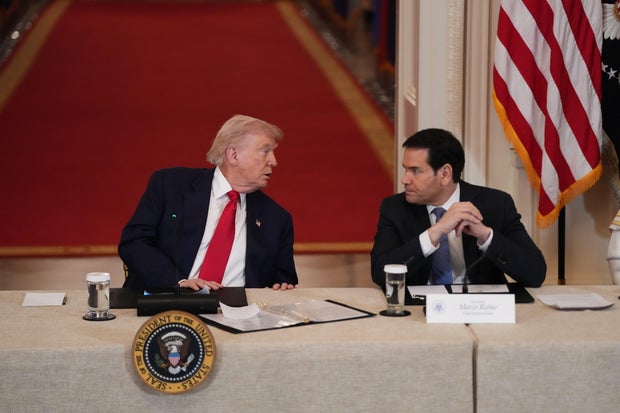
Virtually everyone in the room agreed that the industry needs to be saved from the spiraling costs associated with the onset of NIL payments and that a bill called the SCORE Act, which has struggled to pass the House, could be the base of any change. House Speaker Mike Johnson suggested there were now enough votes to pass it.
Fewer dug into the details, specifically the wide differences that exist over how to fund all this growth. Among the key proposals in play over the last several months was one that would rewrite the existing Sports Broadcasting Act to allow college conferences to pool their TV rights.
One key backer of that, Texas Tech regent Cody Campbell, was at the meeting and told Mr. Trump he would like to be part of a smaller working group that helps him draft his executive order.
Campbell has suggested pooling TV rights could raise another $6 billion, which could keep football, basketball and Olympic sports programs solvent for decades. The Southeastern Conference and the Big Ten disagree with that conclusion.
Julia Demaree Nikhinson / AP 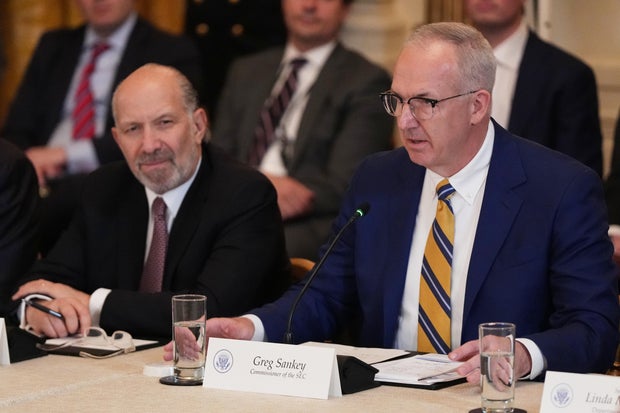
SEC commissioner Greg Sankey urged the Senate to act.
“This is not about revenue, this is about structures and national standards,” he said before listing a number of issues the SCORE Act, as currently written, would address, which includes a limited antitrust exemption for the NCAA that many Democrats oppose.
Sen. Ted Cruz, whose committee is key to getting a bill passed in the upper chamber, said lawmakers needed to look at both the cost side and the revenue side in formulating a law.
“If we wait another year, wait another two years, the programs in your state are going away and the students in your state are losing their scholarships,” Cruz said. “It would be an absolute travesty if we let that happen.”

