TAIPEI (Taiwan News) — When Financial Times journalist Patrick McGee began researching Apple’s supply chain, he thought he was writing a corporate history.
What emerged instead was a geopolitical story about how the world’s most valuable tech company became deeply embedded in China’s rise as a manufacturing superpower — and more worryingly, how “decoupling” has become impossible.
His book, “Apple in China: The Capture of the World’s Greatest Company,” released in May 2025, reached The New York Times Best Sellers list within two weeks.
Drawing on more than 200 interviews and thousands of pages of internal documents, McGee argues that Apple’s pursuit of efficiency and scale reshaped not only its own business but also the fortunes of the US’ greatest global adversary.
McGee, a Canadian journalist who previously reported from Hong Kong and now lives in the US, covered Apple for four years at the Financial Times. He said he initially struggled to penetrate the company’s tightly controlled narrative, which focused primarily on product launches.
The highly siloed nature of Apple, a company where entire teams or departments work in isolation, made it difficult for information to emerge. The company’s insistence on non-disclosure agreements further reduced the likelihood of major disclosures.
The Apple model
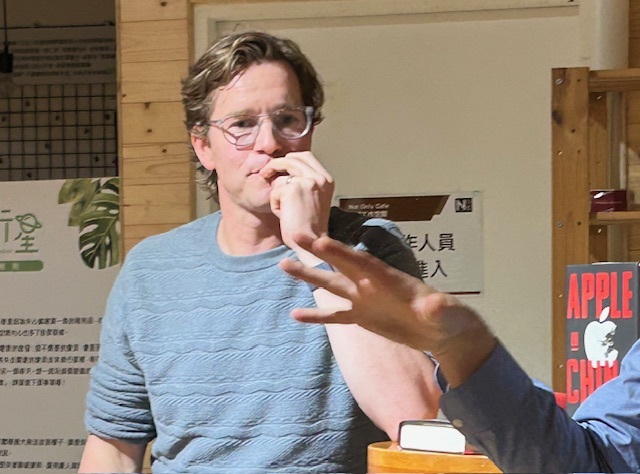
At a book talk for foreign journalists in Taipei on Wednesday, days after appearing at the Taipei International Book Exhibition for the Chinese-language launch of his book, to long lines of readers, he admitted frustration from the Apple beat.
A turning point came while profiling Qualcomm CEO Cristiano Amon, who expressed frustration about traveling to Taiwan during COVID, as he explained the company followed “the Apple model.” McGee was initially confused, as Qualcomm was a fabless company, so why would he need to travel, only to realize he had no idea how Apple made its products.
That question led him to take a closer look at Apple’s production practices, which stretched back to the 1990s, when Apple shifted from domestic manufacturing to outsourcing production across multiple countries, including the Czech Republic, Ireland, Wales, Singapore, South Korea, China, and the US.
“I would read profiles of Tim Cook and people calling him the architect of the China strategy, but then I realized this did not really make sense, as the entire supply chain moved to China, and Apple just sort of rode that wave better than anybody else.”
He later learned there were only tidbits of Apple’s offshoring of production available in Taiwanese media and other sources from time to time, but such reporting was not heavy on details. It became clear early on that if he did not have the answers, at least he should be asking those questions.

Taiwan’s pivotal role
McGee believes that without companies such as Foxconn, founded by Terry Gou (郭台銘), Apple could not have scaled production in China at the speed and precision required for the iPod and later the iPhone.
Taiwanese firms brought not only engineering expertise but also political and operational fluency in China’s system. McGee explained that in Russia, orders move “top down,” while in China, one expert described it to him as “regionally decentralized authoritarianism,” where local governments and grassroots interests compete for investment and wield substantial authority.
Apple effectively outsourced not just manufacturing but also its government lobbying and political mediation to Taiwanese partners who negotiated land deals, subsidies, and local relationships.
It was not until 2013, one day after Xi Jinping was sworn in as Chinese leader, that Apple began to fear political retaliation in China. The company would then station senior executives in the country long-term. By then, China had already become one of Apple’s fastest-growing markets, with annual revenue climbing from under US$1 billion in 2008 to roughly US$25 billion by 2012.
From copycats to technological parity
In the mid-2010s, McGee said Apple executives publicly dismissed Chinese smartphone brands as imitators. By 2019, Huawei had surpassed Apple in global smartphone shipments.
Through litigation disclosures, McGee obtained more than 1,000 pages of internal Apple documents marked highly confidential. He said they showed executives privately acknowledging that Huawei devices were competitive, in some cases superior, at lower prices.
Today, he said, premium Chinese devices, including foldable models, demonstrate advanced industrial design and manufacturing capability. McGee said that while Apple retains design leadership, China now combines scale with increasingly sophisticated engineering expertise.
“Twenty-five years ago, Apple had the skill, and China had the scale,” he said. “Now China has both the skill and the scale.” He added that the “marriage dividend” clearly belongs to China.
Threat of red supply chain
McGee also highlights the rise of China’s so-called “red supply chain.” Domestic firms such as Luxshare, BYD, Goertek, and Wingtech have expanded their roles, while some Taiwanese, Japanese, and Korean suppliers face mounting pressure.
Although Apple has announced diversification efforts in India and Vietnam, McGee argues these moves remain limited in scope.
“If there are 1,000 steps to making an iPhone and only the final step moves to India, that may solve a tariff issue,” he said. “It doesn’t mean you’ve relocated the supply chain.”
Vietnam offers skilled labor but limited scale. McGee describes Vietnam’s main appeal as being geographically close to China. While India has demographic scale, it has yet to replicate China’s dense ecosystem of component suppliers, tooling expertise, and infrastructure.
Citing data from the United Nations Industrial Development Organization, McGee said China accounts for 30% of global manufacturing in 2024 and is expected to grow to 45% by 2030.
Meanwhile, Apple has said it has trained 30 million people across its supply chain since 2008. CEO Tim Cook has estimated that up to 3 million workers in China are involved in making Apple products annually.
McGee argues that this cumulative impact resembles a nation-building effort, whether intentional or not.
Growing corporate vulnerability
Apple executives, McGee said, often reject the notion that China’s concentration is a vulnerability, arguing Beijing would face enormous economic and reputational costs if it targeted Apple.
At the same time, geopolitical tensions and potential US tariffs underscore Apple’s exposure. Market swings tied to US-China policy shifts have erased hundreds of billions of dollars in Apple’s market value within weeks.
For Taiwan, the story carries both recognition and warning. Taiwanese manufacturers were not peripheral players but foundational to Apple’s China expansion. They industrialized Apple’s designs, built supplier networks, and helped create the manufacturing depth that made China indispensable.
Yet as Chinese firms absorb more capability, the ecosystem Taiwan helped construct is evolving. What was once described as “designed in Cupertino, assembled in China” has become a more complex fusion of American design, Taiwanese execution, and Chinese scale.
McGee said his book is not an indictment of any single company but an examination of unintended consequences.
Apple’s partnership with China delivered extraordinary profits and transformed consumer technology. It also accelerated the growth of an industrial system that now stands at the center of global strategic competition, with decoupling next to impossible for one of the world’s most recognizable brands — a reality that could keep corporate leaders and government officials up late at night.