
Six million dollars can buy a lot of things, but they do not guarantee a place in the pantheon of immortality. The amount, give or take a cent, is what Jeff Bezos and Lauren Sánchez have ponied up as star sponsors of the next glitzy gala organized by the Costume Institute of the Metropolitan Museum of New York, to be held on the first Monday of May 2026.
These $6 million (€5.2 million) sound like a tip next to the $125 million donated by financier Oscar L. Tang and his wife, Agnes Hsu-Tang, to renovate the Costume Institute’s modern and contemporary art wing. Five floors spread over 123,000 square meters re-imagined by the Mexican architect Frida Escobedo — the first woman to have a hand in the design of the Met in its 150-year history — that will double the exhibition space and leave the names of their main benefactors engraved in stone when it opens in 2030: The Tang Wing. Nowadays, this is how immortality is achieved, at least if you’re rich.
The lyrics of the song Fame, “remember my name,” should be rewritten. Because fame, a passing lover, invariably ends up being lost in time. Right now, the headlines are being dominated by a new milestone — a tech bro deciding who to invite to one of the world’s biggest annual fashion events. Almost no one seems to remember that Amazon sponsored the Met Gala in 2012, and Bezos acted as honorary chair. Tech multinationals, moreover, have for some years been awarded a place of honor at the table of Anna Wintour, official fundraiser of the Costume Institute since 1995. Along with luxury fashion houses, Yahoo, Apple, Instagram (owned by Meta) and TikTok have all been quick to open their checkbooks to this end in the last 10 years.
Beyond the alleged intentions of the current tech class to gain authority/relevance by joining any major cultural event — including that of fashion as an indisputable mass spectacle of our time — there’s the afterlife to consider. Not content with controlling the lion’s share of the world’s wealth, these billionaires that account for 1.1% of the population are determined to transcend their own mortality. Rather than philanthropy, their boasts of beneficence appear to be nothing short of self-interested payments to buy into a brand of eternal life.
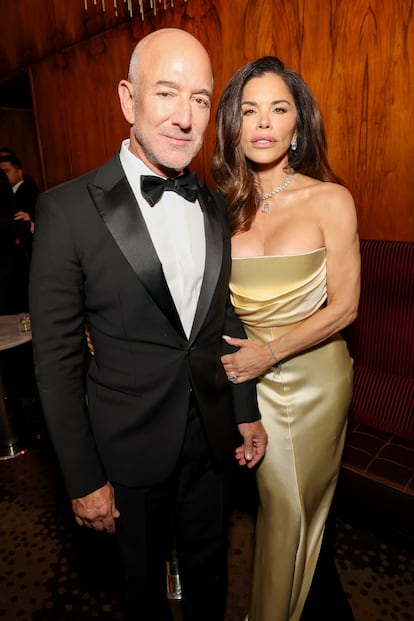
Immortality used to be a by-product of exceptional achievement or dedication to the community, but that prerogative does not appear to apply to the tech caste. “Until the mid-nineties, donations of great wealth were aimed at getting a seat on the presidential boards of institutions of socio-cultural scope. Today, the wealthy want everyone to know that they are as generous as they are powerful without ties,” explains William Drennan, former law professor at Southern Illinois University. “For them, the more personal investment the transaction entails, the better, even if the process means putting the name of hospitals, airports or public parks up for sale. In this way, they reduce their taxes to a minimum, ensuring that federal, state or local governments are going to be forced to lower their rates. For a handful of millions — the small change they carry in their pockets — these tycoons acquire a reputation as philanthropists, when it is really about nothing more than narcissism and a thirst for recognition.”
In San Francisco, a short walk from Silicon Valley, the patients of the former General Hospital are now being treated at the Priscilla and Mark Zuckerberg General Hospital and Trauma Center. The founder of Facebook and his wife, Priscilla Chan who worked as a doctor there, got the complex named after them in 2015 on the back of a donation of $75 million — peanuts for the tech bro who leads the list of billionaires drawn up by Forbes magazine — though at the beginning of November he fell from third to fifth position, after losing around $25 billion with the collapse of Meta’s shares.
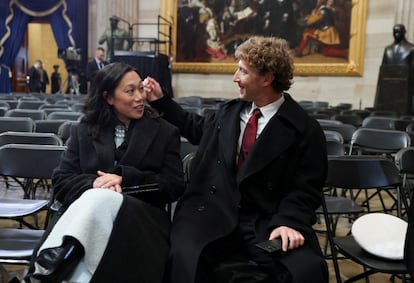
Most of the defenders of this practice align themselves with a certain conservative ideology veering towards the extreme right, from Larry Ellison, co-founder of Oracle poised to take over U.S. TikTok, to Marc Andreessen, computer scientist and creator of Mosaic turned venture investor, to Sam Altman, architect of ChatGPT and defender of Trump policies. Journalist Amy Odell put it this way on the Substack platform when she learned of the Bezos’ sponsorship of the 2026 Met gala: “Rich people are ‘riching.’ The optics are kind of uncomfortable. Maybe these are just going to be the optics of the gala every year until something changes with income inequality in this country.” Odell believes there’s a drift in the gala that needs to be overcome with the Bezos acting as the ‘yuck’ factor.
The author of Wintour’s biography Anna, Odell also notes the coincidence of the Bezos sponsorship with the recent wave of layoffs at Condé Nast, which owns Vogue and helps fund the Met’s Costume Institute through a fundraising dinner that costs $350,000 a pop and whose latest expansion encompassing the basement galleries to the museum’s central lobby, will bear the name of the publishing house’s founder for an undisclosed amount. Odell also noted that Condé Nast’s decision to shut down Teen Vogue was one that “people were very emotional about, because they cut the young, diverse voices who were doing political coverage for a young audience.” Odell added that while we live in the culture of post-shame, where anything goes, she believes the cuts are significant.
The expansion of the Costume Institute, a project with an estimated cost of $50 million, reopens the internal wounds within the Met itself, which grapples with about 20 departments, each with a certain number of square feet and sources of private capital that maintain them. Nowadays, curators of the art galleries are becoming increasingly bitter about the red-carpet fashion displays and parade of celebrities which eclipse the rest of the exhibitions and research activities at the museum.
Hence the Tangs’ $125 million investment to put an end to the long-delayed works planned to renovate the modern and contemporary art wing. The couple has not only linked their names to the institution, but they have been crowned as the royal donors of Zohran Mamdani’s New York. They have even managed to persuade Venezuelan conductor Gustavo Dudamel to leave Los Angeles to lead the city’s Philharmonic from 2026 on the back of a $40 million donation, the largest in the history of the orchestra. And when the New York Historical Society was trying to get its new Wing for American Democracy ready in time to celebrate the 250th anniversary of the United States in 2026, they forked out an added $20 million in return for having it renamed the Tang Wing for American Democracy.
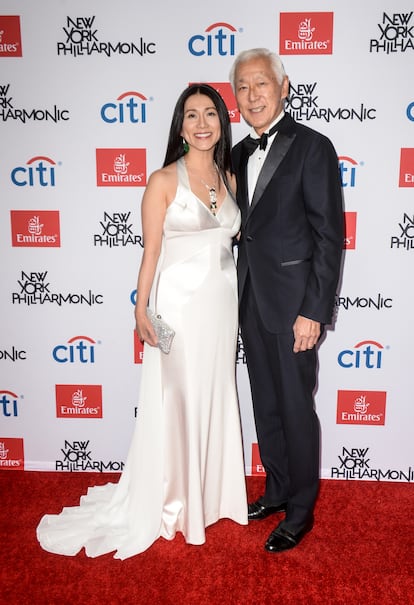
A firm believer in the power of capitalism as a positive force for social progress, Oscar L. Tang has been keeping a low profile until now; his sudden celebrity can only be explained by the current cult of money. A member of the board of directors of the Met for 30 years and of the American Academy of Arts and Sciences, this retired Chinese expert in asset management is a full-time philanthropist at the age of 87, convinced that he has an obligation to reinvest his wealth in society. He is accompanied in the endeavor by his third wife, Agnes Hsu-Tang, 53, a native of Taipei and related to an imperial minister of the Ming dynasty of the 16th century. She is an archaeologist and historian, and a former advisor to UNESCO in Paris and the U.S. department of cultural property during Obama’s term. She is also president of the board of directors of the New-York Historical Society. Altogether, she avoids the cliché of the wealthy society lady whose reputation depends on her husband’s name, the parties she organizes and attends, and the charitable works she promotes.
Married in 2013, together the Tangs form an unusual power couple in an environment of proverbial white supremacy. Activism against racism directed at Asians exacerbated by the pandemic is also on Tang’s agenda. At $2 billion, Oscar Tang’s fortune will not stand out in the Forbes ranking, but at least the couple’s approach to philanthropy is creative. “We get to create things,” Hsu‐Tang told The New York Times. “Because we don’t have children together, these projects are our children.” A more elegant way to buy a slice of immortality, perhaps.
Sign up for our weekly newsletter to get more English-language news coverage from EL PAÍS USA Edition

