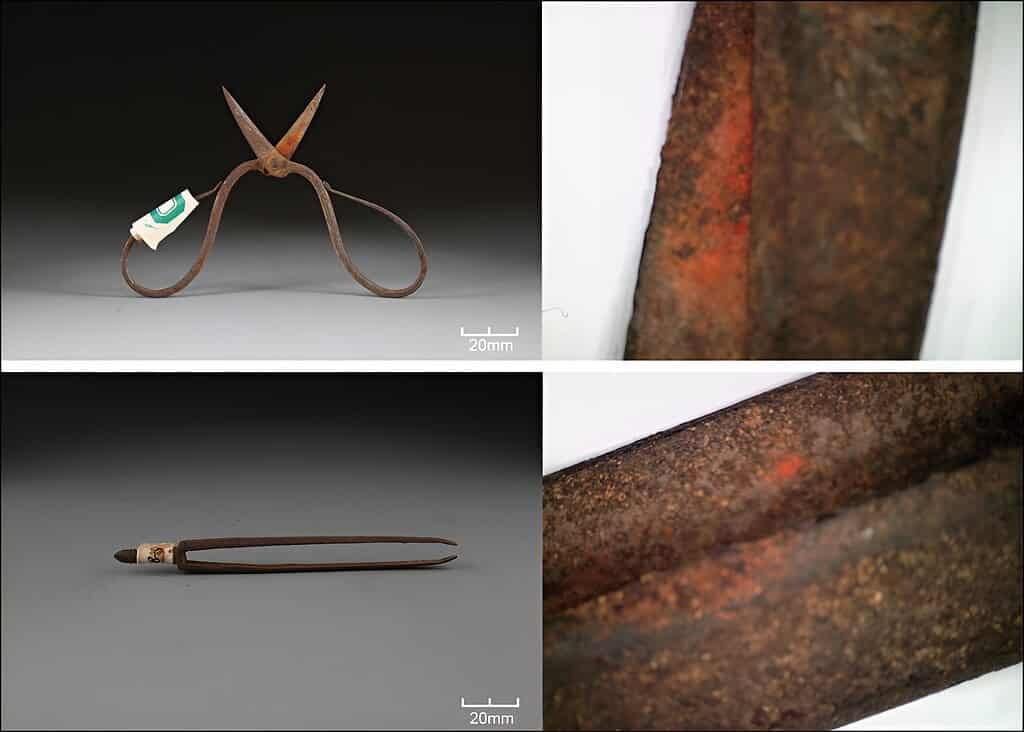

A new study of two 600-year-old surgical tools from a Ming Dynasty tomb in eastern China has identified probable residues of aconitine, a powerful and dangerous compound found in wolfsbane. The finding may be the earliest direct chemical evidence of a topical anesthetic used in surgery, suggesting that some Chinese physicians would numb tissue first before cutting it.
“Six centuries ago, a Ming Dynasty surgeon performed an operation with a pair of iron scissors and tweezers, and today we have read the traces of anaesthetic medicine left on those instruments using a beam of laser light,” Congcang Zhao, an archaeologist at Northwest University in China and a study co-author, said in a statement.
A Surgeon’s Tomb
The instruments came from the tomb of Xia Quan, a physician who lived from 1348 to 1411. Archaeologists excavated the tomb in Jiangyin, in Jiangsu Province, in 1974. Among the grave goods were iron medical tools, including a pair of scissors and tweezers, each about 12.3 centimeters long.
The tools could tell us little beyond their immediate appearance at that time. They were too fragile and too precious for destructive testing. But newer techniques allowed researchers to examine tiny rust-colored residues without physically touching the artifacts themselves.
First, the team used portable X-ray fluorescence to confirm that both instruments were mostly iron, with an average iron content of about 97 percent. That high purity, the authors argue, reflects mature Ming-era ironworking in the region.
Then came the more revealing step. Under a microscope, researchers selected three tiny red particles from the tools: one from the tweezers and two from the scissors. They analyzed them with micro-Raman spectroscopy and stimulated Raman scattering, techniques that use light to identify molecular fingerprints.
The signals showed organic material, including chemical features associated with oils or lipids. More importantly, the team detected a cyano group, a chemical signature that helped point them toward aconite alkaloids. Comparison with a reference sample of Aconitum carmichaelii, popularly known as Chinese wolfsbane, strengthened the case that the residues came from an Aconitum plant.
The residues appeared in places consistent with use, such as on or near functional parts of the instruments, including the blades and concealed areas where splashed liquid could have escaped cleaning. That pattern makes later contamination less likely.

Poison or Medicine?
Wolfsbane has a sinister reputation. Aconitine can disrupt sodium channels in nerve cells and can be lethal. Yet in carefully prepared forms, plants in the Aconitum genus have long appeared in traditional Chinese medical texts, especially in prescriptions linked to pain relief. The dose makes the poison, after all.
The researchers argue that Chinese physicians in the Middle Ages had a working, practical knowledge of how to turn a dangerous plant into a controlled topical medicine.
Ming texts describe ways to reduce aconite’s toxicity, including preparation with boys’ urine, soaking in black soybean decoction, boiling in vinegar, detoxifying with mung beans and removing the outer skin of the tuber. These methods may sound strange now, but they show that practitioners recognized danger and developed procedures to manage it.
We also have surviving records of historical instructions for surgical use. In one Ming medical text, scissors were used after a numbing agent had been applied to the affected area, or after medicinal paste had been applied to the blades.
Carney Matheson, an archaeologist at Griffith University in Brisbane who was not involved in the study, told New Scientist that the finding changes how we should imagine early surgery. “Now we can understand why this surgery may have been present or may have been so prolific and actually manageable in the past,” Matheson said.
He added that preparing such a toxic plant for medical use would have required a “tremendous amount of science.”
“They have to be able to get it out of the plant without harming themselves,” he told New Scientist. “Then they need to process it so it can be applied to whatever they’re going to need it for, without killing themselves or hurting people. Then they have to make sure that it actually works.”
Ancient surgery is often remembered as brutal. Indeed, it was in most cases. But, at least in Ming China, not all procedures were quite so deadly.
The findings appeared in the journal Antiquity.