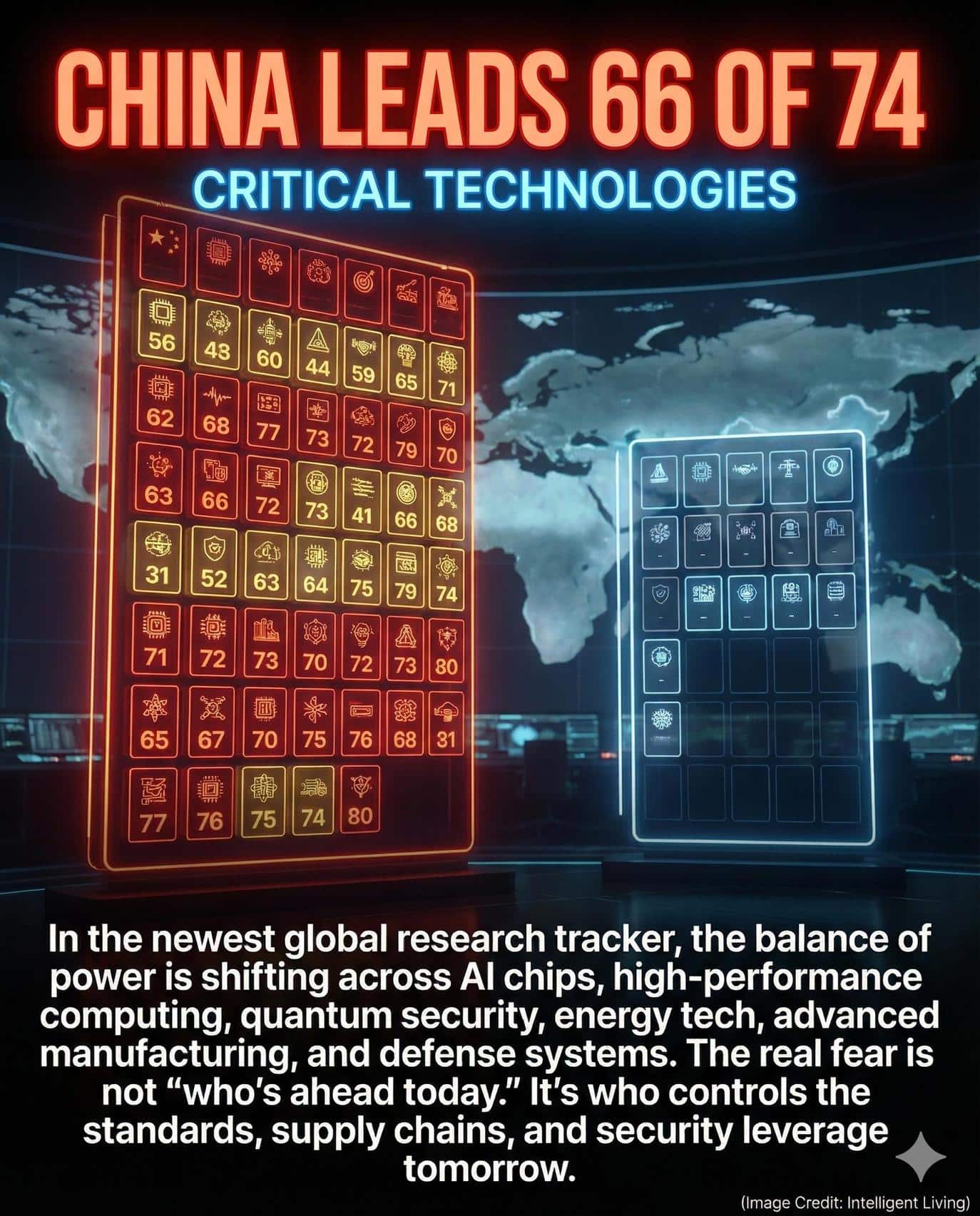
Global power dynamics have evolved into a silent race, spanning from the chips in our devices to the quantum algorithms shaping future wars. On December 1, 2025, the Australian Strategic Policy Institute (ASPI) released its latest strategic technology assessment, revealing a staggering reality: China now leads in 66 out of 74 critical technologies. The United States, once the undisputed tech superpower, now maintains its edge in only eight.
The Shift from Manufacturing to Innovation Supremacy
Beyond the raw statistics lies a more significant reality. The 2025 update shows a tectonic shift in how China leads – moving beyond manufacturing into innovation itself. Once known primarily for scaling production, China’s research institutions now dominate fields like high-performance computing, AI hardware, and quantum communications. Meanwhile, the U.S. still anchors innovation in biotechnology, quantum computing, and medical research – the kind of fields that shape life itself.
The following analysis breaks down all 74 technologies tracked, examining their functions, importance, and implications for the future of global power. Current trends indicate that innovation, security, and national identity are becoming inseparable. We have entered an era where research papers wield the kinetic power of missiles.

Understanding the ASPI Critical Technology Tracker Methodology
The ASPI Critical Technology Tracker isn’t a geopolitical manifesto or a propaganda tool; it’s a data-driven attempt to measure which countries are publishing the most high-impact research across crucial sectors, from quantum mechanics to biotechnology. Its bibliometric assessment protocols use citation analysis to assess global research output based on citation frequency and relevance, indicating where innovation is happening fastest.
Rather than measuring factories or battlefield readiness, the tracker assesses intellectual capital—specifically the concentration of cutting-edge research talent and the quality of their findings. When ASPI says China leads in 66 technologies, it means Chinese researchers produce a majority of the most influential scientific papers in those fields. The tracker focuses on high-impact citation metrics in each field and year. It uses Web of Science data to gauge scientific influence rather than industrial dominance.
Identifying what the tracker does not measure is equally important. It doesn’t indicate how quickly research becomes commercialized or militarized. A nation can lead in papers but lag in practical deployment. Such discrepancies are visible in areas like quantum computing. In this field, U.S. companies such as IBM and Google still hold the operational edge despite China’s prolific academic output.
Critics also point out that bibliometric dominance can be influenced by publication practices, collaboration networks, or language accessibility. For instance, the Leiden Manifesto principles are often cited to explain why citation-based metrics need careful interpretation. Consequently, the gap between research influence and real-world capability varies widely between sectors. Still, the ASPI Tracker remains one of the most comprehensive indicators of technological momentum, showing which nations are steering innovation’s direction.
The 2025 edition confirms that China’s leadership is no longer accidental. The pattern is systemic – a coordinated effort linking academia, industry, and state-backed research into one innovation pipeline.
The 2025 Strategic Shift: Manufacturing to Mastery
The defining narrative of 2025 extends beyond China leading 66 of 74 critical technologies—the nature of those leads has evolved from manufacturing to mastery.
China’s dominance now spans fields defining the core of innovation: advanced semiconductors, AI accelerators, high-performance computing, and quantum-secure communications. According to ASPI’s analysis, China’s “Technology Monopoly Risk” (TMR) has risen in key sectors like cloud and edge computing, computer vision, and generative AI. TMR measures how concentrated global expertise is within a single nation. Far from being fringe areas, they represent the foundations of future warfare, automation, and intelligence.
The United States, meanwhile, retains a fortress-like advantage in a handful of strategic domains. Its continued supremacy in biotechnology, neuroscience, and quantum computing reflects its depth of innovation culture – breakthroughs that can’t easily be replicated through scale alone. But for every American advantage, China now holds eight.
Australia’s role in compiling and promoting this tracker adds another layer of complexity. Strategic observers interpret the report as a call for Western nations to coordinate economic and defense strategies in response to China’s surge. Others view it as a neutral assessment of reality – a data-based mirror reflecting a changing world. Whatever the intent, the report underscores one undeniable truth: scientific leadership has become the currency of global power.

The Eight Strategic Domains Where US Leadership Endures
China’s dominance stretches across most technology categories. Yet, the United States retains leadership in eight critical areas, primarily at the scientific frontier where innovation meets human well-being. Strategic endurance appears in America’s institutional strengths—deep research culture, private-sector innovation, and advanced infrastructure.
Leadership across these eight domains underscores the resilience of the U.S. innovation ecosystem. While China’s scale and coordination drive progress across dozens of sectors, American research culture still excels where creativity, ethics, and experimentation intersect. In the global race for technological supremacy, these are the areas where the West’s edge remains sharp – for now.
1. Quantum Computing
Quantum computing operates on qubits, the quantum equivalent of bits, allowing calculations that can overwhelm classical machines. The battle for cryptographic supremacy defines the strategic stakes. Quantum computers threaten encryption security, forcing governments and businesses to rethink how secrets are protected. American pioneers, including IBM’s quantum computing program and Google’s Quantum AI team, continue to build experimental systems and error-correction roadmaps, even as China’s publication volume accelerates.
2. Vaccines and Medical Countermeasures
The U.S. leads in the rapid development of vaccines and therapeutics. The pharmaceutical ecosystem and regulatory agility secure this advantage. Beyond public health, the sector anchors national biosecurity. Institutions like the National Institutes of Health (NIH) and companies such as Moderna helped accelerate mRNA vaccine technology, reshaping pandemic preparedness for decades to come.
3. Nuclear Medicine and Radiotherapy
Combining nuclear physics with medicine, this field enables early disease detection and advanced cancer treatment. The U.S. leads through institutions like the Mayo Clinic and MD Anderson Cancer Center. Breakthroughs in PET imaging and targeted radionuclide therapy at these centers continue to set global standards.
4. Atomic Clocks
These are the world’s most precise timekeeping devices, essential for GPS, satellite synchronization, and military communications. The U.S. secures its position via its National Institute of Standards and Technology (NIST). NIST instruments achieve precision down to billionths of a second.
5. Genetic Engineering
Mastery of CRISPR and gene-editing techniques sustains American leadership in biotechnology. From resilient crops to next-generation therapies, the U.S. continues to drive progress in life sciences, where ethical oversight and innovation coexist.
6. Natural Language Processing (NLP)
NLP – the branch of artificial intelligence that enables computers to understand and generate human language – is central to everything from translation tools to disinformation analysis. American firms such as OpenAI, Anthropic, and Google continue to lead in foundational models. Corporate breakthroughs reinforce academic work summarized in the Stanford foundation model benchmarks that track capabilities, risks, and research momentum.
7. Neuroprosthetics
The interface between the nervous system and electronic devices defines neuroprosthetics. American researchers maintain a pioneering role, creating prosthetics that restore sight, hearing, and mobility. Advances in brain-computer interfaces (BCI) within DARPA’s neurotechnology programs and advanced prosthetics initiatives at the Johns Hopkins Applied Physics Laboratory hint at the next frontier: direct neural control of machines.
8. Geoengineering
The U.S. also leads in large-scale climate intervention research – controversial but potentially world-saving. Projects on solar radiation management and carbon dioxide removal aim to counteract the worst impacts of climate change. Governance frameworks align with solar geoengineering guidelines outlined by the National Academies. Large-scale climate intervention initiatives inevitably raise deep ethical and geopolitical questions about who controls Earth’s thermostat.

The Full List: 74 Technologies Grouped for Skimmability
Advanced Information and Communication Technologies
Foundational technologies enabling global connectivity, communication, and data exchange underpin this specific sector. These systems remain vital for economic growth, national security, and social cohesion by underpinning everything from internet access to satellite infrastructure. Digital infrastructure development dictates energy consumption, digital equity, and environmental monitoring systems that influence global ecological health.
- Advanced Optical Communication: Transmits data using light through fiber optics or lasers. Photonic chips increasingly power these networks, supporting ultra-fast, low-latency links for global networks and satellite communication.
- Advanced Radiofrequency Communication (5G/6G): Drives high-speed wireless connectivity, enabling seamless Internet of Things (IoT) ecosystems and next-generation military communication networks. Infrastructure densification, conversely, intensifies scrutiny regarding network energy demand and emissions.
- Advanced Undersea Wireless Communication: Uses acoustic or optical systems to transmit data underwater, supporting submarine operations and undersea infrastructure monitoring.
- Cloud and Edge Computing: Divides computing tasks between centralized servers and local devices and is increasingly paired with cloud-native low-Earth-orbit broadband for resilient, low-latency access to data.
- Digital Twins: Builds digital twin models that mirror real systems. Engineers leverage these simulations to predict failures and optimize manufacturing and infrastructure planning.
- Distributed Ledgers (Blockchain): Ensures data integrity and secure transactions, already transforming logistics and energy-tracking systems.
- Extended Reality (XR): Encompasses augmented, virtual, and mixed reality technologies, reshaping industrial training, telepresence, and design visualization.
- High-Performance Computing (HPC): Powers complex simulations for nuclear energy, weather forecasting, and AI model training. High-bandwidth memory supply constraints increasingly constrain accelerator performance.
- Mesh and Infrastructure-Independent Networks: Create resilient networks where devices communicate directly, essential for military coordination during communication blackouts.
- Protective Cybersecurity Technologies: Focuses on defending critical systems from cyberattacks. Priorities include post-quantum readiness for an era when today’s encryption may be breakable.

Artificial Intelligence and Computing
Artificial intelligence and computing technologies function as the cognitive engines of the digital age. Automation, decision-making, and data analysis rely on these cognitive engines, influencing productivity, innovation, and defense capabilities worldwide. Advancements not only drive economic transformation but also raise ethical and ecological questions about energy use and algorithmic transparency.
- Advanced Data Analytics: Extracts patterns from massive datasets to enhance intelligence operations, market prediction, and public policy decisions.
- Advanced Integrated Circuit Design and Fabrication: Develops leading-edge semiconductors below 5 nanometers, the lifeblood of AI, defense, and consumer electronics. Efforts to onshore leading-edge chip manufacturing increasingly shape the field.
- Adversarial AI: Studies how AI systems can be deceived and how to defend against such manipulation, vital for securing autonomous weapons and digital forensics.
- AI Algorithms and Hardware Accelerators: Custom processors like GPUs and TPUs that enable faster AI computation, a race reflected in the AI accelerator performance rivalry now defining data center economics.
- Computer Vision: Allows machines to interpret images and videos for facial recognition, navigation, and industrial automation, with computer vision applications expanding across healthcare, retail, and security.
- Generative AI: Produces new content such as text, code, or images, transforming creative industries while posing challenges for misinformation control.
- Machine Learning: Core of predictive analytics, empowering applications in medicine, logistics, and environmental modeling.
- Natural Language Processing (NLP) (US-Led): Enables communication between humans and machines, essential for real-time translation, intelligence analysis, and digital diplomacy.

Advanced Materials and Manufacturing
Creation and refinement of stronger, lighter, and more efficient materials drive this sector. Industrial evolution hinges on the development of these materials, enabling breakthroughs in transportation, energy storage, and sustainable construction. Technological progress reduces waste, lowers carbon footprints, and creates pathways for circular economies vital to ecological stability.
- Additive Manufacturing (3D Printing): Builds complex components layer by layer, allowing rapid prototyping and reducing waste in aerospace and defense production.
- Advanced Composite Materials: Combines multiple materials for enhanced strength and lightness, critical for next-generation aircraft and electric vehicles.
- Advanced Explosives and Energetic Materials: Develops high-density energy materials for propulsion, mining, and military applications.
- Advanced Magnets and Superconductors: Improves performance in renewable energy, transportation, and medical imaging.
- Advanced Protection Materials: Creates armor and safety gear for personnel and vehicles, increasing survivability in combat.
- Coatings: Provides heat, corrosion, and radar-resistant layers, vital for stealth technology.
- Continuous Flow Chemical Synthesis: Streamlines chemical production by maintaining continuous reactions, improving efficiency and safety.
- Critical Minerals Extraction and Processing: Focuses on refining rare earth elements like lithium and cobalt for electronics and green energy systems. Strategies also prioritize lower-impact recovery routes, such as e-waste sourcing for high-tech metals, which reduces the need for new mining.
- High-Specification Machining Processes: Enables precise manufacturing of critical components such as turbine blades and semiconductor tools.
- Nanoscale Materials and Manufacturing: Manipulates materials at the atomic level to create stronger and more reactive materials. Examples include atom-thin 2D bismuth chips and research into ion irradiation in 2D quantum materials that could unlock new transistor behaviors.
- Novel Metamaterials: Engineers substances that bend electromagnetic waves, offering new capabilities in radar invisibility and advanced optics.
- Smart Materials: Adapts to environmental stimuli, allowing shape-shifting wings or self-healing structures.
- Wide and Ultrawide Bandgap Semiconductors: Handle higher voltages and temperatures, pivotal for efficient energy grids and EVs.

Biotechnology, Gene Technology, and Vaccines
Innovations harnessing living systems to improve human health, agriculture, and sustainability define biotechnology. Healthcare, food security, and environmental remediation advance through these genetic precisions through genetic precision and bioengineering. Ethical and economic debates intensify as societies balance rapid progress with safety and accessibility.
- Biological Manufacturing: Uses living systems to produce sustainable materials and chemicals.
- Brain-Computer Interfaces (BCI): Facilitates direct neural communication with devices, including systems that restored communication for locked-in patients. Nevertheless, rapid progress invites serious governance questions about consent and misuse.
- Genetic Engineering (US-Led): Applies CRISPR technology to edit genes, driving innovation in healthcare and agriculture.
- Genomic Sequencing and Analysis: Decodes genetic information to improve personalized medicine and pandemic readiness.
- Neuroprosthetics (US-Led): Integrates artificial devices with the nervous system to restore lost senses or motor control.
- Novel Antibiotics and Antivirals: Tackles superbugs and viral mutations through synthetic biology.
- Nuclear Medicine and Radiotherapy (US-Led): Uses radioactive isotopes for advanced diagnostics and cancer therapy.
- Synthetic Biology: Designs new biological parts and systems for industrial or environmental applications.
- Vaccines and Medical Countermeasures (US-Led): Advances in mRNA and viral vector platforms to prevent and mitigate pandemics.

Defense, Space, Robotics, and Transportation
Technologies extending human capability across land, sea, air, and space are united here. Maritime and orbital capabilities safeguard national security, expand exploration, and support global logistics systems critical to modern economies. Progress in this field affects defense strategy, satellite-based environmental observation, and the sustainability of transportation infrastructure.
- Advanced Aircraft Engines: Increases power and efficiency for military and commercial aviation.
- Advanced Robotics: Enhances manufacturing automation and logistics efficiency.
- Autonomous Systems Operation: Expands machine autonomy for drones, ships, and vehicles.
- Drones, Swarming, and Collaborative Robotics: Develops coordinated unmanned fleets for surveillance and combat.
- Hypersonic Detection and Tracking: Improves radar and sensor systems to intercept missiles moving over Mach 5.
- Small Satellites: Creates cost-effective orbital constellations for communication and observation. Rapid expansion necessitates investment in space debris removal to keep low-Earth orbit usable.
- Space Launch Systems: Advances reusable rockets and heavy-lift technologies for reliable access to orbit.
- Electronic Warfare: Controls the electromagnetic spectrum to disrupt or deceive enemy systems.
- Autonomous Underwater Vehicles (AUVs): Conducts long-range undersea missions without real-time control, a capability echoed in proposals for AI-enabled deep-sea infrastructure and renewed focus on undersea cables.
- Air-Independent Propulsion (AIP): Extends non-nuclear submarine endurance, enhancing stealth.

Energy and Environment
Energy and environmental technologies manage the generation, storage, and distribution of power while protecting natural ecosystems. Decarbonization and climate resilience depend on the adoption of these cleaner alternatives and smarter resource management. Grid stability is increasingly vulnerable as the renewable grid transition exposes new reliability and cybersecurity challenges.
- Biofuels: Converts biomass into energy-dense fuels for aviation and maritime sectors.
- Directed Energy Technologies: Utilizes lasers and microwaves for defense and power transmission.
- Electric Batteries: Develops high-density storage crucial for renewable energy and electric mobility. Rising supply pressure involves global lithium supply, necessitating the scaling of battery recycling to keep materials in circulation.
- Geoengineering (US-Led): Researches methods to alter climate systems responsibly to mitigate global warming.
- Grid Integration Technologies: Balances renewable energy inputs across power grids to ensure stability.
- Hydrogen and Ammonia for Power: Enables carbon-neutral energy generation for heavy industries, including projects that extract hydrogen from seawater in ocean-based refinery pilots.
- Nuclear Energy: Advances fission and fusion technologies for clean and constant power.
- Nuclear Waste Management and Recycling: Focuses on reprocessing spent fuel safely for reuse.
- Photovoltaics: Innovates solar energy materials, including perovskite-based panels researched at labs such as NREL. Nevertheless, scale-up efforts still wrestle with durability and stability hurdles that can limit performance at a commercial scale.
- Supercapacitors: Provides rapid energy release, supporting hybrid and pulse-power systems. Applications include emerging device concepts for wearable micro-power buffers in low-power sensors and wearables.

Quantum Technologies
Quantum technologies operate at the subatomic level to revolutionize communication, computation, and sensing. Quantum capabilities promise breakthroughs in cybersecurity, drug discovery, and advanced navigation that can redefine entire industries. Scientific paradigm shifts signal profound implications for economies and secure global communication.
- Post-Quantum Cryptography: Protects communications against quantum decryption threats, with standards like the ML-KEM encryption protocols shaping migration plans.
- Quantum Communication: Ensures ultra-secure data transmission using entangled photons and QKD, including work on quantum key distribution networks designed to resist interception.
- Quantum Computing (US-Led): Explores qubit-based computation surpassing classical limitations.
- Quantum Sensors: Measures gravitational, magnetic, and temporal variations with unmatched precision, as explored in university quantum sensing programs for navigation and detection.

Sensing, Timing, and Navigation
Sensing, timing, and navigation systems underpin precision in both civilian and military operations. Accurate transportation, mapping, and synchronization depend on these digital infrastructures. Innovations in these technologies enhance climate science, disaster response, and efficient resource management across global societies.
- Atomic Clocks (US-Led): Provide the backbone of global navigation systems.
- Gravitational Force Sensors: Detect subtle changes in Earth’s gravity for navigation and resource mapping, including approaches toward quantum navigation without GPS when satellite signals are jammed or spoofed.
- Inertial Navigation Systems: Maintain accurate movement tracking without GPS.
- Magnetic Field Sensors: Enable navigation and detection through geomagnetic analysis.
- Multispectral and Hyperspectral Imaging Sensors: Capture wavelengths beyond visible light for environmental and defense use, including tools studied in hyperspectral remote sensing research to map crops, water stress, and pollution.
- Photonic Sensors: Use light to detect physical changes in pressure, temperature, and strain.
- Precision Agriculture: Applies data and sensing technologies to optimize farming, including practices like AI-powered vertical farming that reduce land use and water losses.
- Radar: Remains essential for defense, weather monitoring, and automotive safety, with advances in sensing hardware enabling approaches that can see through certain solid materials under controlled conditions.
- Satellite Positioning and Navigation: Maintains critical location services and missile guidance.
- Sonar and Acoustic Sensors: Provides undersea situational awareness for defense and exploration.

AUKUS-Relevant Technologies
These technologies align with the defense and security objectives of the AUKUS partnership between Australia, the United Kingdom, and the United States. Maritime superiority depends on undersea warfare, signal control, and propulsion systems. Innovation beyond defense supports international stability, economic collaboration, and strategic deterrence vital to maintaining balance in the Indo-Pacific region.
- Air-Independent Propulsion (AIP): Powers non-nuclear submarines to remain submerged for extended periods.
- Autonomous Underwater Vehicles (AUVs): Conducts stealth reconnaissance undersea.
- Electronic Warfare: Manages electromagnetic signals to protect and attack in digital battlespaces.

Strategic Implications for Business, Policy, and Geopolitics
The ASPI 2025 findings underscore that technological innovation now defines geopolitical strength as much as military power or economic might. Knowledge creation leadership holds the keys to future prosperity in this shift to research-led dominance. Such integration accelerates the translation of discovery into deployment through China’s academic-industrial integration model. Conversely, the United States continues to rely on a decentralized ecosystem driven by private-sector creativity and open collaboration.
Businesses face a distinct shift. Access to critical technologies will increasingly hinge on international partnerships and supply chain resilience. Structural shifts signal the rise of Technology Monopoly Risk (TMR), demonstrating how overreliance on one country’s research base can disrupt entire industries. As China consolidates leadership in core sectors such as AI, semiconductors, and green energy, other nations are accelerating efforts to diversify their research networks and manufacturing capacities.
At the policy level, these findings emphasize the need for cooperative innovation strategies. Initiatives under the AUKUS defense technology pact and the Quad critical and emerging technology agenda aim to reduce dependency on single-nation supply chains and reinforce shared technology standards. Funding academic collaborations, protecting intellectual property, and aligning research goals across borders define this new reality: science has become the new frontier of diplomacy.
Societal shifts realign education priorities to workforce training. Nations that invest in STEM literacy and translational research – the bridge between theoretical science and real-world application – will set the pace of global development. Leadership in innovation will determine whose values shape the next century in climate adaptation, quantum encryption, or medical technology.

The Future of the US vs. China Technology Gap
The findings of the 2025 tracker illuminate a critical juncture in history, where the US vs. China technology gap is no longer defined by production volume but by foundational innovation. China’s command over 66 critical sectors signals a maturity in its research ecosystem that has successfully transitioned from imitation to invention.
While the U.S. preserves a qualitative edge in complex fields like human enhancement and quantum mechanics, the breadth of China’s lead presents a systemic challenge to Western technological preeminence. Fundamentally, this report tracks shifting influence, where Technology Monopoly Risk poses a tangible threat to global stability. The nations that can effectively blend government strategy with private-sector creativity—mastering the balance between security and open collaboration—will define the architecture of the 21st century.
Innovation acts as the primary infrastructure of national survival in this new era. The age of invention is no longer confined to laboratories. A contest of scientific vision now defines the global landscape, where ideas themselves are infrastructure and innovation has become the most valuable form of currency on Earth.
Common Questions About the Global Technology Race
What is the ASPI Critical Technology Tracker?
The ASPI Critical Technology Tracker is a data-driven tool that measures high-impact research output across key sectors to identify which nations are leading global innovation.
How many technologies does China lead in?
As of the 2025 update, China leads in 66 out of 74 critical technologies, including advanced batteries, 5G/6G, and advanced robotics.
Is the US losing the tech race to China?
While China leads in volume and breadth, the U.S. retains a qualitative edge in eight strategic areas, particularly in biotechnology, quantum computing, and vaccines.
What technologies does the US still lead in?
The United States maintains leadership in quantum computing, vaccines, nuclear medicine, atomic clocks, genetic engineering, natural language processing, neuroprosthetics, and geoengineering.
Explain Technology Monopoly Risk.
Technology Monopoly Risk (TMR) measures the danger of a single country dominating the global research expertise in a specific critical technology, potentially creating supply chain vulnerabilities.