A version of this story appeared in CNN’s What Matters newsletter. To get it in your inbox, sign up for free here.
The contrasts are remarkable.
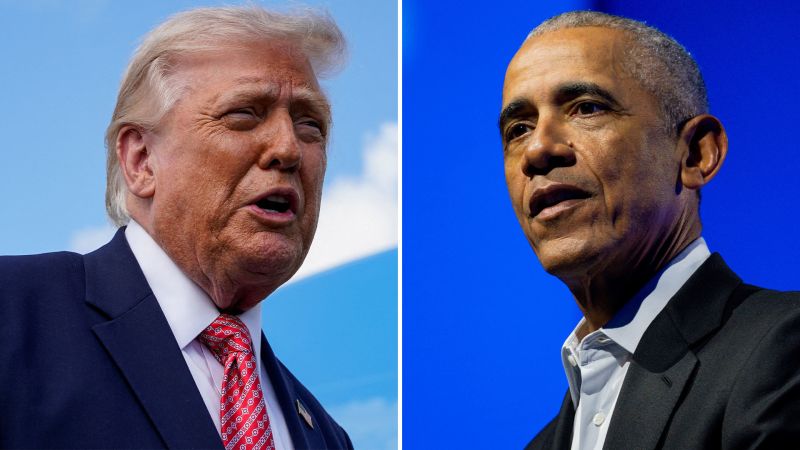
One president chose diplomacy. Barack Obama and a large international coalition negotiated a deal with Iran to shelve its nuclear program for a decade over the objections of an outraged Israeli Prime Minister Benjamin Netanyahu, who came to Congress in 2015 to speak out against the deal and the American president.
Another president chose war. Donald Trump, years after tearing Obama’s deal into shreds, and after becoming frustrated with talks for a new nuclear deal, brought Netanyahu into the White House Situation Room, according to a New York Times report. The Israeli prime minister sat across the table from the US president and sold him on a sneak attack against Iran without consulting allies in Europe or the Middle East.
The war has not gone exactly according to Trump’s plan, however. The US and Israel did achieve their goals of compromising Iran’s military, as well as its naval and missile capabilities. But Iran’s nuclear material is still in the country, albeit apparently buried underground, and the Islamic Republic has seized control over the Strait of Hormuz, discovering a new piece of leverage over the world economy.
However the war with Iran ultimately ends — talks will get underway in Islamabad, Pakistan, on Saturday to try to build on a fragile ceasefire — Trump will want to declare that the outcome is better than what his predecessor Obama achieved without going to war.

Trump rarely talks about Iran without trashing Obama and the 2015 nuclear deal, formally known as the Joint Comprehensive Plan of Action, or JCPOA.
“Barack Hussein Obama — what he did, where he gave them the Iran nuclear deal, gave them free will toward a nuclear weapon. Basically, he chose Iran over Israel and others that didn’t want him to do it,” Trump said at a March 26 Cabinet meeting.
He repeated the sentiment that Obama chose Iran over Israel at an April 6 news conference.
“If I didn’t come along and terminate the Obama deal, which was terrible, the Iran nuclear deal was a — a road to a nuclear weapon,” Trump said. “A big one, unlimited.”
Trump also likes to talk about the fact that as the deal was finalized, the US dispatched a planeload of cash — $400 million in cash, much of it Swiss francs — to Iran. The money was actually repayment of Iranian funds frozen decades earlier, but it dovetailed with adoption of the nuclear deal and release of Americans in Iranian prison, including the Washington Post journalist Jason Rezaian.
That planeload of cash — and the billions Iran got in unfrozen assets and from selling oil while the JCPOA was active — could ultimately be dwarfed by tolls Iran may now demand to end the war. These new funds could include tolls charged to ships for passing through the Strait of Hormuz, money from unfrozen assets or revenue from lifting of sanctions.
The JCPOA had a hard-to-remember name and it was a complicated piece of diplomacy. The multifaceted agreement was signed by Iran, the five permanent members of the UN Security Council — US, China, Russia, France, the UK — plus Germany and the EU.
The general outline of the JCPOA, which had international support but was controversial in the US when it was reached, was that Iran would limit its nuclear ambitions, cap its uranium enrichment and allow international inspectors from the International Atomic Energy Agency (IAEA) to inspect its sites in exchange for the lifting of some sanctions on its oil wealth and unfreezing billions in frozen Iranian assets.
Netanyahu was so alarmed about the deal that, in an unprecedented move, he addressed Congress in 2015 in an attempt to spike Obama’s deal on US soil.
Trump ultimately did withdraw the US from the deal in 2018 during his first term. While other countries tried to continue with the deal, Iran ultimately violated terms and the deal fell apart, although both the Joe Biden and Trump 2.0 administrations tried to restart negotiations.
Trump launched the war on Iran after talks to reach a new nuclear deal fell through, though one foreign diplomat involved with those talks said a breakthrough was “within our reach.” And now, after more than a month of war, Trump is again looking for an Iran deal of his own.
The JCPOA was from a very different time, according to Daryl Kimball, executive director of the Arms Control Association.
For starters, the IAEA and the US intelligence community in 2018 agreed that while the JCPOA was in place, Iran did not appear to be seeking nuclear weapons capability, and it was generally abiding by the restrictions in the deal, although it continued to support terror groups and maintained ballistic missile capabilities.
Iran increased nuclear program after Trump abandoned JCPOA
At the urging of Israel, Trump in his first term reneged on the JCPOA for the US, which he did not believe was good for the country. A year after Trump abandoned the old deal, Iran again began obviously developing its nuclear program in earnest, further enriching uranium and building out nuclear sites. At the same time, it continued to say it would abide by the 1970 Nuclear Non-Proliferation Treaty and not pursue nuclear weapons.
“Looking forward, any new agreement with Iran to constrain its nuclear capacity is going to have to look different from the JCPOA, but there will likely be some similar elements,” Kimball told me earlier this month.
Key among the similarities, in his view, will have to be an insistence on IAEA inspectors to verify that Iran is complying with any potential deal.
Trump has a maximalist view of demands. Rather than limit uranium enrichment, he wants Iran to abandon it and to hand over its existing stockpiles to the US.

Iran has also now found, as a result of the US and Israeli-launched war, that it has power over the world economy by controlling the Strait of Hormuz, which ordinarily carries about a fifth of global oil and natural gas supplies and a third of the world’s urea fertilizer exports.
“What this war has done is handed Iran a weapon that is far more usable than nuclear weapons, which is the Strait of Hormuz choking off global supplies,” CNN’s Fareed Zakaria told Anderson Cooper this week.
Even before addressing Iran’s nuclear capabilities, any deal to the end the war will need to include reopening the strait, according to retired Gen. David Petraeus, the former CIA director.
“That is, I think, the central issue,” he told CNN’s Dana Bash on Thursday. Some Iranian demands will be nonstarters, like withdrawing US forces from military bases in the region or acknowledging Iran’s right to enrich uranium. Others are more negotiable.
But the new issue of Strait of Hormuz traffic offers Iran power and potentially a financial lifeline, a sort of Panama Canal where they are charging tolls.
“If it’s $2 million per vessel, which is reportedly what some companies have been paying to transit, and you multiply that times 100 or more ships a day, that is a very substantial amount of hard currency to enable Iran to repair the extraordinary damage that has been done (to their military),” Petraeus said.
Was a breakthrough at hand before Trump launched the war?

Trump attacked Iran in late February because he felt it was not serious in negotiations to reach a new nuclear deal, although that conclusion was contradicted by one of the mediators. Omani Foreign Minister Sayyid Badr bin Hamad Al Busaidi appeared on CBS’ “Face the Nation” just before the attacks commenced and said Iran had agreed to major concessions.
The day before Trump kicked off the war, Al Busaidi said Iran had agreed to giving up its stockpiles of enriched uranium by irreversibly downgrading their enrichment below current levels, which are close to what would be needed for a nuclear weapon.
“There would be zero accumulation, zero stockpiling, and full verification. That is also equally important achievement, I think,” Al Busaidi said.
Trump’s chief negotiator, special envoy Steve Witkoff, had a very different view of those pre-war talks, which he shared at the March 26 Cabinet meeting.
Iran, Witkoff said, believes it has “the inalienable right to enrich.” Witkoff also said the Iranians made clear “they would not give up diplomatically what we could not win militarily.”

Kimball said Witkoff and his negotiating partner, Trump’s son-in-law Jared Kushner, may not have understood the significance of the concessions Iran was willing to make.
“Witkoff was too — I’m going to say a strong word: incompetent — and technically ill-informed to understand the significance of what was on the table,” Kimball said.
Now Witkoff and Kushner are joining Vice President JD Vance for new talks in Islamabad.
So the US must still ultimately negotiate with whatever leaders it can find in Iran. The regime has maintained that, as a signatory to the Nuclear Non-Proliferation Treaty, Iran is within its legal ability to enrich uranium for an energy program.
In exchange for putting that aside, the regime is likely, just as in the Obama era, to insist on the lifting of sanctions on Iran’s oil. But now Iran will also want to formalize its control of the Strait of Hormuz, which means the regime could have more power than it did before.