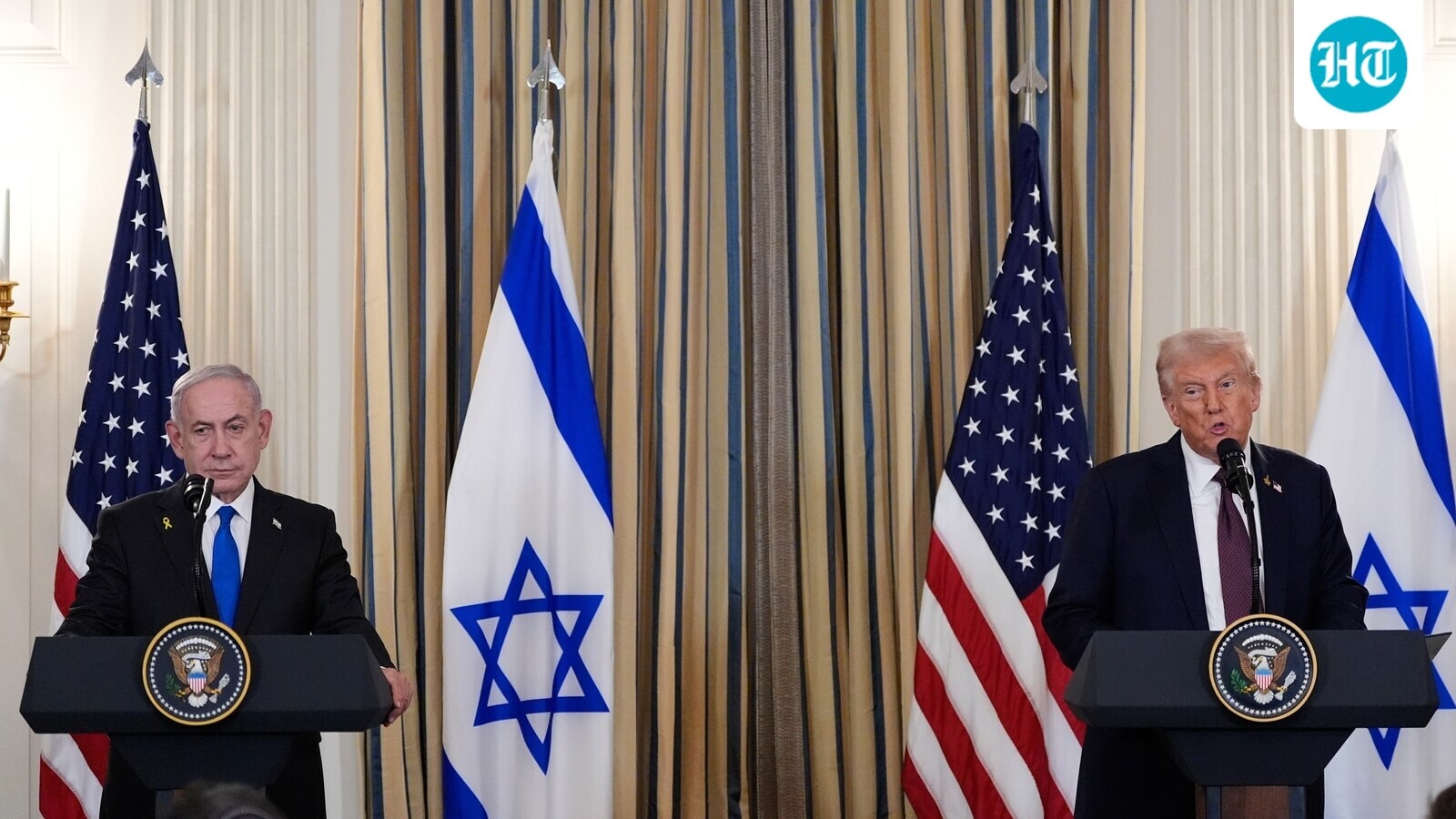
Two years after Hamas’s Oct. 7 atrocities, the U.S. should be grateful to Israel. The Jewish state has defanged a range of militant actors who despise the U.S. and have killed Americans. Yet the Gaza war, with its substantial civilian casualties, has turned much of the Democratic Party against Israel and fractured European-Israeli relations. Israel’s enemies on the left depict the Jewish state as an illegitimate pro-Trump “apartheid” state, and the war has also stirred anti-Israel sentiments in corners of the American right.
This hostility to Israel wasn’t inevitable; wars have sometimes transformed the Middle East for the better. Take the Six Day War. In the 1960s, the radical Arab republics led by Egypt’s Gamal Abdel Nasser aligned with the Soviet Union. Nasser helped finish off the British in the Middle East, menaced the oil-rich Gulf sheikhdoms, and harassed Israel. Arab nationalism—a crude amalgam of socialism, opposition to Western imperialism, violent cultural chauvinism, and sometimes not-so-latent Muslim pride—had gained sway in the region. Nasser and militant Arabism looked like the future.
That future evaporated in June 1967, when—in a war Nasser provoked—Israel destroyed the Arab armies and with them the promise of Arab nationalism. Conservative religious monarchies quietly rejoiced. Although the Soviets rearmed their allies, Moscow’s interests were now tied to fading causes and ever-more-vicious tyrants.
The Six-Day War made Jerusalem seem like a modern-day David facing down Goliath. Americans were no longer drawn to the Jewish state solely because of sentiment or biblical prophecy, but as a strategic partner that could serve as the surrogate of U.S. power in a volatile region. At a time when America was fading in Vietnam, Washington needed partners that could stand sentry. The special relationship between Israel and the U.S. took on a different meaning after the 1967 conflict: high-level coordination between American presidents and Israeli prime ministers began in earnest, and U.S. arms flowed in ever-larger quantities to the Jewish state.
Today’s post-Oct. 7 wars should have followed the same script. After a savage assault by Hamas, Israel began to degrade America’s enemies one by one. Hamas, an Iran-allied Islamist outfit dedicated to killing Jews, no longer exists as a military force. The Israel Defense Forces and Mossad took apart Hezbollah, the most lethal of Iran’s terrorist proxies, which has killed many Americans including 241 in the 1983 Beirut bombings. The Sunni-slaughtering, drug-running Assad dynasty in Damascus—depleted by years of civil war and robbed of Hezbollah’s help as well as Iranian and Russian troops—collapsed. And in a stunning 12-day aerial duel, Israel badly damaged the Islamic Republic’s nuclear program, killing scores of its generals and atomic scientists.
Israel’s success convinced President Trump to send the B-2 bombers that ensured that Iran’s most deeply buried uranium-enrichment site went offline. Israel’s use of hard power disproved the common refrains, on both the American left and right, that militarily checking Iran automatically meant another “forever war” and catastrophe in the Persian Gulf.
But Israel’s fight against Hamas has proved different from the Six-Day War. Hamas, Israel’s savviest enemy, borrowed a page from the playbook of past guerrilla forces. By shielding themselves with civilians, the terrorists have been able to use innocents’ deaths to mobilize the international community against the Jewish state.
Democracies are particularly vulnerable to this cruel tactic. In the early 1960s, France decisively defeated Algeria’s National Liberation Front. But by manipulating mass media and nongovernmental organizations, the Algerian forces divided French domestic opinion and ostracized France abroad, compelling Paris to relinquish its gains. A decade later, the Viet Cong did the same to the U.S. The Vietnam War was lost not in the rice paddies but on TV, in the newspapers and on college campuses.
Hamas replayed this stratagem. Concealing its cadre in tunnels below residential buildings, schools and hospitals, it maximized civilian deaths to demonize Israel. Right on cue, Amnesty International and the International Court of Justice condemned Israel for “genocide,” and college kids tore up their campuses. One hundred fifty-seven countries have now recognized a nonexistent Palestinian state. The European Union is debating sanctions on Israel, and many Democrats, including luminaries from the Biden administration, have called for an arms embargo.
Any justification for this outrage can’t survive historical comparisons. From June to August 1944, the U.S. and Britain obliterated many towns and cities in Normandy, France, killing 20,000 civilians, according to historian John Keegan. And that may underestimate those killed by carpet bombing preceding the landings. But would any sane person castigate the Allies as so many have scorched Israelis?
While French President Emmanuel Macron has led the most recent effort to raise recognition for a Palestinian state, he’d certainly feel differently were Paris in Jerusalem’s position. Imagine if the Islamic Salvation Front had won the Algerian civil war in the 1990s and vengefully struck France with the ferocity of the Oct. 7. attack. France would have lost roughly 7,520 citizens and seen 1,580 taken hostage. Is there any doubt the French would have unleashed hell?
Historical ignorance is part of the internet age. So is antisemitism. Israel likely has many more wars before it. Will Washington have the understanding and intestinal fortitude to stand by an ally that has repeatedly enhanced America’s influence throughout the Middle East and beyond? Not all of Israel’s enemies are America’s. But enough of them are to do more than wish it well.
Mr. Gerecht is a resident scholar at the Foundation for Defense of Democracies. Mr. Takeyh is a senior fellow at the Council for Foreign Relations.

